
Repair and replacement proposals often end at different conditions, so a national range would obscure the decision this guide addresses. Compare the same structural outcome, remaining serviceable work, access, temporary support, restoration, and recurrence assumptions before weighing the initial project scope.
Published price context
 HomeAdvisor’s U.S. guide lists a typical US$2,225–US$8,133 range for general foundation repair; HomeGuide’s U.S. guide reports US$20,000–US$100,000 for lifting a house and replacing the entire foundation. These are different project classes, not alternatives priced for the same property. Compare only proposals built around the same diagnosis, intended result, access, and restoration.
Start with the outcome, not the percentage rule
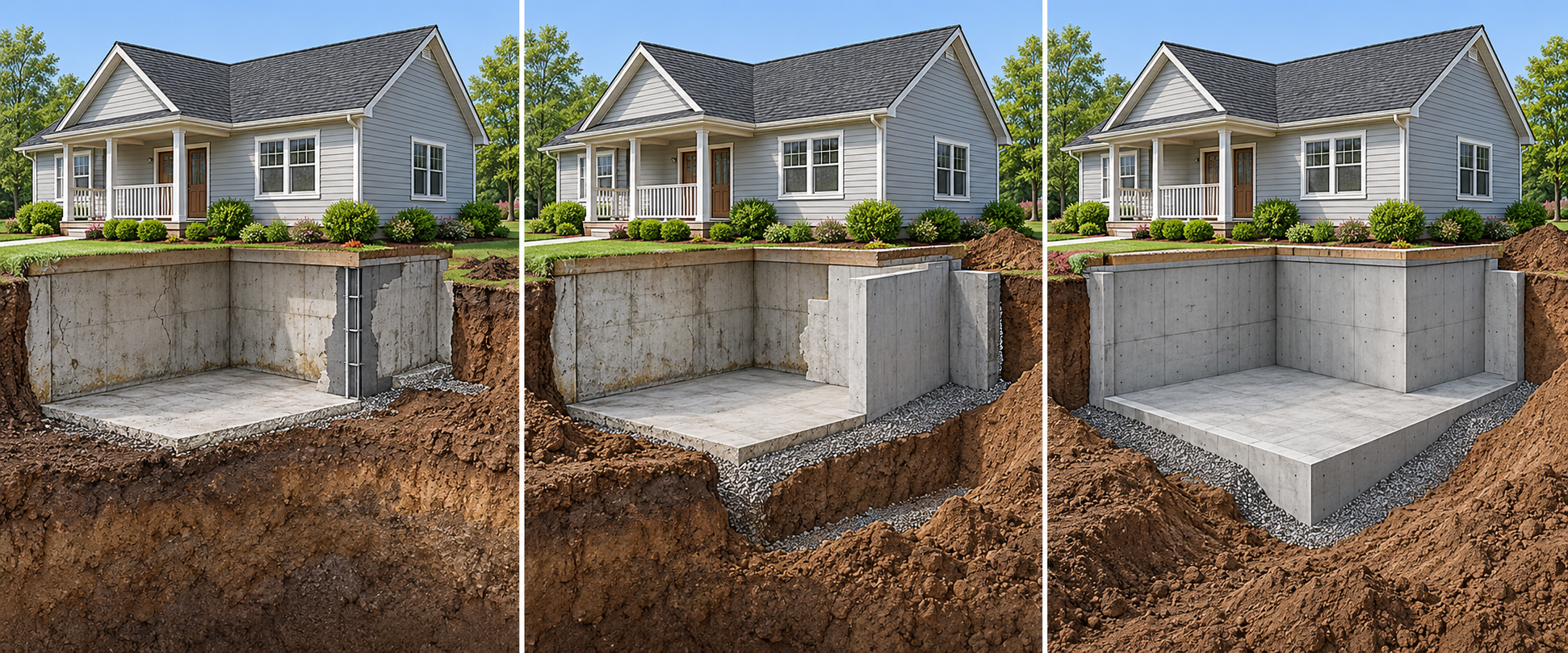
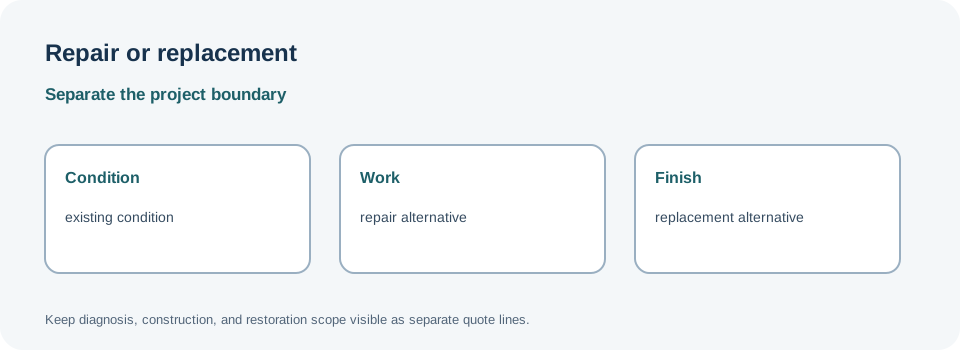 Repair can mean sealing, reinforcing, underpinning, stabilizing, partially reconstructing, or returning an element to service. Replacement can mean one wall, a perimeter, or the full foundation. A rule such as “replace when repair is half the cost” is unreliable unless the two scopes have the same outcome, access, root-cause treatment, and restoration.
The central question is: what condition remains after each option, and what future work is still likely? A less expensive stabilization may be excellent if it provides a credible long holding period. A replacement may be economically stronger if deterioration, movement, or repeated access makes repair a sequence of temporary fixes.
Build a comparable total
For each option, list assessment and engineering, permits, temporary support, excavation, demolition, structural materials, labor, soil or drainage correction, utilities, disposal, waterproofing or moisture boundaries, finish restoration, landscaping, temporary relocation, warranty, monitoring, and contingency. Mark each item included, excluded, allowance, or unit-priced.
Do not let one proposal bury root-cause work in a broad total while another excludes it. Do not compare a new foundation with optional basement remodeling. The comparison is only useful when both options are normalized to the same property boundary and intended outcome.
Conditions favoring repair
Repair tends to be stronger when the failed area is bounded, surrounding material is serviceable, the cause can be controlled, access is manageable, the repair has a defined structural outcome, and the remaining system is likely to provide useful service. Documented stabilization can preserve capital and reduce disruption.
Ask what evidence supports the bounded scope and what happens if opening exposes more deterioration. A repair estimate with no concealed-condition process is not necessarily a lower-risk budget.
Conditions favoring replacement
Replacement becomes more persuasive when deterioration is widespread, the foundation cannot provide a credible load path after local work, movement or water pressure continues, repeated repairs require the same disruptive access, or the replacement can solve several related deficiencies in one mobilization. The immediate price and disruption are higher, but the residual-condition risk may be lower.
Replacement is not automatically superior. A new wall will not solve uncontrolled site water or ground movement unless those scopes are addressed. A high price can also include elective excavation or remodeling that should be separated.
Use an ownership horizon
For a short horizon, compare cash requirement, disruption, financing, documented condition, and whether a future buyer or insurer will need more work. For a long horizon, include repeat mobilization, maintenance access, recurrence risk, future utility or basement plans, and the cost of opening the same area twice. Neither horizon justifies hiding uncertainty.
Quote and decision thresholds
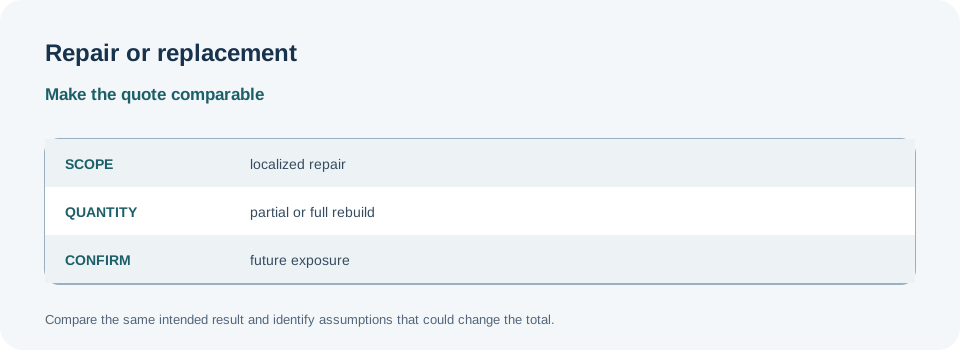 Ask each bidder to price stabilization, broader repair, and replacement where viable. Require the assumed movement, measured area, support or reconstruction plan, engineering, permit responsibility, cause-correction boundary, restoration, warranty, and change-order controls. A decision is ready when the residual condition and difficult-case exposure are explicit.
If the “repair” quote only treats a visible crack or symptom while the “replacement” quote includes diagnosis, drainage, and restoration, the result is a scope comparison—not a repair-versus-replace conclusion.
Test the proposal against three futures
Model what happens if the repair performs as intended, if it stabilizes but leaves cosmetic or elevation differences, and if the concealed condition is broader than expected. Include the cost and disruption of a second mobilization. This is more useful than assigning an arbitrary contingency percentage because it connects uncertainty to an actual decision.
Ask whether the proposed warranty covers workmanship, movement, water entry, or only the installed product. A warranty that excludes the suspected cause may be legitimate, but it changes the economic comparison. Record the excluded work and the evidence needed before signing.
A simple decision worksheet
For each option, write the visible condition it addresses, the condition it leaves in place, the base price, allowances, likely difficult-case exposure, disruption, and the next decision it prevents or creates. Then ask whether the option can be inspected and maintained without repeating the same demolition. This turns “repair versus replacement” into a comparison of future projects rather than two marketing labels.
If one bidder cannot provide a replacement option, that is not proof replacement is necessary; if another cannot explain a repair outcome, that is not proof repair is unsafe. Obtain the missing scope or professional assessment before treating a price difference as an economic recommendation.
Use decision thresholds, not a slogan
The repair option deserves a closer look when the affected area is bounded, the cause is controllable, the retained foundation is serviceable, and the contractor can explain the expected holding period or outcome. Replacement deserves a closer look when deterioration or movement is distributed, the same access would be repeated, or a new system can correct several deficiencies at once. These are questions to take to the responsible professional, not remote diagnoses.
Normalize the options by foundation length, support count, excavation, shoring, engineering, permits, drainage, utilities, finishes, temporary relocation, warranty, and concealed work. If one price includes optional basement remodeling or site improvements, remove those items before making the structural comparison. The most economical choice is the option whose remaining condition and uncertainty you can actually carry.
Compare the next five years, not only the contract total
Repair and replacement can shift costs into different parts of ownership. A repair may preserve finishes and occupancy now but leave monitoring, limited access, or a future opening. Replacement may require relocation and restoration now while reducing the chance of repeating the same excavation. Neither future is guaranteed, but both should be modeled as possibilities rather than hidden in a generic contingency.
Ask what the warranty actually covers and what condition it assumes. A workmanship warranty, a product warranty, a movement warranty, and a water-entry warranty are different promises. A warranty that excludes soil movement or drainage may be reasonable, but the exclusion is part of the economic comparison. Keep records of measured conditions, repaired areas, support locations, and unresolved causes so a future contractor can price the remaining risk.
Make the alternatives comparable at the decision boundary
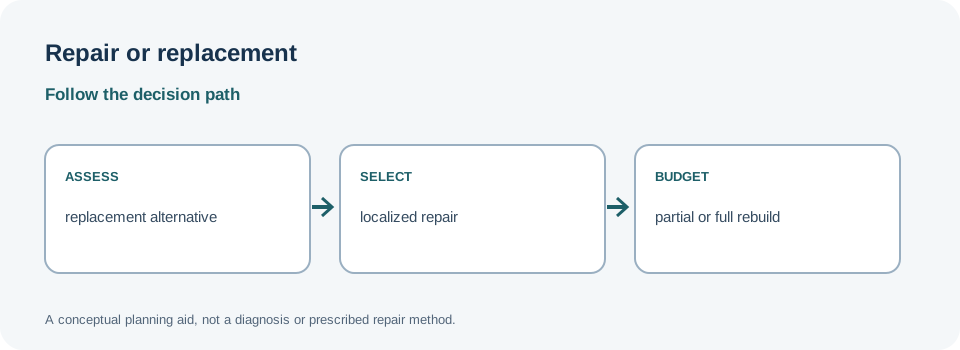 If the repair option depends on further investigation, price that stage and state what it will decide. If replacement is being recommended because the retained foundation is deteriorated, identify the evidence and the retained work that the replacement avoids. If one option includes drainage, waterproofing, basement remodeling, or landscaping, remove or separately label those items before judging structural value.
The result should answer three questions: what problem is corrected, what condition remains, and what future work is still possible. This is more reliable than applying a percentage rule to two proposals that have different access, restoration, engineering, and root-cause assumptions.
Ask which uncertainty each option is carrying
A repair proposal may carry uncertainty about concealed deterioration, future movement, or the durability of the retained structure. A replacement proposal may carry uncertainty about excavation, groundwater, utilities, occupancy, neighboring structures, and restoration. Neither option is automatically the lower-risk choice. Ask each bidder to identify the discovery that would change the scope and the rule for approving that change.
The comparison should also include the information already purchased. Engineering, investigation, monitoring, selective openings, and design documents may be necessary for a responsible repair even when construction remains limited. Do not treat those costs as evidence that replacement is better; treat them as the cost of making the alternatives comparable. Conversely, do not let a low repair price omit the information needed to know whether the retained foundation is serviceable.
For long-term ownership, include maintenance access, future openings, recurrence, and the consequences of a second mobilization. For short-term ownership, include disruption, records, sale disclosure, and the remaining condition. A sound decision is one the homeowner can explain in terms of outcome and uncertainty, not one that merely applies a ratio to two unlike bids.
State the point at which the decision changes
A useful comparison names the evidence that would move the project from repair to replacement, or from a limited repair to a broader one. That evidence might be concealed deterioration, inadequate bearing, continued movement after source correction, inaccessible conditions, or a design review that cannot support the retained structure. Price the investigation needed to answer that question and set an approval threshold before demolition expands.
Keep the practical endpoint visible as well. One option may leave a monitored or partially displaced foundation; another may restore support but require relocation, utility work, and extensive finish reconstruction. For long-term ownership, include records and future access. For short-term ownership, include schedule, disclosure, and accepted residual conditions. The better value is the option whose uncertainty and finished result are explicit.