
Changing brick color is an appearance decision with maintenance and moisture consequences. Compare painting, masonry staining, cleaning, and leaving brick natural only after checking the wall’s condition and history.
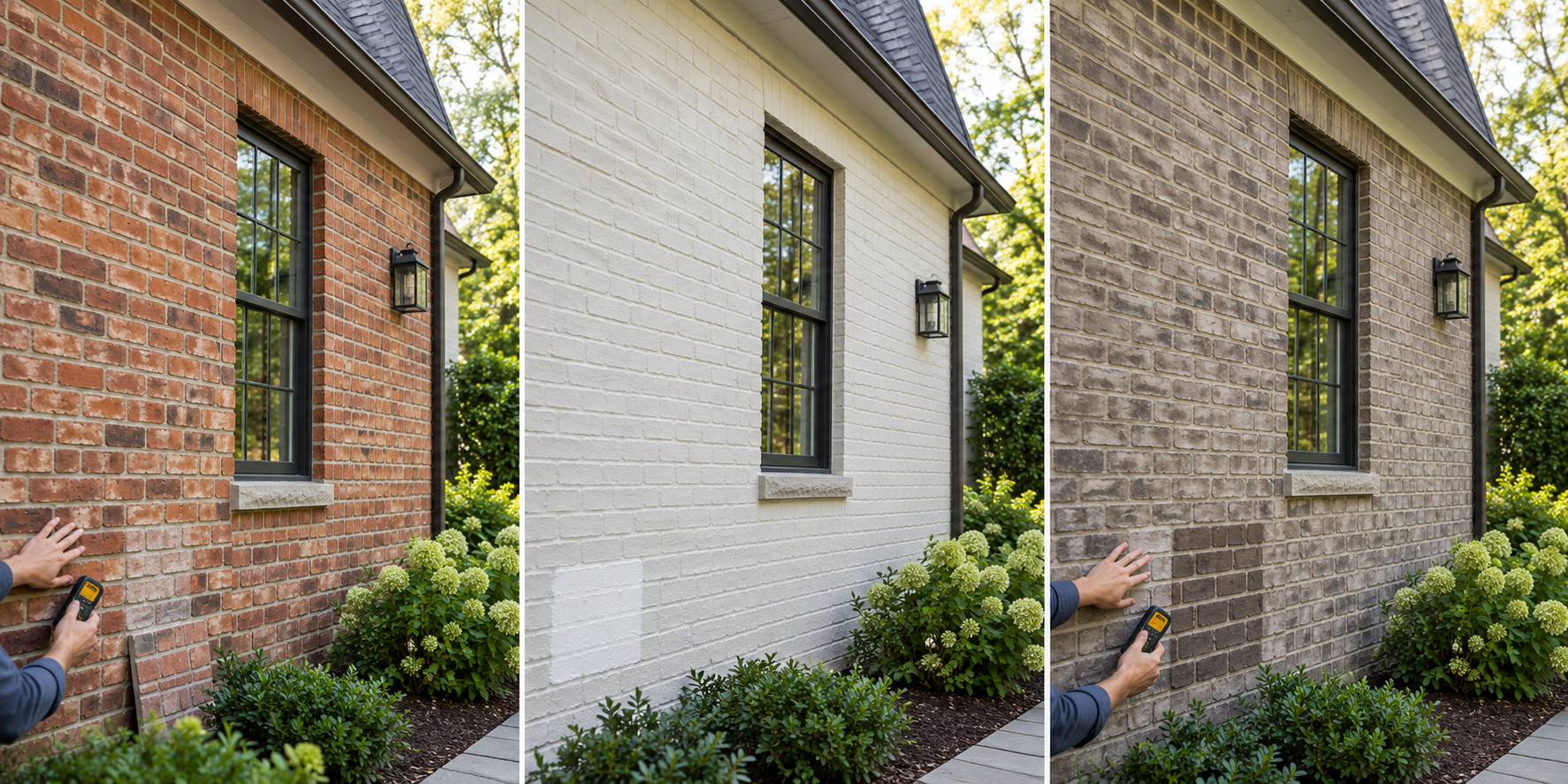
Paint forms a film and may require future preparation and recoating. Stain interacts differently with masonry, but products and results vary. Neither is suitable for every brick, mortar, exposure, or prior coating. Ask for the exact product, preparation, test area, coats, finish, access, protection, and maintenance expectations.
Cracked units, spalling, friable mortar, efflorescence, recurring dampness, or failed flashing should be evaluated first. A coating can improve appearance without correcting water entry and may change future inspection and repair access. Do not use a universal claim that masonry coatings are always harmful or always protective.
Homewyse’s September 2026 U.S.-oriented model gives $2.64–$4.99 per square foot for basic brick painting after limited preparation and two coats in favorable conditions. It does not establish that painting is suitable for a particular brick or mortar, how long the coating will last, or the cost of stain or later removal; it is not a Canadian benchmark. Historic or older masonry may need preservation advice. For ordinary sound brick, compare the cost horizon with brick cleaning and efflorescence removal cost.
Evaluate the existing brick and desired appearance
Painting and staining create different finishes and should not be priced as interchangeable coatings. Ask the contractor to describe the proposed product, surface preparation, test area, coverage, coats, and maintenance instructions. A sample on the actual brick can reveal color, texture, and absorption before a large elevation is committed. Confirm whether repairs, mortar work, cleaning, and efflorescence treatment are excluded or priced separately.
Before coating, investigate active moisture, salts, loose paint, and deteriorated mortar. A new finish may fail or obscure conditions if the masonry is not ready. Ask how the contractor evaluates the wall and what remedy is proposed if a test patch shows poor adhesion, uneven absorption, or an unacceptable appearance. Do not assume that a coating will waterproof the assembly or correct a leak.
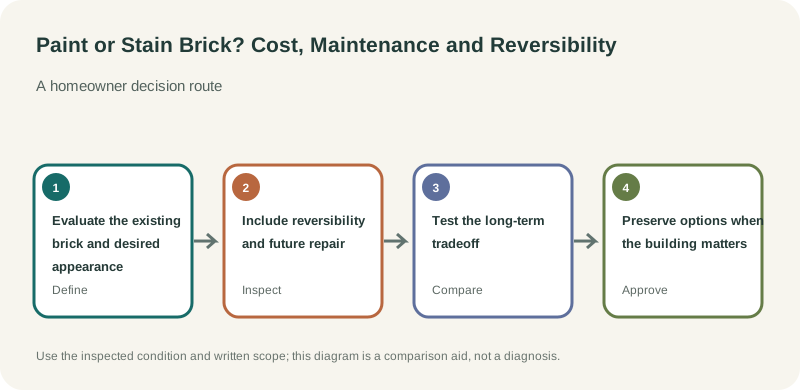
Include reversibility and future repair
A coating can make later brick matching, cleaning, or restoration more difficult. Ask what future maintenance looks like, whether the product can be recoated, and whether removal is practical without damage. Retain the product, color, batch information, and care instructions. If the building is historic or has architectural significance, consult an appropriate preservation specialist and verify local restrictions before coating.
Compare a coating with cleaning, repointing, selective unit replacement, or leaving the brick uncoated. Each addresses a different condition. The lower first price may not be the most economical choice if a finish will conceal rather than repair defects or restrict later treatment. A written estimate should state the intended visual result and explicitly exclude structural or moisture corrections it does not perform.
Test the long-term tradeoff
A small trial should include the full preparation and coating process, not only a color dab. Review the surface after it has dried and ask how it will look at the actual distance and lighting. For a stain, confirm whether the product is penetrating or film-forming and how the existing brick’s absorption affects color. For paint, ask how the system handles vapor movement and what maintenance or recoating is expected; use the product documentation rather than a generic claim that masonry can or cannot be coated.
If coating is chosen, define how many elevations, returns, mortar joints, lintels, and patches are included. Clarify whether the contractor will stop at a corner or blend around openings, and how a later repair will be made to the finish. Keep extra product from the same batch if the manufacturer recommends it and store the label and technical data.
Preserve options when the building matters
On older or architecturally significant brick, consult a preservation professional before changing the finish. Existing paint may also contain hazardous constituents depending on age and jurisdiction; assessment and safe disturbance belong to qualified local professionals. Include those controls in the price if they apply rather than assuming ordinary wash-and-paint preparation covers them. The chosen finish should reflect appearance goals, condition, future maintenance, and reversibility together.
Include repairs and masking in the total
A coating project may require repointing, replacing damaged units, cleaning, masking, protection, or scaffold before application. Ask the contractor to list the condition of the substrate and separate masonry repair from coating. If repairs change the absorption or texture, the finish may not look uniform; review a test patch after the full preparation sequence. Confirm whether window frames, roof edges, metal work, and adjacent siding are included in masking and cleanup.
For a multi-elevation project, ask whether a single crew will complete all surfaces in one mobilization and how visible stopping lines will be managed. A partial project can leave differences in color and weathering. The estimate should state which walls, returns, and architectural details are included so later change orders do not redefine the original finish boundary.