
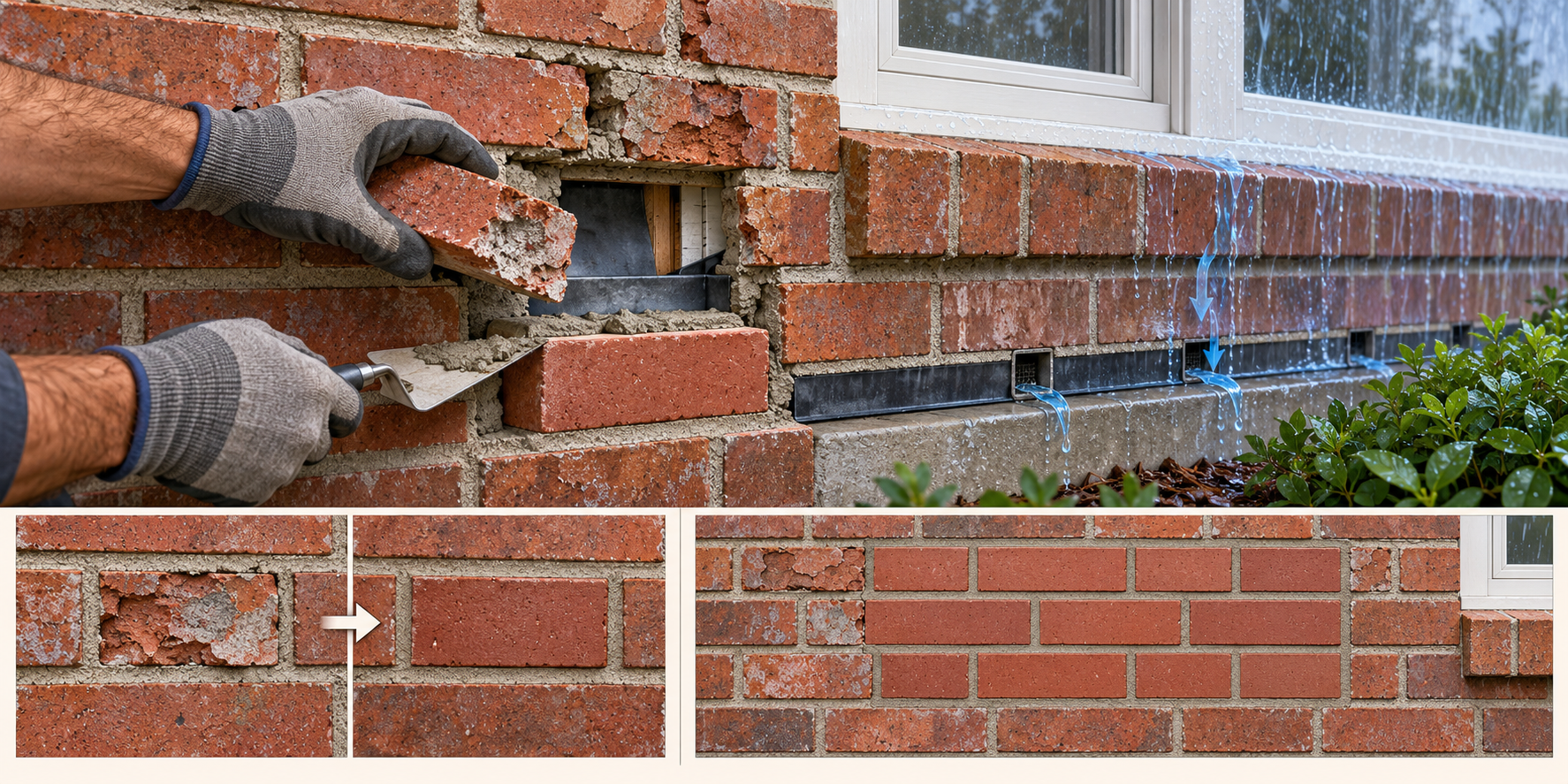
Localized brick repair may involve replacing individual units, repairing adjacent mortar, correcting water entry, or investigating movement. Spalling—the face flaking or breaking away—does not identify one universal cause.
What changes the scope
Ask whether the quote includes inspection, removal of damaged units, replacement brick, mortar, tooling, cleaning, access, protection, and finish matching. An older brick may require salvage, custom sourcing, or a larger area to look consistent. Upper stories and restricted access add labor.
Moisture, brick properties, freeze-thaw exposure, drainage, salts, coatings, and workmanship can interact. Canadian research supports treating climate and moisture as variables rather than proof that one visible defect has one cause.
A veneer wall can depend on flashing, weeps, mortar joints, and drainage behind the masonry. If water entry or damaged sheathing is involved, replacing units alone may not be enough. Homewyse’s September 2026 U.S.-oriented model reports $203–$267 for replacing one brick under favorable conditions, including removing the damaged unit and mortar and setting a replacement. It is not a spalling diagnosis or a larger-wall repair rate; do not multiply the per-brick figure mechanically because access, minimum labor, matching, and the moisture source change the scope. Request a local mapped quote with separate allowances.
Displaced masonry, recurring cracks, movement at openings, or patterns extending through units and joints may warrant qualified structural or masonry assessment. Do not diagnose foundation movement from a photo or crack width alone. For mortar-only deterioration, see brick repointing cost.
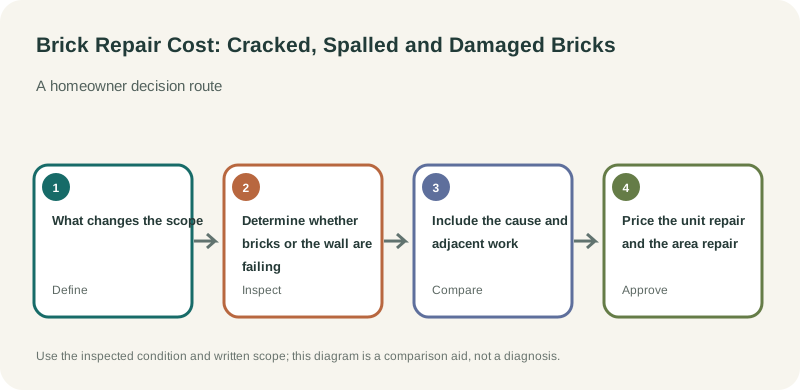
Determine whether bricks or the wall are failing
Spalling can follow water exposure, freeze-thaw cycling, incompatible repairs, salts, or other conditions. Ask the contractor to identify how many units are damaged, how deep the deterioration extends, and whether mortar, flashing, drainage, or nearby roof and grade conditions are contributing. A quote to replace visible brick should say whether units will be removed individually or in a larger area and how the surrounding bond and support will be protected.
Color and texture matching may require salvaged or special-order units. Ask for a sample and learn whether the proposed match is based on size, face texture, color, and weathering. If no close match exists, compare a small patch with a larger panel bounded by corners or other natural breaks. A larger repair may cost more but can avoid a scattered pattern of visibly different units; it should not be expanded without a clear appearance or performance reason.
Include the cause and adjacent work
If water is reaching the masonry, replacing bricks without addressing the source may lead to repeated loss. Ask whether the estimate includes correction of defective joints, flashing, coping, sealant, or another identified detail. Structural movement, bulging, or widespread displacement requires assessment beyond a routine brick replacement quote. Keep that diagnosis distinct from cosmetic repair and consult the appropriate specialist when the wall’s stability is uncertain.
For concealed damage, agree on photographs, unit pricing, and written approval before additional removal. Clarify whether scaffolding, protection, disposal, compatible mortar, and cleaning are included. The scope should leave the surrounding brick and mortar in a condition that can drain and dry as intended, not just restore the face appearance.
Price the unit repair and the area repair
For a handful of damaged units, ask for a per-brick or per-location scope that includes removal, replacement, mortar, and cleanup. If damage is scattered or matching is difficult, request an alternate price for a larger contiguous panel. The two options should list the same access and water-management corrections so the difference reflects repair boundary rather than omitted work. Confirm whether matching material is stocked, salvaged, or special-order and whether delivery minimums apply.
Ask how the mason will protect adjacent brick while removing the damaged units and whether the bond or support requires additional work. If replacement changes the face depth, joint width, or color, request a sample panel. A small mismatch may be acceptable on a low-visibility wall but distracting around a prominent entrance; decide that before the crew begins.
Watch for patterns that change the diagnosis
Map affected units by elevation and note whether the damage is concentrated below a coping, at a parapet, near sprinklers, or close to grade. A pattern can point to repeated water exposure rather than isolated impact. Ask the contractor whether the proposed work addresses the contributing detail and what remains untested. If the wall is bulging, shifting, or broadly cracked, pause cosmetic pricing and get an appropriate assessment of the wall’s condition.
Include procurement and appearance in the schedule
Special replacement bricks can take time to source, especially when the size, texture, or color is no longer common. Ask whether work can proceed safely while material is ordered and how exposed openings will be protected. Confirm who approves the sample and whether the price includes delivery, breakage allowance, and extra units retained for future maintenance. If the exact match is unavailable, document the agreed alternative before demolition.
At closeout, request the supplier and product identification, the number of units replaced, mortar description, and photos of the repaired area. This makes it easier to locate matching material later and distinguish new work from older repairs. Keep the record with any related flashing or moisture corrections.