
An electrification roadmap is a planning service, not a disguised equipment quote. It should connect your goals, existing systems, utility use, electrical capacity, building condition, replacement timing, and possible project sequence. There is no standardized North American fee because providers sell different combinations of audit, modeling, load review, design, and contractor coordination.
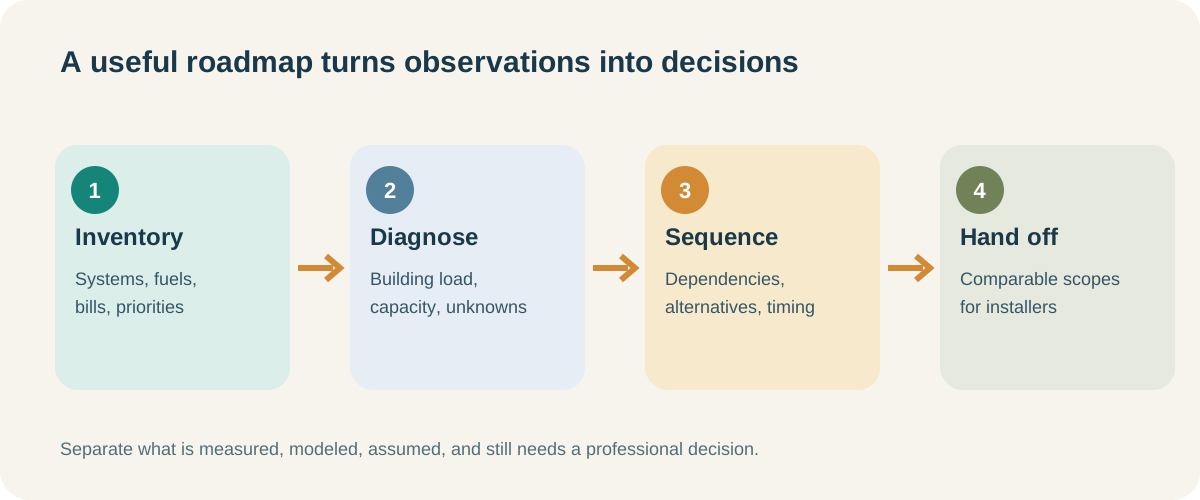
What a useful roadmap covers
The provider should inventory heating and cooling, water heating, cooking, drying, ventilation, fuel service, electrical equipment, and future loads such as an EV. It should record equipment age and condition, not just list model names. Utility bills and occupant priorities help distinguish a theoretical energy saving from a change that is likely to matter in this house.
For a Canadian EnerGuide evaluation, Natural Resources Canada describes an on-site assessment from basement to attic that can examine airtightness, insulation, windows and doors, mechanical systems, water heating, and ventilation. A resulting renovation report can show modeled energy use, heat-loss breakdowns, recommendations, and a sequence. That is valuable context, but it does not automatically include an electrical load calculation or a complete contractor-ready design.
Assessment, audit, load calculation, and quote are different
A basic walkthrough may identify obvious opportunities at a low fee but provide little diagnostic data. A diagnostic energy audit may add blower-door testing, thermal investigation, or modeling. An electrification roadmap adds the question of how several loads interact and when to replace them. An electrical load calculation is a separate professional service in many projects, focused on capacity and local requirements. A contractor quote prices a defined installation; it is not necessarily an impartial whole-home plan.
Before accepting a fee, ask which of these are included, which are subcontracted, and which are explicitly excluded. A roadmap that says “upgrade the panel” without showing the future-load assumptions is incomplete. One that promises savings without explaining weather, operating conditions, rates, and equipment performance is also incomplete.
How fees are commonly structured
Because the service category is not standardized, compare scope rather than trying to find a national average. Providers may use a fixed fee for a site visit and report, an hourly consulting arrangement, an audit-plus-roadmap package, or a program-supported assessment. A complex house with multiple fuels, an addition, a cold climate, or a planned service change needs more work than a single-system replacement decision.
The economical choice depends on the cost it can prevent. A paid roadmap is easier to justify when several major systems will change, a service upgrade is being considered, equipment is at different life stages, or walls will soon be opened. It is harder to justify when the decision is only whether to replace one failed appliance and the scope is already clear.
What to demand in the deliverable
The final report should identify baseline assumptions, proposed measures, dependencies, alternatives, and a sequence. Look for:
- a whole-home load and fuel inventory;
- electrical capacity questions routed to a qualified calculation where needed;
- envelope or comfort conditions that affect sizing;
- low, expected, and difficult project cases;
- gross costs separated from uncertain allowances and possible incentives;
- a replacement-cycle roadmap;
- questions for installers and utilities.
Modeled energy use is not a promise of your future bill. NRCan specifically explains that standard operating conditions, weather, and unusual household loads can make modeled use differ from utility bills. A good report makes that limitation useful by showing which assumptions drive the result.
Questions before hiring
Ask about the provider’s experience with your fuels, climate, housing type, and jurisdiction; the instruments and data they will use; whether the report includes future loads; whether the electrical review is a formal load calculation; and how revisions are priced. Ask for a sample redacted deliverable rather than a list of credentials alone.
The best assessment is not the cheapest visit. It is the one whose deliverable lets you postpone, combine, or reject work with a clear reason—and lets multiple contractors quote the same intended scope.
How to judge the roadmap economically
The report should show the cost and consequence of at least three paths: a minimum viable transition, a coordinated package, and a difficult case that includes capacity, access, or fuel-retirement work. It does not need to predict a precise total. It should identify the assumption that would move a project from one case to another.
For example, changing the water heater may be independent while the heating decision waits for a load review. An open-wall remodel may be the best time to add pathways even though final equipment can wait. Retaining gas for one fireplace may leave a fixed charge that changes net economics. Those are useful outputs even without a universal consultant fee.
Choose the right level of planning
Use a basic assessment when the household needs an inventory and short list. Use diagnostic testing when the building load or comfort problem is uncertain. Use a full roadmap when several replacement cycles, fuels, or trades interact. Add a separate load calculation when service capacity could change the equipment or utility project. Paying for the broadest label is not automatically economical if the decision is narrow.
Ask the provider to show what information a contractor will receive. A useful deliverable translates findings into comparable scopes: what is measured, what is modeled, what must be verified, what can be phased, and what would make the project difficult.
Warning signs in a weak deliverable
Be cautious if the provider recommends a service upgrade without listing future loads, promises savings without a baseline, treats a generic audit as electrical approval, or supplies products without equipment-location and fuel-retirement dependencies. The report should state what it did not inspect and which conclusions require an electrician, utility, HVAC professional, or local program administrator.
Ask how revisions work when a contractor proposes a different system. A roadmap that can be updated around real quotes is more valuable than a static report that becomes obsolete as soon as capacity, equipment, or incentive assumptions change.
What current program examples do and do not price
A few programs publish a homeowner price for an assessment, but their offers are useful only when the property and purpose fit. Prince Edward Island lists a subsidized home energy assessment at CAD 99 plus HST through its program partners; the fee is tied to the province’s Home Insulation Rebates pathway. It is not a general price for a private electrification roadmap, a formal service-capacity study, or a heat-pump design.
In Massachusetts, eligible one-to-four-unit homes in participating utility sponsor territories can receive a no-cost Mass Save Home Energy Assessment. New York’s EmPower+ offers a no-cost comprehensive assessment and custom plan to eligible income-qualified owners and renters in one-to-four-family homes. Its broader Residential Energy Assessment Program has concluded, so the active route and current eligibility should be checked with the program. These are examples of program delivery, not evidence that every U.S. home can obtain a free assessment.
Before treating a program visit as the roadmap you need, compare its written outputs with the decisions on your list. Does it assess electrical capacity, or route that question to an electrician? Does it include heat-pump sizing, a service calculation, multiple replacement scenarios, contractor-ready scopes, or only efficiency recommendations? Is a follow-up included? Program support can make a useful first step inexpensive while still leaving design or electrical work to be purchased separately.
When comparing a program assessment with a paid consultant, list the decisions each can resolve and the missing deliverables that would still block a quote. The cheapest useful path may be a no-cost assessment followed by one targeted professional calculation, rather than paying for a broad package twice. Conversely, if several systems and a remodel interact, a limited program visit should not be mistaken for a complete sequencing plan.
A useful contract names the handoff
Before hiring, ask who owns the next step after the assessment. The report might identify a capacity question but not answer it; it should name whether an electrician, engineer, utility, or HVAC designer must resolve that question and what documents they need. Ask whether the provider will review bids or revise the roadmap if equipment choices change. A referral list is not the same as coordinated design.
If an assessment is program-funded, clarify whether you may use the report with an independent contractor and whether the program’s recommended measures are limited to its rebate rules. If it is a paid consultation, ask whether travel, testing, follow-up, and revisions are included. The fee is easier to evaluate when it buys a named deliverable and a defined handoff rather than an open-ended promise of savings.
Keep the report actionable after the visit
Before the provider leaves, confirm when the report will arrive, who answers follow-up questions, and whether corrections are included if equipment information was missing. Ask that the report label measured data separately from assumptions and show which recommendations are prerequisites versus optional improvements. Keep utility bills, photographs, model numbers, and the load list with the report so another professional can check its conclusions.
If the report recommends several projects, ask the provider to name the first decision and the evidence needed to make it. This is more useful than a long list ordered only by estimated energy savings. A roadmap should explain what can proceed, what depends on a load review or remodel, and what should wait for a current quote.