
An interior panel is only one point in the electrical path. A high-load electrification project may require utility review of the meter, service conductors, connection, transformer, or neighborhood capacity. Ownership and customer responsibility vary by utility and property, so there is no national customer-fee range to use as a substitute for an early utility response.
What sits beyond the panel
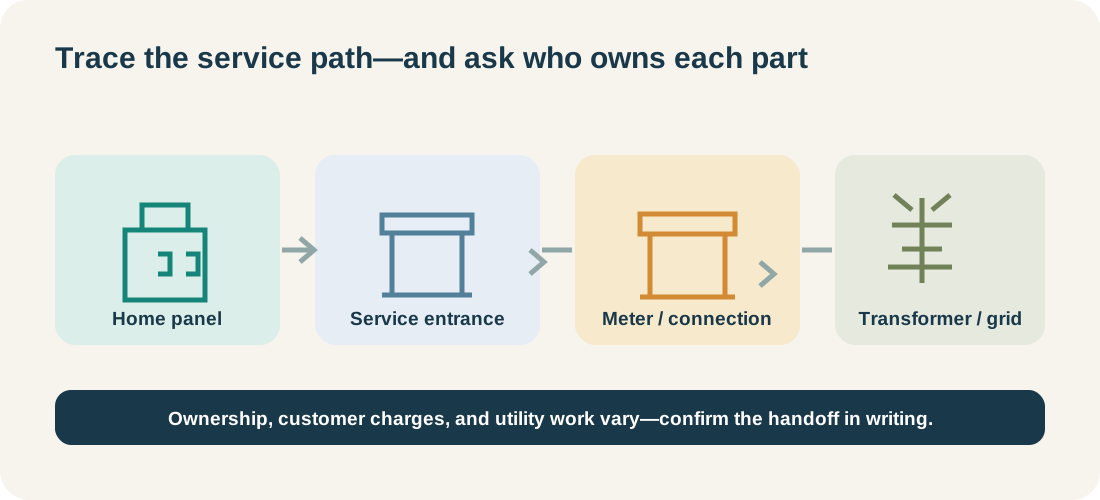
Depending on the property, the capacity path can include the service entrance, meter equipment, overhead or underground conductors, a pole or connection, and the distribution transformer. Some parts may belong to the homeowner and others to the utility. A panel quote that stops indoors cannot establish that the project is fully priced.
Utility review may be triggered by a larger service, multiple new loads, a new dwelling unit, a change in service configuration, or a request that exceeds existing neighborhood capacity. The trigger and sequence are local. A utility may approve the requested service, require engineering, schedule a transformer change, or require customer work before connection.
Where cost appears
Potential cost layers include engineering or application charges, meter or service equipment, new conductors, overhead work, underground trenching, pavement or landscaping restoration, temporary service, and coordination with the electrician. Some utility work may be included under a tariff or contribution policy; other work may be charged to the customer. Do not assume either outcome.
Underground work is especially easy to underestimate because the visible electrical item may be small while excavation, traffic control, rock, private utility locating, restoration, and access dominate. A transformer constraint can also create delay without producing a simple line-item price.
Timing is an economic cost
Waiting can force an equipment replacement to proceed before the full electrification plan is ready. It can also create temporary fuel costs, redesign, or a lost remodel window. Ask the utility early whether the proposed service and load are available, what drawings or load documentation it needs, who schedules each step, and whether the response is an approval, estimate, or merely preliminary information.
Do not sign a fixed-price whole-home contract that makes the homeowner responsible for an undefined utility contribution. State the dependency and a change-order or cancellation process. If the utility cannot confirm capacity, maintain a safe temporary plan and avoid ordering equipment whose operation depends on an unresolved service change.
US and Canadian differences
The same vocabulary does not create the same responsibility. A US utility tariff, Canadian utility service manual, or local contribution rule applies within its own territory. BC Hydro’s capacity guidance illustrates the value of using actual household demand information, but it is not a universal Canadian process. Verify the actual utility, municipality, service voltage, and adopted requirements.
Ontario provides a useful example of why the utility conversation should start early. Hydro One lists changes to panel size or type, service location or meter equipment, poles, conduits, cables, and service type among the situations that may require a service-upgrade request. It says its initial review may determine whether an upgrade design or temporary disconnection is needed, and that project completion varies by location, queue, and scope. The page also directs customers to obtain an Electrical Safety Authority permit before changing the service and an inspection afterward. Those are Hydro One and Ontario process details, not Canada-wide rules.
Make the utility request specific
Give the utility the proposed service rating, future-load inventory, expected equipment, voltage, EV or storage plans, and the professional capacity documentation it requests. Ask whether the response is a capacity confirmation, preliminary estimate, engineering review, or construction approval. These are different stages with different certainty.
Request written answers about ownership of the meter, service conductors, transformer, and underground route; customer contribution; application and inspection fees; design responsibility; lead time; and conditions that could change the estimate. Have the electrician identify the handoff point in the contract.
Price delay and failure scenarios
Include temporary heating or fuel costs, redesign, equipment storage, repeated mobilization, and restoration if the schedule slips. A service upgrade that arrives after a failed furnace can force an interim replacement, while a utility review started during a remodel may fit the work window.
A practical investigation sequence
Give the utility a written future-load inventory and the professional load calculation when requested. Ask for written answers about service size, meter changes, transformer or feeder constraints, customer-owned equipment, application fees, contribution rules, lead time, and inspection dependencies. Have the electrician and utility agree on the division of work.
Compare two budgets: an approved baseline with known customer work and a risk case with an allowance for unresolved utility work. Keep the risk case visible without pretending it is a quote. Utility uncertainty is resolved by the utility—not by multiplying an interior panel price.
Survey estimates are not a utility tariff or a local quote
A 2026 Berkeley Lab stakeholder survey offers bounded U.S. context for electrical-upgrade discussions. Among single-family industry respondents, the median estimated panel replacement cost was USD 3,500 (IQR USD 2,100–5,000; n=34). For a service-rating increase, the reported median customer-side equipment cost was USD 2,800 (IQR USD 2,000–5,000; n=22), while utility-side costs passed through to the customer had a distinct USD 3,500 median (IQR USD 1,650–7,000; n=19). These estimates come from separate samples and cost categories. They are not transaction records, do not define a utility’s contribution policy, and should not be added to create a presumed total.
Use them to ask whether a proposed budget separates interior panel work, customer-owned service conductors and meter equipment, and utility-side design or construction. Ask the utility which work is included in its tariff or contribution rules, which is billed to the customer, and whether the estimate is preliminary or approved. The study’s utility-side sample is small, and a utility may handle the same physical issue differently by service territory and property conditions.
Hydro One illustrates the handoff in Ontario: a change to panel size or type, meter equipment, service location, poles, conduits, cables, or service type can trigger a service-upgrade request. Its process includes an initial review, possible design work, a separate Ontario permit and inspection handoff, and a schedule that varies with scope and location. This example helps define questions but is not a national procedure. Ask the utility and electrician to agree on who submits drawings, who schedules disconnection and reconnection, and who owns trenching or restoration before comparing bids.
Keep a risk allowance for unresolved utility work separate from confirmed customer work. The survey and a neighboring homeowner’s project can inform questions, but only the serving utility can confirm the property’s scope and charges.
Treat the utility response as a project milestone
A utility application can return different levels of certainty. A service-capacity statement may not be a construction design; an early estimate may not include trench route or restoration; and an approved design may still depend on customer work, payment, scheduling, or inspection. Record what stage the response represents and which conditions remain open.
Set a milestone before the contractor orders equipment or closes a remodel wall. The milestone should include the utility’s service rating, point of connection, ownership boundary, required drawings, expected customer contribution, and the documents needed for final connection. Assign a person to submit missing information and track the utility schedule. If the response is late, decide whether the project can proceed safely under the existing service or must pause.
A delay also affects the homeowner’s choices. Temporary heating, equipment storage, repeat mobilization, and seasonal construction may add cost without changing the hardware budget. Ask the utility whether the quoted schedule includes design and construction, and ask the contractor how long its price remains valid. Do not use a national survey timeline as a promised local completion date.
Keep temporary solutions in the risk case
If utility work is delayed, the household may use a different equipment sequence or retain an existing fuel temporarily. Price that interim plan separately and make sure the current service remains within the professional’s approved design. Do not assume a portable heater or smaller charger is a harmless substitute if it changes the calculated loads or creates a safety issue.
A risk case can include extra mobilization, storage, restoration, and an additional season of fuel, but each should be tied to a possible delay or utility condition. Remove those items when the utility confirms the final scope. This keeps the allowance visible without treating the most difficult outcome as inevitable. When the utility responds, compare its letter or estimate with the contractor’s assumptions line by line. Confirm the requested service rating, the customer/utility handoff point, the work covered, the estimate expiration date, and any prerequisites such as permits or easements. If the utility requires customer construction, ask whether its design must be approved before excavation begins.
Keep a dated copy of the response with the quote. A later rate or process change may affect the project, and verbal guidance can be difficult to reconcile after schedules and prices change.
Record the point where the estimate stops
A utility estimate should state what physical boundary it covers. It may end at the delivery point and exclude the customer’s meter socket, service conductors, panel, trenching, or restoration. Ask the electrician to mark that boundary on the site plan and assign each excluded item to a quote. This prevents the utility letter and electrical bid from both omitting the same connection—or both charging for it.