
“Smart panel” can mean a replacement distribution panel with circuit monitoring and controls, or a broader home-energy-management package. The hardware price is only one layer. Installation, service compatibility, commissioning, internet or subscription dependence, and the value of managed capacity determine whether it is a better investment than a conventional panel or service expansion.
What makes a panel smart
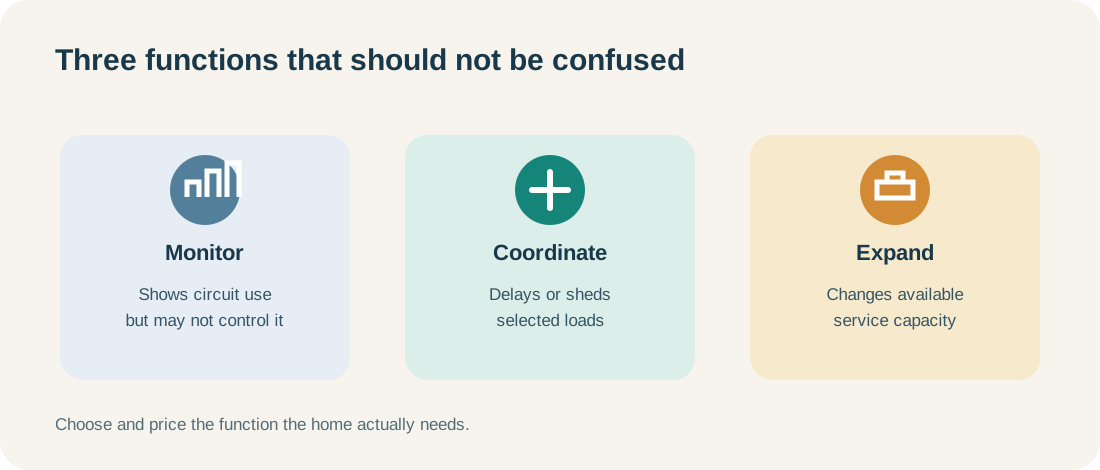
A smart panel may measure circuit-level use, report it to an app, control selected loads, or coordinate a capacity limit. These functions are different. Monitoring can explain demand without preventing it. Load control can delay or shed equipment but may impose operating rules. Backup-power integration is a separate relationship to solar and storage and should not be assumed from the word “smart.”
Ask for a capabilities sheet tied to the exact model. A DOE research project describes the potential of integrating a smart panel and energy-management system for circuit-level measurement and coordinated loads, but a research demonstration is not a universal consumer product specification.
Cost layers to compare
Request line items for the panel or controller, breakers and accessories, electrician labor, permits where applicable, service changes, sensors, networking, commissioning, and recurring software. A replacement is more involved if the existing panel is crowded, the service entrance needs work, circuits are poorly documented, or the new panel must coordinate several remote loads.
Use three comparisons:
- a conventional panel replacement that solves condition or space problems;
- a smart-panel or smaller control system that solves a defined monitoring or load-management need;
- a larger service project that provides capacity without relying on software or load priorities.
The available published information does not establish a universal installed range for a conventional or smart-panel replacement. Obtain current local quotes and treat subscription terms as part of the price.
When the premium can be rational
A smart panel may add value when the household needs visibility into demand, wants to coordinate flexible loads, has a real capacity constraint, or is already replacing the panel. It can make future decisions easier if it documents consumption and has an upgrade path. The value is weaker when the homeowner only needs more breaker space or when a conventional panel already solves the stated problem.
Do not pay for a dashboard to solve a service-capacity problem unless the controls are designed and accepted for that purpose. A panel that reports an overload after it happens is not the same as one that prevents simultaneous operation.
Three buying scenarios
- Panel replacement already required: compare the incremental smart hardware and software with a conventional replacement. Monitoring may add value, but do not pay for controls that do not solve a stated load problem.
- Capacity is constrained: compare the smart panel with a smaller management device and the full service path. Name the exact loads controlled and the convenience lost.
- Future loads are uncertain: prioritize documentation and a flexible pathway over a proprietary system sized around guesses.
Read the proposal line by line
Check whether the quote includes a load assessment, panel and breaker replacement, service entrance changes, utility coordination, permit, commissioning, internet setup, subscription, app access, and warranty. Ask who owns the data and whether local operation continues if the network is unavailable. Confirm how a failed controller affects the loads and whether manual operation remains possible.
Long-term tradeoffs
Ask how the panel behaves without internet, whether controls continue during an outage, who owns the data, whether the app is required, and what replacement electronics cost. Proprietary ecosystems can limit future equipment choices or create a subscription obligation. A simple conventional installation may be easier for another electrician to service. Conversely, visibility and controllability may be worth more in a home with multiple future loads.
Count the opportunity cost. If the household expects an EV, heat-pump water heater, or additional dwelling unit, a smart control solution sized only for today can strand the investment. If the proposed load is flexible and future expansion is unlikely, management may be an economical alternative to invasive utility work.
Ownership break-even
Compare the smart-panel premium with the value of monitoring, control, avoided service work, and future flexibility over the years you expect to own the home. Include a subscription or replacement-electronics allowance and the cost of changing the system if the household adds a load. If the panel is not replacing a defined problem, the premium is difficult to justify.
Verify before signing
Confirm exact model compatibility, listing or certification, control limits, equipment connections, utility and authority acceptance, warranty, software terms, and commissioning tests. Ask the electrician to state which loads are controlled and what the failure mode is. Code and utility treatment varies by jurisdiction; product marketing cannot establish legal capacity.
The right decision follows the problem. Choose a conventional panel for conventional space or condition work, a smart solution for a documented monitoring/control need, and a service upgrade when the household needs durable unrestricted capacity. Compare complete ownership cost, not the label on the equipment.
A current hardware reference is not an installed quote
SPAN’s U.S. pricing page lists manufacturer suggested retail prices by panel form: MLO24 at USD 2,550; MAIN16 at USD 2,950; MAIN32 at USD 3,500; MLO48 at USD 3,850; and MAIN40 at USD 4,100. The page specifies that installation, shipping, and applicable tax are not included, and the listed U.S. pricing is for the United States and Puerto Rico. These are one manufacturer’s hardware prices, not an installed-market range, a Canadian price list, or proof that the model fits a particular service.
Use the price as the start of a scope check. Identify the exact enclosure and main-breaker form, number and type of circuits, monitoring components, controlled loads, and any accessories. Then ask the installer to price removal and disposal of the old equipment, transfer and labeling of existing circuits, required service-entry work, permits and inspections, commissioning, and restoration separately. A product with a lower MSRP can result in a larger installed project if more accessories, a difficult retrofit, or a service change is needed.
Compare like with like: a smart panel replacing a failed or undersized panel; a smart panel chosen to manage demand; and a conventional panel combined with a smaller dedicated control device. The value of the smart option is the incremental cost over the baseline replacement or control plan, not its full equipment price compared with zero. Include recurring subscription terms, software support, replacement electronics, warranty, data access, and local serviceability over the expected ownership period.
If a contractor quotes a bundled figure, ask for model number and a written list of included installation work. The published MSRP helps detect whether hardware is a material part of the estimate; it cannot validate the labor, service, permit, or utility parts.
Read model pricing alongside installation limits
A published MSRP is useful only after confirming the model can serve the property. Ask whether the selected enclosure and main configuration match the service and utility connection, how many circuits can be monitored or controlled, and whether the product supports the loads named in the design. A price for one panel form should not be used to assume that another form or the required accessories cost the same.
Ask for a written bill of materials and a commissioning scope. It should identify which circuits receive monitoring, which loads are actually controllable, any required internet or cloud account, and whether the homeowner can see data if a subscription ends. Check warranty handling, electrician authorization requirements, replacement-part availability, and what local support exists. The published U.S. panel prices exclude major parts of project cost, and the product page is not a substitute for current installer pricing.
The buying decision should be revisited if the panel is being selected only for a possible future load. A conventional replacement with a planned pathway may preserve options at lower complexity; a smart panel is easier to justify when the household can name a present control or monitoring need.
Separate monitoring from capacity control
Ask the proposal to identify the exact function that justifies the premium. Circuit-level visibility can help find large loads and compare rate periods, but monitoring by itself does not limit simultaneous demand. A capacity-control claim should name the controlled breakers or connected equipment, the limit enforced, and the response if the control is unavailable.
If the household only wants usage data, compare the panel premium with less invasive monitoring options and ask what decision the data will inform. If the goal is to avoid service work, require the electrical design and local acceptance in writing. This keeps a useful dashboard from being presented as proof that the service can support any future combination of loads. A useful quote comparison should identify the baseline panel condition. If the existing panel needs replacement regardless of electrification, compare the smart premium with a conventional replacement rather than with the full cost of an avoided service upgrade. If the existing panel is serviceable, include the entire new-panel installation and any additional work.
Ask the electrician to document circuit labels and existing conditions before replacement. A smart panel may add visibility, but poor circuit identification can still make commissioning and future troubleshooting harder. The homeowner should know what information the app provides and what remains in the electrical records.