
Keeping gas for one appliance can be reasonable, but the appliance’s fuel use is only part of the decision. Customer charges, minimum bills, line and meter requirements, the cost of replacing the final appliance, and the value of future flexibility can make a low-consumption service surprisingly expensive. The answer belongs to the tariff and the property, not a universal monthly estimate.
Calculate the annual cost of keeping service
Use the current tariff to identify fixed customer charges, minimum bills, delivery charges, taxes, and the variable cost of the remaining appliance. Add maintenance or inspection obligations that would disappear after retirement. Keep fuel consumption separate from the fixed service cost; using one small appliance does not necessarily reduce the latter.
Then model the replacement. Include the electric appliance, circuit or capacity work, installation, removal, gas-line treatment, venting, restoration, and any utility disconnection fee. The final appliance may be inexpensive while its enabling work is not.
The case for keeping gas
Retain service when the appliance is valuable as backup, replacement would trigger a large infrastructure project, the household expects to use the service again, or the property’s future plan is uncertain. A fireplace, cooking preference, or backup heat can have household value beyond the annual fuel calculation. State that value rather than hiding it in “savings.”
Keeping service can also be a temporary phase while other systems are tested. Set a review date and trigger; otherwise the household may keep paying fixed charges indefinitely for an appliance used rarely.
The case for completing electrification
Retiring service is stronger when the final appliance is old, the gas charge is high relative to use, the electric replacement is already planned, or the meter and line create ongoing maintenance or restoration obligations. It may also simplify a property sale, but resale assumptions are market-specific and should not be treated as guaranteed return.
Break-even without false precision
Compare the one-time cost of the final conversion and service termination with the annual fixed and variable cost of keeping gas. Run low, expected, and high rate cases. If the break-even depends on a rebate, use only a program that is currently available and eligible; US Home Energy Rebates are administered by states, territories, and Tribes, not guaranteed by the federal framework alone. Canadian programs require separate verification.
Include the possibility that rates, appliance life, or household use changes. A five-year decision and a twenty-year decision may reasonably produce different choices.
Before disconnecting
Ask the utility how service termination works, who caps or removes the line, whether the meter is removed, what permits or inspections apply, and whether reconnection would be costly. Have a licensed trade confirm that the remaining electric equipment can meet the household’s needs. Do not perform fuel disconnection or line work as a DIY shortcut.
The answer is clear when you can show the annual cost of keeping service, the complete cost of replacing the final load, the value of retaining flexibility, and the local rules for termination. “Only one appliance” is a starting fact, not the conclusion.
Use an annualized comparison
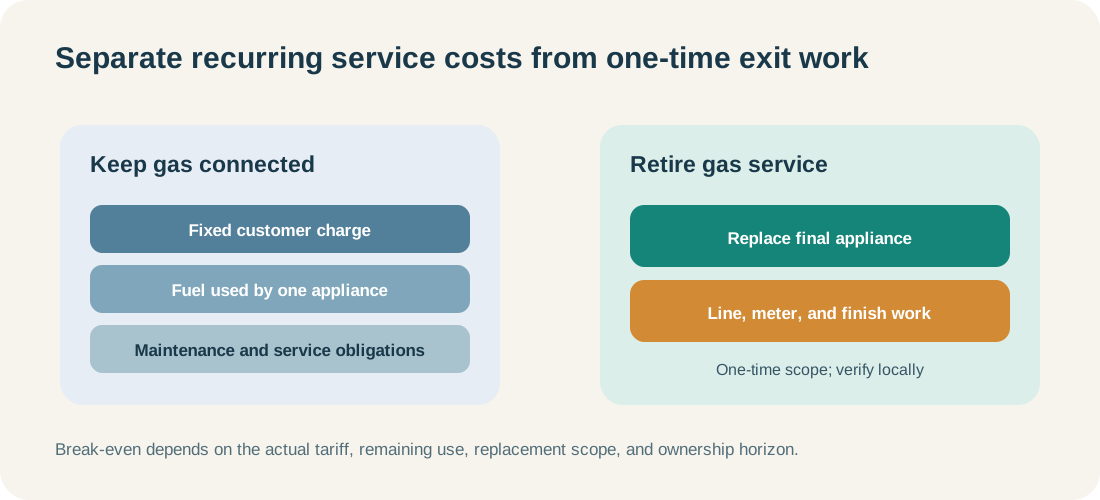
Write down the annual fixed service cost, expected fuel use, maintenance, and probable years until the appliance needs replacement. Then list the complete electric conversion: appliance, circuit, capacity, installation, gas-line and vent treatment, utility disconnection, restoration, and financing. A replacement that lasts longer or fails early changes the result.
Run a short-horizon case in which keeping service preserves flexibility and a long-horizon case in which fixed charges accumulate. Add a difficult case where the electric replacement requires capacity work. If break-even depends on an incentive, verify the program before committing and keep the gross-cost case visible.
Set a review trigger
If gas is retained temporarily, record the date or event that will reopen the decision: final appliance failure, a remodel, a tariff change, or a service upgrade. Otherwise a temporary phase can become a permanent fixed charge. If gas is cancelled, retain the utility’s written end-state requirements and the equipment documentation for future owners.
Compare the final-appliance quote
Ask whether the electric replacement requires a new circuit, service work, ventilation change, or room restoration. If the remaining appliance is a furnace, include heat-pump capacity and backup; if it is a range, keep the cooking project separate from a whole-home service conclusion. A final appliance can be cheap to replace and expensive to enable.
Do not overlook nonfinancial value
Cooking preference, backup heat, future equipment, resale expectations, and the inconvenience of a service interruption may justify retention. Those are legitimate inputs, but they should be explicit. Conversely, an unused meter or line can create future maintenance and disclosure questions. Ask the utility and licensed trade to define the safe end state before service is cancelled.
Put the fixed charge beside the appliance’s useful value
The continuing gas bill may include a customer or basic charge that is owed even when one appliance uses little fuel. Two current examples show why the amount is local: Enbridge Gas Ontario’s Rate 1 listed a CAD 27.69 monthly customer charge for marketer-supplied residential customers effective July 1, 2026; FortisBC’s Main/Vancouver Island residential basic charge was CAD 0.4216 per day, or CAD 13.07 for a 31-day example. They apply to different utilities, territories, and rate structures. They are not a Canadian average, a cancellation fee, or proof of what your bill will show.
Start with the most recent full year of bills and separate fixed customer charges from commodity, delivery, taxes, and any third-party marketer charges. Then identify which charges would actually disappear if service ended. Confirm this with the utility or retailer in writing; some components may remain, while others may be avoided only after meter or line work. If the final appliance is used seasonally, compare its annual fuel consumption with the full-year cost of keeping the service.
The nonfinancial use can still justify the expense. A gas fireplace may provide familiar heat during an outage only if its controls and venting work without grid power. A range may be retained for cooking preference, but that choice keeps an account active and may constrain later renovation. A standby generator has separate transfer and safety requirements. State what the remaining appliance provides, how often it is used, and whether another method offers the same value.
Use a break-even test that includes replacement cost for the final appliance, any circuit or vent change, utility retirement work, remaining fixed fees until disconnection, and expected charges while gas remains. Do not treat a monthly charge as the total retirement cost or assume that ending an account automatically removes a physical service line. Set a review trigger, such as appliance failure, a remodel, or a fixed-charge increase, so the decision can be revisited when the remaining use changes.
Confirm the exact exit process before replacing the last appliance
Before assuming that one appliance can keep service active cheaply, ask the utility or marketer which account charges continue at zero or low usage and which are tied to the supply contract. The Enbridge July 2026 Rate 1 example applies to Ontario residential customers buying gas from a marketer and lists a monthly customer charge; FortisBC’s basic charge example covers its Mainland and Vancouver Island residential rate. A customer on a different rate class, zone, or supplier may see different components.
Ask for the effective date and request a projected bill after the appliance is retired. If a retailer or marketer is involved, confirm the notice period and any contract effect. Ask separately about account closure, meter removal, service-line removal, and any final bill. A fixed customer charge does not answer whether physical retirement costs money or whether that charge disappears at the time you expect.
If the appliance is retained for emergency use, ask whether it is maintained and usable under the conditions that matter. A device that is rarely used still needs safe, professional upkeep. Include that cost in the nonfinancial case for keeping it.
Separate fixed service cost from the final appliance’s consumption
The monthly customer charge continues because the account remains connected, while commodity and delivery charges change with use. Build the comparison from the actual bill components and the remaining appliance’s consumption. If the provider has a minimum usage or marketer contract, include that term separately. Then compare those recurring costs with the one-time cost of replacing the appliance and retiring service.
Do not multiply a single month by twelve if the tariff or fuel use varies. Use a full year of bills and ask the utility to explain any charges that continue after the account closes. This prevents a local fixed-charge example from being treated as a universal annual savings figure. If a household keeps gas, set a date to revisit the decision after the appliance’s next service or replacement. The fixed cost may be reasonable for several years of use but poor value after the appliance becomes unreliable. A review date keeps the decision aligned with actual use and avoids paying an indefinite charge by inertia.
The homeowner can also document why the appliance is retained, what maintenance it needs, and what would replace it. That makes the cost visible without assuming that every household should choose the same fuel boundary.