
There is no reliable universal installed range for a home load-management system because the term covers several products. A single circuit-sharing device, a load-shedding controller, and a multi-load energy-management system do not have the same hardware, labor, or capabilities. Build the budget from the loads being coordinated and compare it with the complete alternative: a service or utility upgrade.
What you may be buying
Systems can monitor current, disconnect or delay selected loads, share one circuit between equipment, schedule flexible demand, or coordinate several connected loads. Some are panel-side; others use dedicated controls. A product’s ability to measure a load does not automatically mean it can control it, and control capability does not automatically establish code acceptance or compatibility with every appliance.
Cost layers
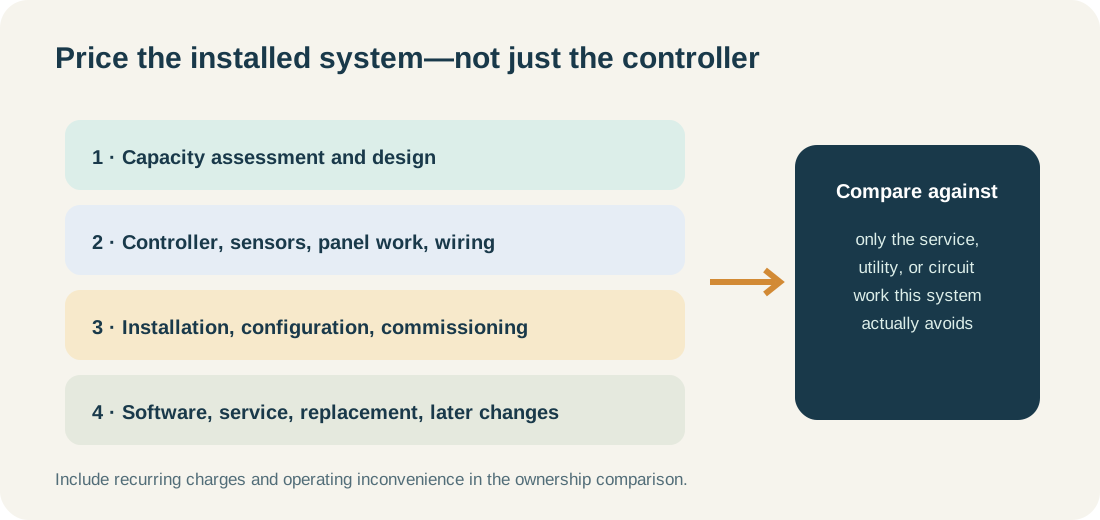
Ask for separate prices for hardware, sensors, panel work, wiring, electrician labor, configuration, communications, commissioning, and recurring cloud or monitoring fees. Difficult access, an older panel, multiple load locations, and a need to integrate heat pumps, water heating, and EV charging increase labor and design time. A system that needs a new panel or service review is not a small add-on even if the controller itself is compact.
Include the professional load assessment. The controller must be selected around the proposed capacity limit and the actual equipment behavior. If backup resistance heat is a controlled load, ask how it is prioritized during cold weather and what happens during a control fault.
Low, expected, and difficult cases
- Low complexity: one compatible flexible load, accessible wiring, no panel replacement, and no recurring service.
- Typical complexity: several monitored circuits, electrician installation, commissioning, and a written operating strategy.
- Difficult complexity: an older or crowded panel, multiple equipment brands, communications dependence, utility coordination, or controls that must be accepted as part of a capacity solution.
These cases are more useful than a product-only price. The installed cost can be reasonable when it avoids trenching or a full service project, but it is poor value when it only delays a capacity expansion the household will soon need.
Decide whether complexity pays
Use a single-load solution when one flexible load is the only constraint and the household understands the control behavior. Consider a broader system when several loads interact, monitoring will change future decisions, and the equipment has a clear service and data path. Do not buy a platform merely because a future load is imaginable.
Request a written comparison with a service upgrade and identify the work the system truly avoids. A system that costs less but adds recurring fees, delays, and proprietary replacement risk may have a higher ownership cost.
What management changes for the household
Load management trades capacity for coordination. Charging may be delayed, water heating may pause, or auxiliary heat may be limited while another load runs. Those behaviors may be acceptable, but they need to be explained before purchase. Ask who can change priorities, whether the system works without internet access, how alerts are delivered, and whether future equipment can be added.
Research-backed home energy-management projects describe circuit-level measurement and coordinated loads as capabilities, not as proof that every commercial product has the same performance or economics. Treat vendor savings and “no upgrade required” claims as product-specific assertions requiring verification.
Quote and acceptance checklist
The proposal should name the exact loads, capacity limit, control sequence, equipment compatibility, listing or certification, installation responsibility, commissioning test, warranty, software terms, and failure behavior. Confirm the authority and utility accept the proposed method. Code treatment varies by jurisdiction; a national technical discussion cannot substitute for local approval.
Finally, compare ownership cost over the planned horizon. Add subscriptions, replacement electronics, service calls, inconvenience, and the possibility of a later service upgrade. A load-management system is worth its cost when it solves a defined capacity constraint safely, legally, and durably—not merely when the controller is cheaper than a larger panel.
Test the operating scenarios
Ask the installer to describe a normal day, a cold day, and a control-failure day. A normal day may allow scheduled water heating and overnight charging. A cold day may prioritize space heating and limit resistance backup. A failure day should explain whether loads default on, default off, or require a service call. The answer affects comfort, bill risk, and the need for a backup plan.
Compare avoided work honestly
If the system is intended to avoid a service upgrade, obtain that upgrade estimate first, including utility and restoration work. If it only avoids a new circuit or permits a lower-power charger, compare the smaller avoided cost. Do not assign the control the value of a project it does not actually replace.
Confirm replacement availability, data access, software support, subscription increases, and whether another electrician can service the installation. A single-load device may be a better fit than a broad platform when the capacity problem is narrow; a multi-load system may earn its complexity when several controllable loads are genuinely planned.
Use local examples without turning them into a market range
One Lower Mainland electrical contractor advertises a straightforward residential EV energy-management installation starting at CAD 2,000 plus an electrical permit. The quoted starting scope excludes the EV charger circuit and charger hardware, panel or service work, and other electrical work. A Canadian retailer listed an Emporia EV charger with a Vue monitor bundle at CAD 869.99 in September 2026; that is a charger-and-monitor equipment bundle, not a standalone controller or an installed system. The two prices answer different questions and should stay in separate budget lines.
Ask an installer to map the proposal against the actual loads. A charger-sharing device may coordinate two vehicles on one circuit; an EV energy-management system may limit charging against whole-home demand; a smart panel may monitor or control multiple circuits. Confirm whether the product uses a meter, current sensors, a communications link, or a service rating input, and whether it sheds load, modulates output, or only reports conditions. The chosen function affects labor, equipment, commissioning, and failure behavior.
Then price the boundaries explicitly: capacity study; controller and sensors; panel modifications; new charger or branch circuit; permit; setup and test; network or subscription; and any later service change. If one quote includes a charger and another excludes it, normalize the scopes before deciding. Ask the contractor to demonstrate that the system responds at its limit and to document what happens if a sensor, internet connection, or controller fails. Verify local acceptance with the authority or utility before counting an avoided service project as savings.
Because the available examples are one local installed starting price and one retail bundle, they do not support a broad installed-cost range. They do establish why a product-only price can differ sharply from the total project budget.
Require a commissioning record the next electrician can use
The final price should include a documented commissioning test. Ask the installer to show the normal load limit, which loads are monitored, how the system responds when the limit is approached, and how the setup is restored after a power interruption. Keep the model and serial numbers, wiring and sensor locations, control priorities, settings, firmware or software terms, and warranty information with the electrical records.
Clarify what happens when the connected load changes. A replacement EV charger may have a different maximum output; a heat-pump control may be changed during service; a new appliance may not communicate with the system. Ask whether the homeowner can add a device or whether the design must be reviewed by the original installer. A system that prevents an upgrade today can become a dependency that needs attention at the next replacement.
The quote should name the responsible party if commissioning fails or if local approval is withheld. That allocation matters more than a low controller price because the promised savings depend on the installed system being accepted and functioning as designed.
Price service after the warranty period
Ask who can diagnose the system once the original installer is unavailable. Confirm whether sensor replacement, software support, app access, or configuration changes are billable and whether the homeowner can retain operating records. If the controller becomes unsupported, determine whether the electrical system continues safely and what temporary operating limits apply.
Include a future-service allowance if the system is central to capacity. A low initial price can be misleading if a proprietary controller must be replaced before the electrical equipment reaches the end of its life. The installer should identify the expected maintenance path without promising a lifespan that the product documentation does not establish. Ask how the price changes if the system must manage a different combination of loads. A single EV charger may be a narrow job; adding water heating or heating equipment can require additional sensors, controls, commissioning, and an accepted design. The proposal should identify the current system boundary and the price or process for expanding it later.
This matters when equipment is installed in phases. Before the first phase, confirm whether the selected controller can still be supported when later loads arrive. Do not assume that a system advertised for one use automatically supports another.