
One U.S. specialist source reports a $175–$300 planning range for professional 240-volt outlet installation, with equipment, distance, access, and circuit complexity moving the total. HomeStars lists CAD $250–$800 for installing a dedicated 240V outlet, describing a circuit run back to the panel. Treat that as one Canadian published observation, not a national rate or a converted U.S. range. Both figures are planning context; the actual load, route, termination, panel, and local requirements determine a quote.
Angi’s separate 2026 220V page presents a $80–$596 Cost Insights range and, in its article prose, a $138–$320 usual range with a $229 average. The page uses $ without an ISO currency code and does not reconcile those presentations. Keep them separate from the $175–$300 observation above; do not average the figures, assign the page an unstated currency, or apply them to every 240V circuit or EV installation.
“240V outlet” can mean a receptacle for a defined appliance, a hardwired connection, or the circuit and protection feeding it. The required voltage, amperage, phases, receptacle, disconnect, protection, and equipment instructions must be confirmed for the actual load.
Cost layers
- load and equipment review;
- two-pole breaker or other protection;
- conductors and route from the panel;
- receptacle, box, disconnect, or hardwired termination;
- panel space and condition;
- access through walls, ceilings, crawl spaces, or exterior routes;
- permit, notification, inspection, and testing;
- patching, trenching, or finish restoration;
- equipment connection or commissioning where included.
The appliance itself is usually a separate purchase. EV charging, generators, solar, and storage have their own system decisions even when they use 240-volt wiring.
For one Ontario-specific example, ESA says a 240V receptacle serving only a stacked washer/dryer may satisfy the washer-receptacle requirement. Its bulletin distinguishes a laundry room from a laundry closet. That does not establish the circuit or connection requirements for every dryer or other 240V appliance; confirm the actual equipment and current local interpretation before pricing the endpoint.
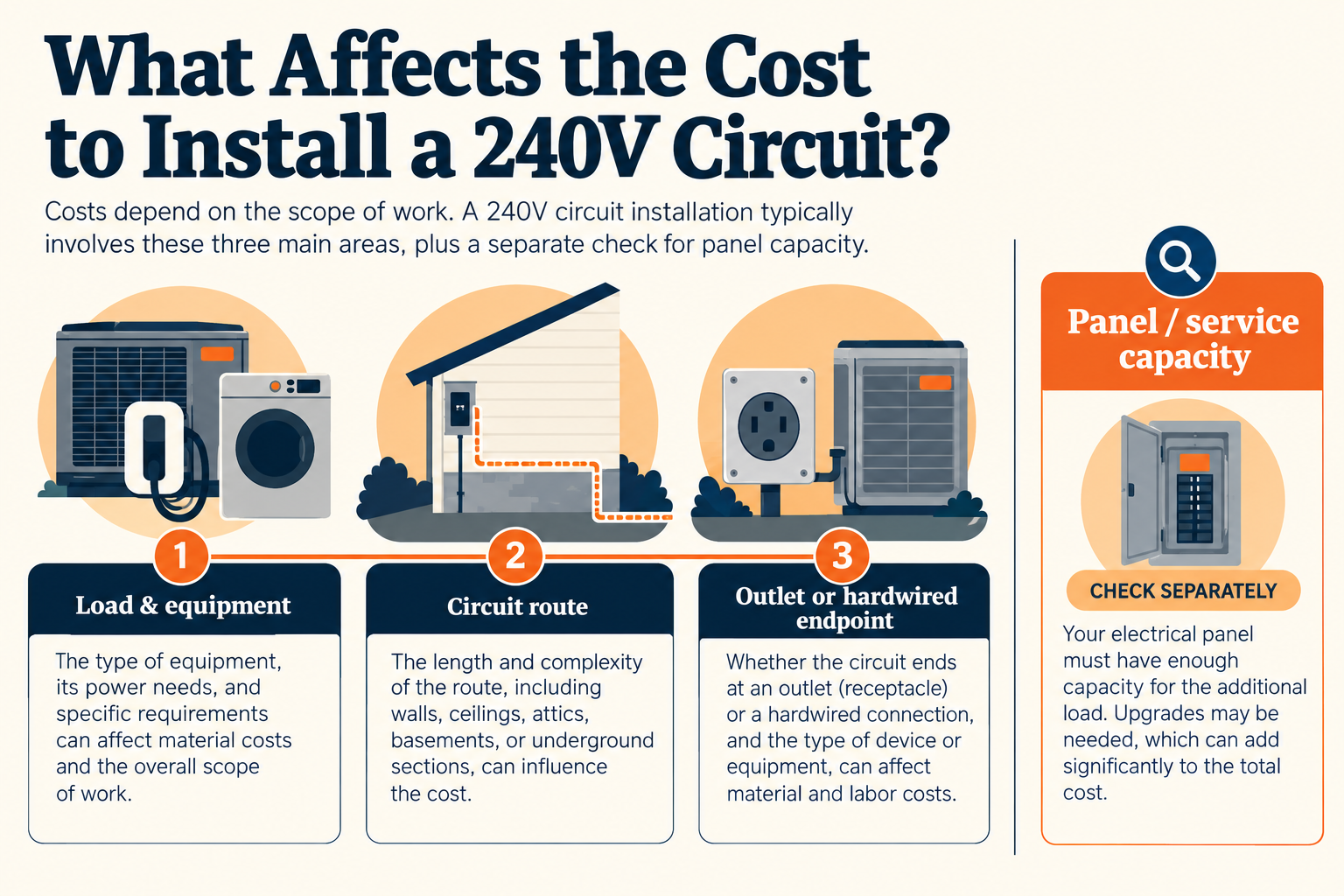
What changes the price
Distance and access are often larger drivers than the receptacle. A short route through open framing can be manageable; a route through finished masonry or an occupied upper floor can require more labor and restoration. The load determines conductor and protection requirements, while panel space and service capacity determine whether the circuit can be added without a broader project.
Do not treat all 240-volt receptacles as interchangeable. The exact equipment and listed installation determine the suitable termination. A quote should name the equipment assumption and who verifies compatibility.
Scenario budgets
Existing-panel, accessible route: One defined appliance, clear panel space, short route, and ordinary finish conditions. This is the narrowest installation.
Finished-home installation: Long or concealed route, new box, access openings, and patching add labor. If the endpoint is in a garage or exterior location, equipment and weather exposure add another layer.
Panel or service project: The panel lacks suitable space or the home cannot support the added load under the applicable analysis. Panel replacement, service upgrade, or whole-home capacity planning may be needed. Do not price this as an outlet add-on.
Administration is jurisdiction-specific
Technical Safety BC’s 2026 homeowner schedule lists CAD $136 for one new circuit or existing-circuit modification and separate service categories. Ontario’s electrical notification and inspection process uses different classifications and fees. These examples are not universal rules or total project costs. Verify requirements with the local authority and qualified contractor before work begins.
Quote checklist
Compare proposed voltage and amperage, equipment, breaker, conductor, receptacle or hardwire termination, panel space, route length, access, service-capacity assumption, protection, permit/inspection, testing, finish restoration, and exclusions. Ask what happens if the existing panel or service cannot support the load.
The correct 240-volt budget follows the equipment and route. The phrase “240V outlet” alone is too broad to justify a fixed price or a particular device.
Define the endpoint before comparing quotes
“Installed” can mean a receptacle or junction point ready for an appliance, or it can mean a named piece of equipment connected and tested. Ask the electrician to state which result is included, who supplies and connects the equipment, what load and model were assumed, and whether commissioning belongs to another installer. If the appliance is not selected, keep a written allowance and identify what would trigger repricing.
A 240V label alone does not make two projects comparable. A stove, workshop tool, heat-pump component, and vehicle charger can have different electrical and installation requirements. Keep the article’s circuit price separate from appliance or EV-system costs.
Separate a contained circuit from a capacity project
| Project condition | What the quote should resolve |
|---|---|
| One known load, clear route, and suitable existing panel | Breaker and protection, conductor route, endpoint, testing, and local administration. |
| Known load but concealed or exterior route | Access method, openings or trenching, weather exposure, restoration, and who repairs finishes. |
| Several planned loads or a panel/service limitation | A capacity assessment and separate panel or service scope before individual circuits are authorized. |
A new circuit can be complete even when equipment work is not. Conversely, an outlet quote may be incomplete if the homeowner expects the electrician to connect and test an appliance. Ask how a changed model, inaccessible route, or unsuitable existing panel affects the price. The most useful estimate names the assumed load, route, endpoint, completion test, and handoff; it does not treat a receptacle price as a promise that every 240V use will fit.