
The choice is not “rewire a percentage of the house” versus “rewire everything.” It is whether a defined partial scope leaves a credible, serviceable system or merely postpones work that will have to be reopened. A current Canadian specialist observation places whole-home rewiring around CAD $8,000–$20,000 or more, while partial work can range from a small circuit project to a substantial occupied-home job. The ranges are not interchangeable, and there is no universal percentage at which a full rewire automatically wins.
What partial rewiring means
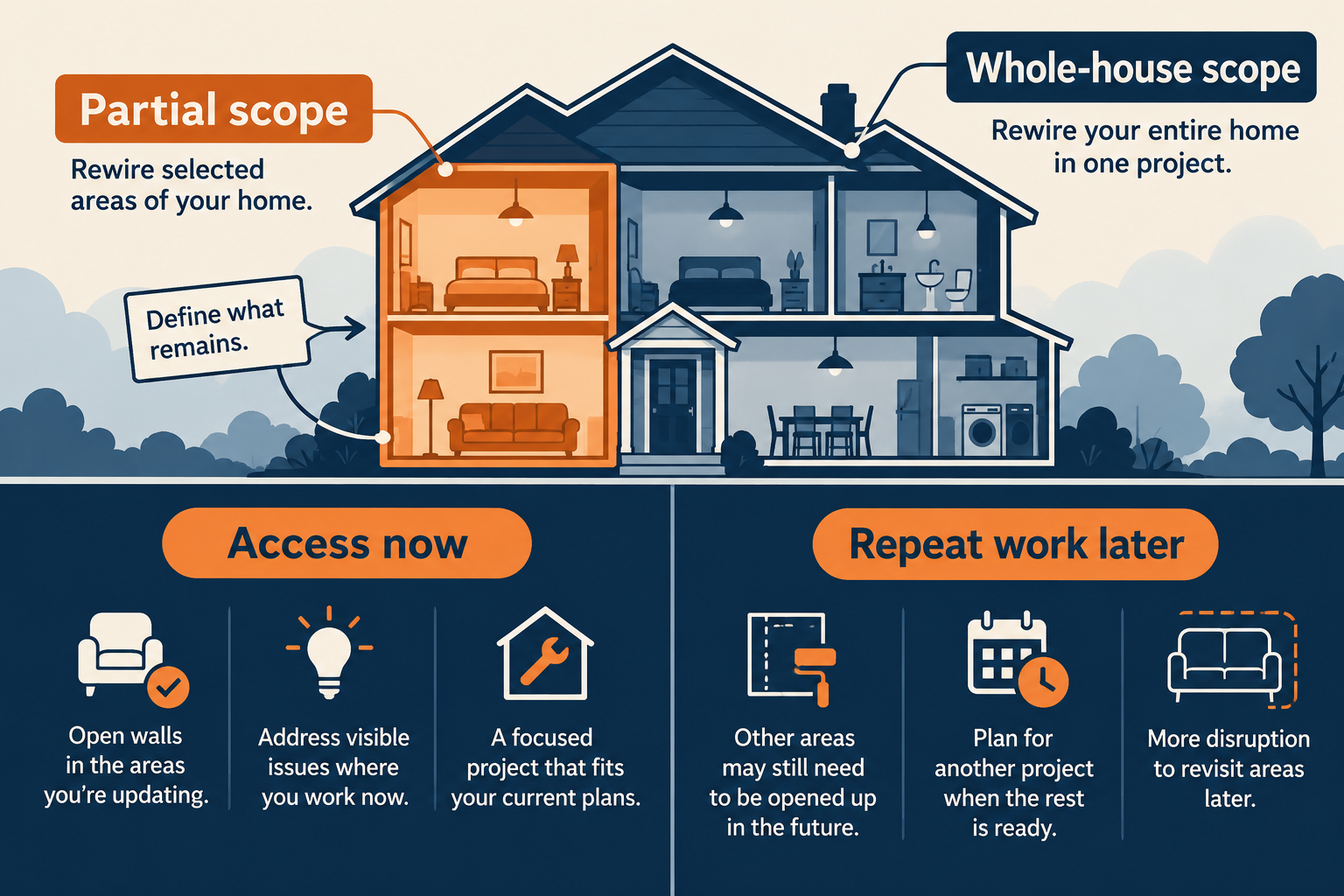
A partial rewire replaces identified circuits, areas, or wiring types while retaining other assessed portions. The boundary might follow a damaged branch circuit, a renovation area, a serviceable addition, or a legacy wiring section. A good scope states what is retained, why it is acceptable for the intended use, and how new and old portions interact.
Whole-house work replaces a much larger portion of the branch distribution, but even it may retain service equipment, certain circuits, or finishes unless the quote says otherwise. “Whole-house” is a scope label, not a guarantee that every electrical component changes.
When partial work is rational
Partial rewiring is stronger when the hazard or defect is localized, the affected circuit can be isolated, natural access exists, the retained wiring has been assessed, and the homeowner has a credible plan for the remaining system. It may also make sense when a renovation opens only one area or when immediate capital must address the most consequential condition first.
The risk is not simply that old wiring remains. The risk is that piecemeal work creates repeated access, inconsistent documentation, incompatible devices, or a sequence that becomes more expensive later. Ask the electrician to identify those risks rather than accept a generic “partial is cheaper” conclusion.
When whole-house work is stronger
Whole-house work becomes more persuasive when the condition is distributed, the same access will be needed in many areas, multiple partial repairs would repeat mobilization and patching, the retained segments cannot support the planned use, or a full project can be coordinated with open walls. It may also provide a clearer system record for a transaction or insurer, although insurer acceptance varies.
Knob-and-tube and aluminum branch wiring require separate condition and remediation decisions. Ontario ESA says properly maintained knob-and-tube may be safe and that current rules are not retroactive in its jurisdiction; that does not approve every installation or determine insurer treatment elsewhere. CPSC’s aluminum guidance supports professional assessment of connection hazards but is not a current universal remediation standard.
Compare the economics over time
| Question | Partial rewire | Whole-house rewire |
|---|---|---|
| Upfront cash | Usually lower for a genuinely bounded scope | Higher and more disruptive |
| Access | Concentrated openings | One coordinated access/restoration plan may be efficient |
| Retained risk | Depends on documented condition of remaining wiring | Reduces the amount of legacy branch wiring retained, but may expose more unknowns |
| Future work | May require another mobilization | Can create a clearer baseline for later projects |
| Disruption | Smaller immediate footprint | Larger shutdown and finish-restoration sequence |
| Flexibility | Preserves capital if the boundary is durable | May support a broader planned use, but service capacity remains separate |
Use an ownership horizon. For a short horizon, a documented partial correction can be sensible if it does not conceal known limitations. For a long horizon, include repeated visits, patching, planned renovations, future load changes, and the cost of reopening finished areas.
Access changes the answer
An attic, basement, crawl space, or open renovation can make additional circuits cheaper to reach now. Finished plaster, tile, built-ins, and occupied rooms make every later phase more expensive. Timing can therefore matter more than a generic per-circuit price. Ask whether combining areas creates real shared savings or simply bundles unrelated work.
How to compare proposals
Require a circuit or area schedule, wiring retained, access plan, device and box scope, panel/service interactions, grounding/bonding, restoration, permits or notifications, testing, documentation, and unit prices for additional circuits. Ask each bidder to price the same partial boundary and explain the next likely phase if full work is deferred.
The economically credible choice is the smallest scope that resolves the documented condition without creating an unreasonable repeat-work or retained-risk problem. “Do everything” and “do only the visible defect” are both incomplete recommendations without that analysis.
Document retained wiring and define phases
Every partial proposal should identify which circuits or areas will be replaced, what will remain, why those portions are retained, and which visible limitations are known. This record is not a promise about future performance; it tells the homeowner what the project did and what it did not resolve. Ask how the new work connects to the retained system and whether inspection, labeling, or documentation applies to each phase.
Compare a partial scope with a whole-house scope on the same basis: circuits and devices, panel interaction, grounding or bonding, access, restoration, administration, and the cost of returning later. A partial phase can be good value when it follows a documented boundary and shares access with a renovation. It can lose that advantage if repeated visits reopen the same finishes. Whole-house work can establish a clearer baseline when a system-wide condition and open access justify it, but it does not automatically include a service upgrade or every related repair.
When diagnosis remains incomplete, request a defined assessment or first phase with a price and approval threshold for concealed work. The quote should state what finding would change the scope. That protects against both an undefined contingency and a premature recommendation to replace wiring that has not been assessed.