
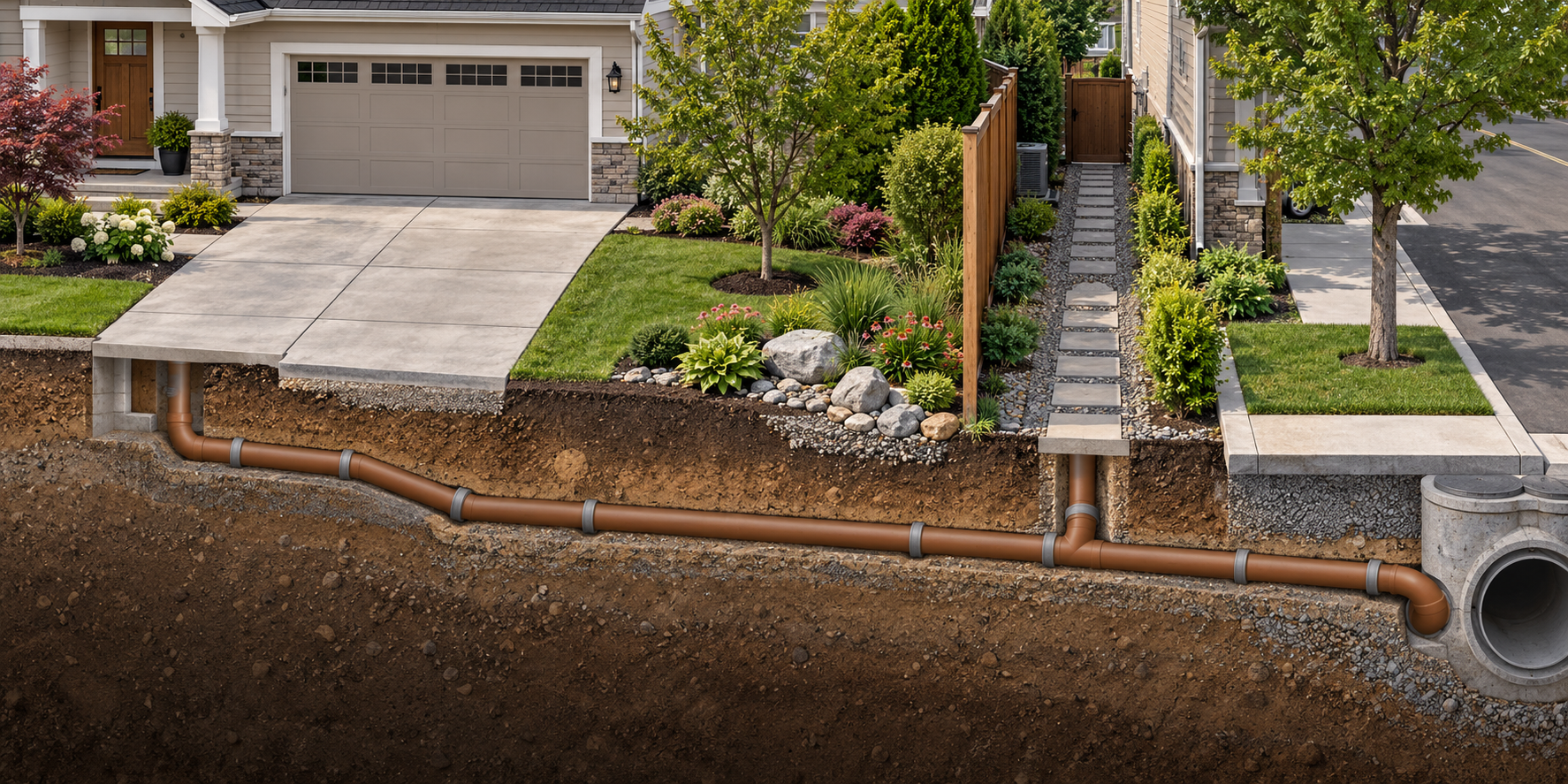
When a sewer runs deep, beneath a driveway, through mature landscaping, beside a structure, or into a public right-of-way, access can matter more than the pipe price. The same defect may be a focused repair in an open yard and a multi-trade project where excavation, protection, permits, traffic control, and restoration dominate. There is no honest universal percentage uplift for difficult access.
Why access changes every layer
Restricted access can increase locating, setup, labor, equipment handling, protection, spoil movement, and schedule. A hard surface adds removal and reinstatement. A deep route adds excavation volume and safe-work requirements. A street crossing adds municipal coordination and possible traffic controls. These costs interact rather than appearing as one neat surcharge.
The EPA condition-assessment guidance lists access or excavation, traffic control, surface restoration, reporting, and service disruption as possible cost categories. Its utility context is broader than one residential quote, but the categories describe why a simple per-foot number is weak planning information.
An OCM Excavation 2026 Greater Toronto Area table gives scale to a few defined settings: house-to-property-line open-cut work is described as 20–35 feet and 4–6 feet deep on lawn or a simple driveway, with a published CAD $5,500–$12,000 range; a property-line-to-main segment with boulevard cut and saddle tap is CAD $4,500–$11,000. A full 30–60-foot house-to-main run is listed at CAD $8,000–$22,000. These are one provider’s table values, not a difficulty surcharge or representative market study. The listed scopes include standard restoration but exclude landscaping reconstructed beyond the cut, so ask what surface and access work your own proposal includes.
Access conditions to put on the map
- pipe route and depth, including uncertain sections;
- driveway, patio, walkway, pavement, or retaining features;
- trees, irrigation, fences, sheds, and neighboring property;
- narrow side yards or overhead restrictions;
- basement, slab, or interior access;
- public sidewalk, road, or right-of-way;
- utility crossings and shared or traversing lines.
Photographs and a marked route make two quotes more comparable. A contractor should distinguish what is known from what must be exposed.
Open cut and trenchless choices
Open-trench work exposes more of the route and may require greater restoration. It can be the better option where the line’s alignment, collapse, connections, or condition must be corrected directly. Trenchless lining or pipe bursting can reduce surface disturbance when the host pipe, alignment, access, utilities, and connections are suitable. Both may still need openings, pits, permits, and restoration.
Do not choose trenchless solely because a driveway is expensive. Price the access pits, preparation, connections, method limits, and remaining risk. Do not choose open cut solely because it is familiar; include the full restoration and disruption cost.
Scenario bands
Deep open yard: Excavation and protection drive cost, but surface restoration is modest. Route and depth certainty can make the project comparatively predictable.
Driveway or patio crossing: Removal, replacement standard, curing time, and access for equipment can dominate. A trenchless method may be worth comparing if its access pits fit and the existing alignment is suitable.
Mature landscaping and narrow side access: Protecting or replacing plants, irrigation, fences, and soil adds coordination. Avoid promising that a trenchless method will leave the property untouched.
Public right-of-way: Permits, traffic, inspection, utility notification, and municipal connection requirements may be separate from the contractor’s private-work price. Confirm them directly with the authority.
Separate pipe scope from restoration
Ask each bidder to price or clearly exclude excavation, spoil, backfill, concrete, asphalt, paving, lawn, trees, irrigation, fence removal, traffic control, and interior finishes. “Restore surface” is not specific enough when a driveway or landscaped area is involved. Request the restoration standard and who is responsible if the repair settles or a material cannot be matched.
The plumbing quote may be accurate and still not be the final project cost. A surface contractor, utility, or municipality may own another layer. Keep those boundaries visible.
Difficult access and repeat work
Access cost changes the repair-versus-replace decision. A spot repair may be sensible when it avoids reopening an expensive surface and the defect is truly isolated. It may be poor value when the same access would be repeated for adjacent defects. A lining or replacement proposal may earn its premium if it corrects a larger defined condition with one mobilization.
That reasoning does not justify a broad replacement without evidence. Ask for the affected length, camera limits, retained pipe, and method suitability. The cost of access makes evidence more valuable, not less.
Quote checklist
- route, depth, and surface map;
- equipment and staging assumptions;
- excavation or pit locations;
- utility, easement, neighbor, and right-of-way coordination;
- permit, inspection, and traffic requirements;
- pipe, connection, and testing scope;
- temporary access and service interruption;
- surface restoration standard and exclusions;
- contingency trigger and approval process.
Difficult-access economics are best handled with scenario bands: known access, expected complications, and a difficult case tied to a specific unknown. That gives the homeowner a useful budget without pretending that every driveway, tree, or street has the same cost.
A useful access worksheet
For each quote, write down the route surface, access point, depth confidence, equipment path, and restoration owner. Mark each item as confirmed, allowance, or excluded. Then ask what changes if the line is deeper, a utility crosses the route, a tree cannot be protected, or the public authority requires a different restoration standard. This produces a practical upper scenario without inventing a percentage premium.
The worksheet also helps with timing. A contractor may be able to repair the pipe in one visit but need another crew for concrete, paving, landscaping, or traffic control. If those trades are not coordinated, the homeowner may face temporary surfaces, an open excavation, or a second mobilization. Ask who protects the opening between stages and whether the quoted schedule includes weather or permit dependencies.
An access-heavy project can make a defined longer repair more attractive than several small openings. That is a comparison to request, not an instruction to replace more pipe. The proposal should show the additional length, evidence supporting it, the surface saved or disturbed, and the future access it creates.
Build an access schedule for each quote
Ask the contractor to mark every planned opening, pit, staging area, and restoration surface on the same route drawing. Record approximate depth confidence, equipment path, utility crossings, temporary protection, and the party responsible for each finish. A bidder who assumes open yard access is not comparable with one who priced a narrow side passage and driveway reinstatement, even if both used the same pipe length.
Identify which conditions are confirmed and which remain an allowance: a visible cleanout, a measured route, a camera-located defect, unknown soil, groundwater, buried services, public permits, or restoration matching. Give each allowance a trigger and a unit basis where the contractor can provide one. Ask whether unexpected depth changes equipment or safe-work requirements and who must approve a longer or wider opening.
Compare surface cost with pipe scope
An expensive driveway can make lining or bursting worth a comparison, but the access pits may still fall in the driveway and the method may not fit the alignment. An open-trench project through lawn may be less disruptive than a trenchless project needing difficult pit access. Estimate the area each method disturbs and what the surface would cost to restore under its own scope.
The Greater Toronto Area examples in this guide show a provider’s published prices for defined open-cut segments, not a surcharge for depth or restricted access. Use them to ask which segment and surface your quote resembles, then confirm the actual route and inclusions. Do not apply a percentage premium to a local or national price simply because access is “difficult.”
Reduce repeat access without overbuilding
When two repairs would use the same expensive opening, ask for a price comparison between one defined repair and a broader work scope using that access. Include the evidence for treating additional pipe, the additional restoration avoided or incurred, the connections affected, and the future access left behind. This may show that a longer scope is coherent, or that the extra pipe is sound and should remain untouched.
If an access constraint cannot be resolved before construction, stage the work with a written stop point. The contractor can expose or assess the defined area, document what is found, and obtain approval before expanding. This balances the real cost of mobilization with the owner’s need to control an uncertain project total.
Keep measurements and photographs of the restored work area with the final route record; those help explain future access and avoid paying to rediscover the same surface constraints.
When an access constraint is temporary, such as a vehicle, stored material, or a scheduled landscape project, ask whether clearing the path changes equipment, labor, or restoration assumptions. A contractor may price setup differently if staging is ready; get the revised scope in writing so a lower mobilization assumption does not erase required protection or utility checks.
Mark excluded surfaces before work begins so restoration responsibility is clear.