
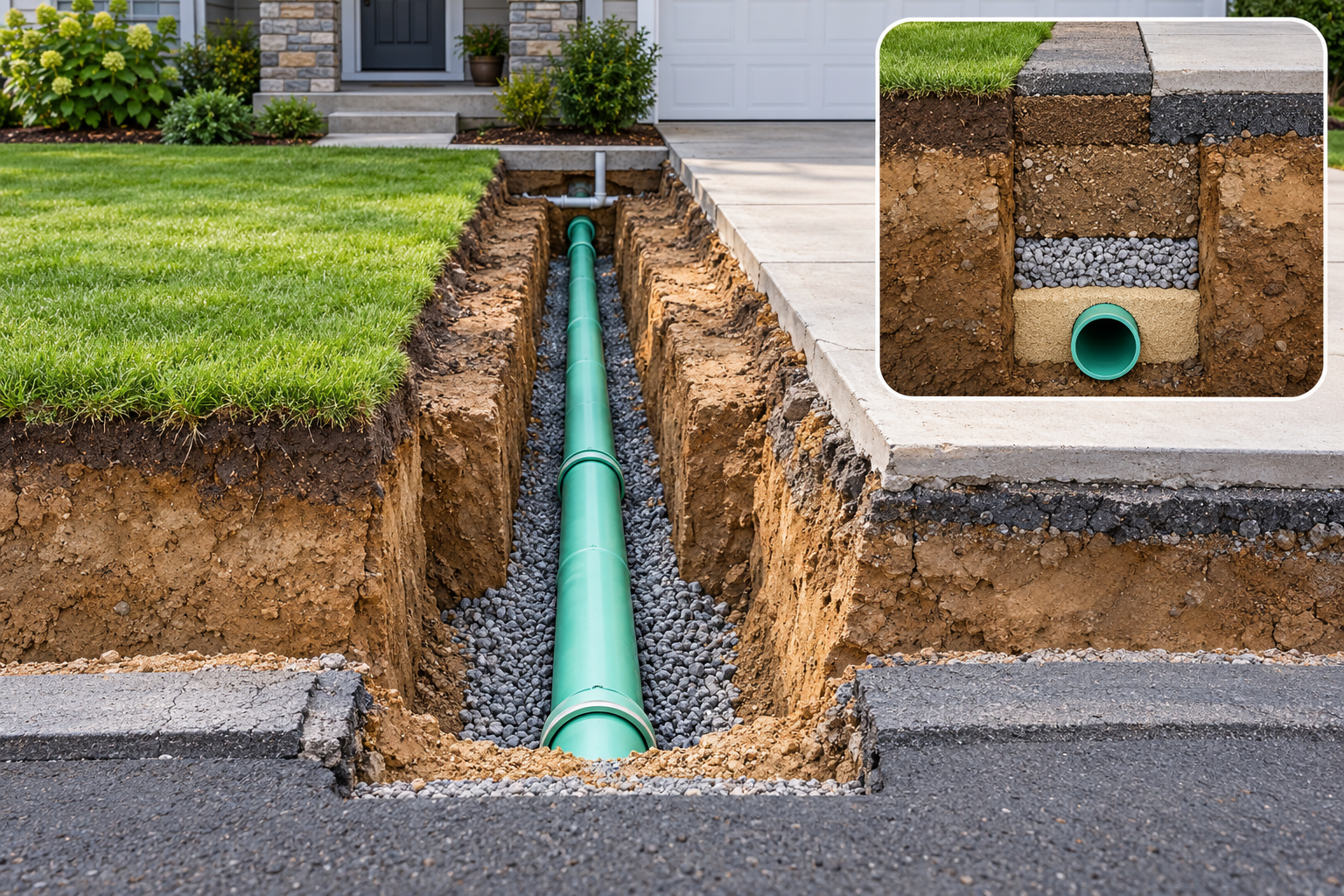
Open-trench replacement exposes the route so the contractor can remove and replace the sewer directly. It may be necessary when collapse, poor alignment, difficult connections, or unsuitable trenchless conditions make a less disruptive method unreliable. It can also be the clearest way to address a long route, but excavation, protection, backfill, and restoration often dominate the project total.
What the project includes
A complete scope may run from inspection and locating through excavation, pipe removal, bedding or support, new pipe and connections, testing, inspection, backfill, and surface restoration. It may also involve public right-of-way permits, traffic control, utility coordination, spoil handling, and temporary access.
Vancouver identifies open trenching as one local sewer-renewal method and describes permitting and post-work inspection in its jurisdiction. Local rules differ, so use the example to ask the right questions, not to assume that every municipality has the same process.
Cost layers
| Layer | Main drivers |
|---|---|
| Investigation | Length, route, depth, camera limitations, locating |
| Excavation | Soil, groundwater, depth, equipment access, protection requirements |
| Pipe work | Length, material, connections, removal and disposal |
| Public interface | Permits, inspection, road, sidewalk, traffic or utility coordination |
| Restoration | Backfill, pavement, driveway, lawn, tree, patio, fence or interior finish |
| Disruption | Temporary access, fixture outage, staging, weather and schedule |
There is no useful single excavation surcharge. A shallow open yard and a deep street crossing are different projects.
One Greater Toronto Area contractor’s 2026 table illustrates the difference between segments: OCM Excavation lists CAD $5,500–$12,000 for open-cut work from house to property line (20–35 feet, described at 4–6 feet deep on lawn or a simple driveway), CAD $4,500–$11,000 from property line to main with a boulevard cut and saddle tap, and CAD $8,000–$22,000 for a 30–60-foot house-to-main run. The page states that its ranges include labor, equipment, pipe, bedding, backfill, compaction, permits, locates, and standard restoration; it excludes interior plumbing beyond the foundation, hazardous-soil disposal, and landscaping beyond the cut. These are one provider’s quoted-job observations, not an independently sampled GTA or Canadian market range. Confirm today’s segment and inclusions in a written quote.
Why depth and access interact
Depth increases excavation volume, handling, equipment time, and restoration exposure. Restricted access can prevent ordinary equipment from reaching the route and may require manual work, staging, protection, or more mobilization. If the line runs beneath a driveway or patio, the surface may have to be restored to a defined standard rather than simply covered with soil.
Ask for a route drawing and surface map. A measured length alone does not tell you how much ground or hardscape is affected.
Soil, water, and safe construction
Soil conditions and groundwater can change excavation, dewatering, backfill, protection, and schedule. The homeowner should not receive trenching or shoring instructions from a cost article. Ask the contractor what locally required safe-work controls, permits, inspections, and professional reviews apply.
These conditions are also why the lowest bid may carry a broad allowance. Require the allowance to identify the trigger and the approval process rather than accepting an unlimited contingency.
Restoration is part of the decision
Restoration may include compacted fill, concrete, asphalt, paving, landscaping, irrigation, fences, retaining features, basement access, or interior finishes. A quote can legitimately exclude some work, but those exclusions must be visible before comparing totals. If another project is already opening the surface, coordination may reduce duplicate disruption while changing neither contractor’s ownership boundary.
Keep stormwater, foundation drainage, and contaminated-property restoration separate when they become dominant projects. A sanitary sewer replacement may affect those systems without including them.
Three project cases
Shallow private-yard replacement: The route is known, equipment access is open, and restoration is modest. Open trench may be a straightforward total to compare with trenchless work.
Deep route beneath hardscape: Excavation and restoration become major budget layers. Pipe bursting or lining may reduce surface exposure, but access pits and method suitability still need pricing.
Public-road connection: The contractor may need permits, traffic controls, inspections, utility coordination, and a defined connection to the public main. Municipal charges can sit outside a plumbing quote.
Compare with trenchless proposals
Compare the same endpoints, pipe length, connections, testing, permits, surface restoration, and warranty. A trenchless proposal may carry specialized equipment and pit costs while an open-trench proposal carries larger excavation and restoration. “Cheaper per foot” is not a complete comparison.
Open cut may be the better economic choice when the route is already exposed for another reason, when alignment must be corrected, when the host condition is unsuitable, or when a clear view of the full route reduces risk. Trenchless may be more attractive when surface disruption is expensive and geometry supports it. Method selection remains site-specific.
Quote checklist
- route, length, endpoints, and depth assumptions;
- excavation, access, equipment, soil, water, and protection;
- pipe removal, disposal, new pipe, and service connections;
- permits, inspections, traffic, and right-of-way;
- backfill, compaction, and temporary versus final restoration;
- landscaping, pavement, structures, and interior exclusions;
- concealed-condition allowance and approval threshold;
- testing, documentation, and warranty.
Open-trench work is not simply “the pipe plus a trench.” It is a coordinated access and restoration project. The most useful cost estimate makes the ground above and around the sewer as explicit as the sewer itself.
Ask how the excavation will be staged
The quoted project may be performed in one continuous opening or in sections as access, permits, traffic, and household use allow. Ask where equipment and spoil will be staged, whether vehicles can reach the work area, how long fixtures may be unavailable, and what temporary surface will remain between excavation and final restoration. These details affect labor and disruption even when they do not change the pipe length.
Where a road or sidewalk is involved, separate the private pipe installation from public-area approvals and reinstatement. Confirm who obtains the right-of-way permit, coordinates utility markings, provides traffic controls, schedules inspection, and meets the required restoration standard. A private contractor’s total should say whether those items are included, paid directly to the authority, or still unknown.
Define the restoration boundary before comparing bids
For each affected surface, record the area to be removed, the material and finish to be reinstated, and who is responsible. A lawn may need topsoil and seed; a driveway or public sidewalk may have a specified patch or replacement standard; landscaping outside the cut may be excluded. Ask whether compaction, temporary cover, final paving, and later settlement work are part of one contract or separate stages.
One GTA provider’s published table includes its own stated standard restoration but excludes rebuilt landscaping beyond the cut. That does not mean another provider’s “restoration included” has the same meaning. Request a line item or clear written description. If an adjacent surface project is already planned, compare coordinated timing while keeping the necessary sewer work distinct from elective upgrades.
Choose excavation when direct access solves a real problem
Open trench may be justified when the pipe has collapsed, alignment or grade must change, connections need direct work, or the full route must be exposed to define a repair. It may also be straightforward when the yard is open and restoration modest. If excavation is chosen solely because trenchless work is unfamiliar, compare the complete alternatives; if trenchless is chosen solely to avoid a visible trench, confirm that its access pits and method can address the defect.
Before work, identify what evidence would cause the planned length or method to change. Agree on a price for the base scope, unit rates or allowance for defined concealed conditions, and a homeowner approval point. This protects both schedule and budget when the exposed pipe differs from the camera’s view.
When open cut can be the lower-risk choice
Open excavation may carry a higher visible restoration bill but a lower uncertainty cost when the route, connections, or grade must be corrected directly. It can also be coherent when a driveway or yard is already being opened for another defined project. That does not make it automatically cheaper; it means the comparison should include the value of seeing the route and correcting the actual cause.
Ask whether the proposal includes a temporary surface, final surface, and time between them. A homeowner may otherwise compare a finished trenchless quote with an open-trench price that stops after backfill. If settlement, pavement matching, or landscaping is excluded, record who is responsible and when the final work occurs.
The close-out record should identify pipe material, connection points, inspection results, and restoration responsibility so future access does not repeat the same discovery cost.
Ask whether the contractor will test flow or inspect the completed section before backfill and whether the permit authority requires a separate inspection. The work sequence can affect how long the excavation remains open and whether another crew must return to restore the surface.
Record who signs off each stage and who performs final reinstatement.
Confirm the route before the trench is closed
Ask the contractor to document the installed endpoints, connections, depth changes, pipe material, and any deviation from the approved route. Keep inspection sign-off and photos before backfill. If the route crosses several surfaces, match each reinstated area to the written standard and note any later finish work assigned to another contractor. This record supports locating, maintenance, and future responsibility questions.