
Project-delivery method describes how design and construction are organized: who contracts with whom, when pricing becomes available, who coordinates the work, and where responsibility sits. It changes the homeowner’s decision structure, but no method is universally cheaper or safer. Actual contracts and local practice control.
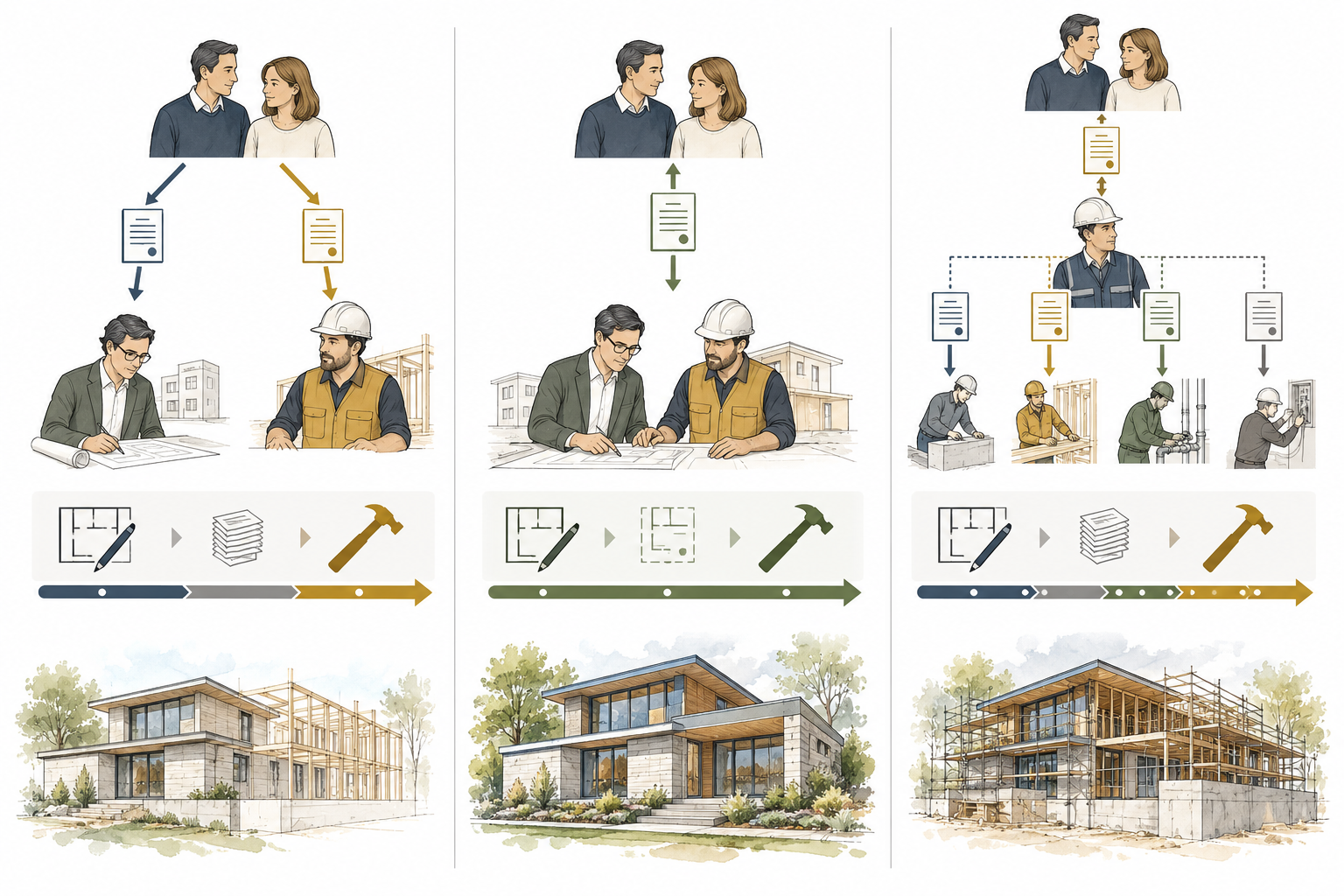
Three common patterns
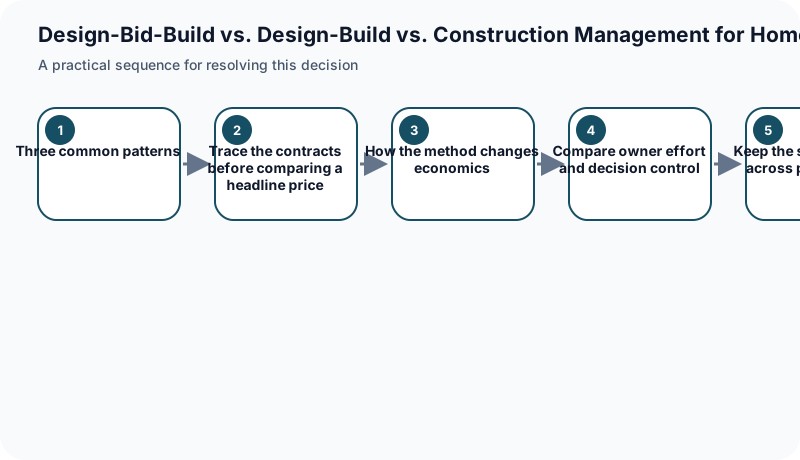
| Method | Basic relationship | Cost and responsibility question |
|---|---|---|
| Design-bid-build | Owner hires designer, then solicits construction bids | Can the completed documents produce comparable bids, and who handles the design-to-construction handoff? |
| Design-build | Owner has one contract with an entity responsible for both design and construction | How are design independence, changes, allowances, and single-point responsibility defined? |
| Construction management | A manager coordinates or manages construction; the contract structure determines whether it holds trade contracts and risk | Is the manager an adviser, agent, or at-risk contracting party? |
The AIA/AGC primer distinguishes design-bid-build, design-build, CM-at-risk, and CM-adviser by contract and risk relationships. CM-adviser is project management rather than the same structure as CM-at-risk. Residential providers may use the labels differently.
Trace the contracts before comparing a headline price
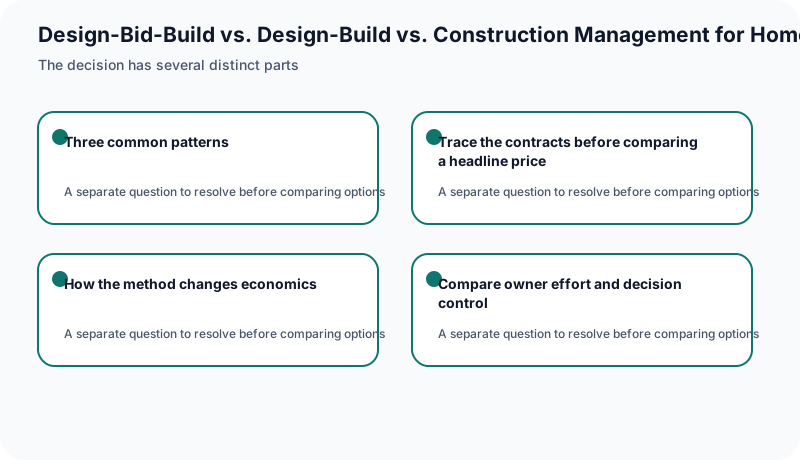
Draw a simple contract map: homeowner to designer, homeowner to builder, builder to subcontractors, and any direct owner contracts with engineers or suppliers. Mark who coordinates the work, who carries each design or construction responsibility, and who receives payment. A delivery label has little value if the actual contracts allocate tasks differently.
Ask when the price is established and how much remains an allowance. A design-bid-build project may reach competitive pricing after drawings are developed, while a design-build proposal may begin earlier with a target budget and allowances. A construction manager may advise on budget before trade contracts are set or may hold the trade contracts and different risk. Compare the timing and certainty of pricing, not just whether there is one contract or several.
How the method changes economics
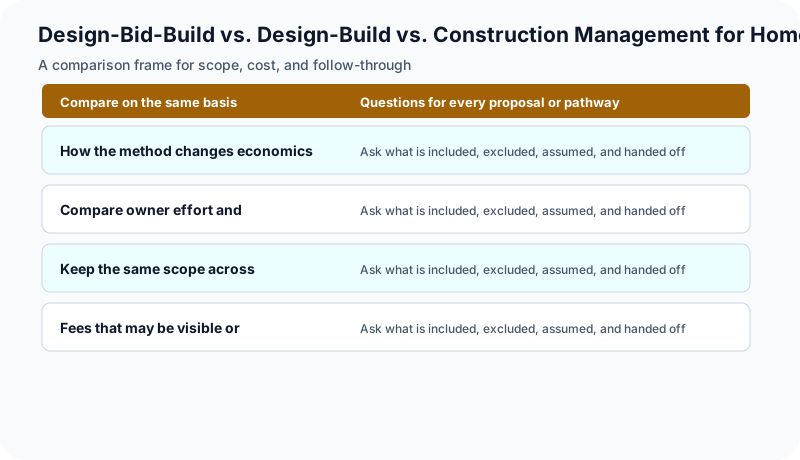
Design-bid-build can make design fees and construction bids visible as separate purchases. It may require more owner coordination and a complete document package before bidding. Design-build may allow design and construction to overlap and can reduce the number of owner contracts, but the owner should understand how pricing is developed, how substitutions are chosen, and who represents the owner’s interests. Construction management can add a professional coordination fee while offering more control or transparency, depending on the structure.
Overlap can accelerate decisions but also make scope and price harder to compare. Separate design can improve independence but can leave coordination gaps. The method itself does not prove a lower total cost.
Compare owner effort and decision control
Each structure asks the owner to make decisions at different times. Separate design can give the owner a clearer opportunity to review alternatives before construction pricing, but it may require managing the designer-to-builder transition. Design-build can coordinate design and construction earlier, but the owner should understand how selections, substitutions, and price changes are approved. Construction management can add planning and reporting but may leave the owner with several direct trade contracts.
Estimate the owner’s time as part of the practical cost. Who prepares meeting agendas, tracks submittals, compares changes, verifies invoices, coordinates access, and maintains the schedule? If those tasks are not assigned, they fall to the homeowner even if the contract name sounds comprehensive. An owner’s representative can help with owner-side coordination, but it is a separate fee and authority relationship.
Keep the same scope across proposals
When comparing delivery options, use a common project brief and identify design phases, engineering, permit drawings, fees, construction administration, preconstruction services, contractor overhead, insurance, taxes, allowances, and exclusions. A bundled proposal should still explain what it includes. A separate designer fee should not be counted as an extra if another option’s price also contains design work.
Ask how each structure handles changes, incomplete drawings, concealed conditions, delayed decisions, and a pause in construction. Compare who pays for rework caused by an error, what constitutes an owner change, and how the parties resolve a scope gap. Review the contract terms with an appropriate local adviser before signing.
Fees that may be visible or bundled
Any method can include design, engineering, estimating, permit preparation, construction administration, project management, contractor overhead, insurance, and trade work. A bundled price may be convenient but should still list deliverables, assumptions, allowances, exclusions, change rules, and permit responsibilities. A separate fee may look higher because it makes a service visible rather than because the project costs more.
Questions before choosing
- Who holds each contract with the owner and trade contractors?
- Who is responsible for design errors, coordination, and construction means?
- When is the price developed, and what remains an allowance?
- Are design, engineering, permits, inspections, and administration included?
- Who can approve substitutions and changes?
- How are conflicts, delays, and redesign handled?
- What is the owner’s role in decisions, payments, and quality review?
British Columbia’s permit overview shows that local authorities may require property information, site plans, architectural drawings, professional assurances, trade permits, and final inspection regardless of the delivery method. A design-build contract does not eliminate those external requirements.
Track permits and closeout across the contracts
Regardless of delivery structure, identify who prepares permit documents, submits applications, answers review comments, schedules required inspections, and confirms final closure. Authority fees, design documents, contractor work, and professional administration may be included in different contracts. Ask for a line-by-line allowance and the current official record rather than assuming one party has handled every requirement.
If work changes after permit issuance, identify who reviews the design, who submits the revision, who prices construction changes, and who confirms the authority’s response. If work pauses, name who monitors the permit status and related approvals. These are handoff questions that should be answered before a project starts, not after a deadline or inspection is missed.
Compare delivery options with the same decision brief
Give each provider the same project description, target budget, desired completion window, site information, and list of required outcomes. Ask each to show the phase fee, construction pricing method, allowances, owner responsibilities, and decision deadlines. If one option cannot provide a comparable number yet, ask what information must be completed first.
Create a responsibility matrix for design, permits, estimating, contractor selection, construction sequencing, change approval, inspections, and closeout. For each task, identify the lead, the person who approves, and the person who receives the record. This can reveal gaps that a simple price comparison misses.
Check the transition between phases
Ask who owns the project documents when moving from design to pricing, pricing to construction, or one contractor to another. Confirm whether the design professional will answer bidder questions and whether the builder can rely on the issued documents. Ask how early contractor input is reflected in the design and whether the owner can compare alternatives.
Agree on how changes and disputes are handled
Before signing, ask how a scope disagreement, design error, delay, or contractor default is documented and escalated. Identify who may request a change, who prices it, who checks design implications, and who approves the cost. Ask whether mediation, an independent cost review, or another dispute step is named in the agreements.
For a homeowner, the best arrangement is one where responsibilities can be explained in ordinary language. If a provider cannot state who decides, who pays, and who carries the record, get the contract clarified before work begins.
Revisit the structure if the project changes
An owner may begin with design-bid-build and later hire a construction manager, or start with design-build and engage a separate owner adviser. If the arrangement changes, list which contracts remain, who owns the drawings, who can direct work, and how existing fees are credited. A change of delivery method does not automatically transfer professional responsibility or permit approvals.
Ask the current team for a transition package with the budget, schedule, contract commitments, approved plans, permits, change orders, and open issues. Confirm that the new provider accepts the intended role before ending the old agreement.
The selected contracts should use the same project description and drawing issue so fees and responsibilities can be compared accurately.
Match the method to the project
A small defined job may not justify extensive management. A complex addition, custom home, historic project, or multi-disciplinary remodel may benefit from clearer coordination and phase responsibilities. If you need independent owner-side advice, read owner’s representative cost. If the main issue is the architect’s scope, read architect fees.
Choose the structure you can understand and administer. Make the contract relationships, decision authority, fee basis, design deliverables, construction responsibilities, and change process explicit before work begins.
Compare management effort as well as price
Delivery structures distribute coordination work differently. The owner should ask who obtains bids, checks design completeness, manages changes, coordinates consultants, reviews payment requests, and keeps the schedule current. A lower professional fee may leave more tasks with the owner, while a bundled arrangement may reduce handoffs but limit control over pricing or provider selection. Compare proposals using the same project scope and list every relationship among the owner, designer, builder, and manager. Ask how disputes, substitutions, and design changes are handled. The best fit is the arrangement whose responsibilities and decision process the owner can administer, not a label that sounds simpler.