
An owner’s representative or independent residential project manager works for the owner to coordinate information, budget, schedule, decisions, and communication. The service can be useful on a complex remodel, addition, restoration, or custom home, but the title is not consistently defined in the consumer market. Read the proposed duties and authority before comparing fees.

What the service may do
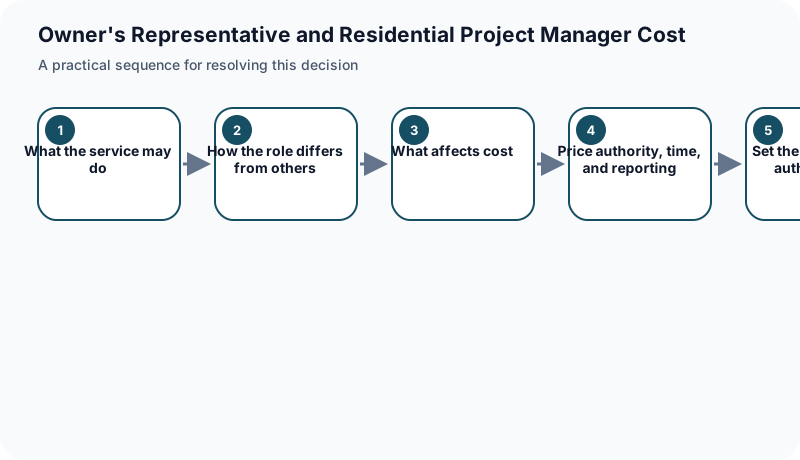
An owner-side manager may help with feasibility, consultant selection, estimating, bid comparison, schedule tracking, change review, meeting records, payment documentation, inspection coordination, and closeout. The person may coordinate professionals without taking responsibility for their design, and may coordinate contractors without supervising means, methods, safety, or workmanship.
How the role differs from others
| Role | Primary relationship or function |
|---|---|
| General contractor | Contracts for and manages construction under the building agreement |
| Architect | Design and possibly construction-phase administration under the owner-architect agreement |
| Owner’s representative | Advises and coordinates for the owner within a defined authority |
| CM-at-risk | A delivery structure in which the construction manager may hold trade contracts and risk |
| CM-adviser | Project-management role that does not necessarily hold the trade contracts |
| Independent inspector | Checks a stated condition or phase, not necessarily budget and schedule |
AIA’s project-delivery primer distinguishes design-build, design-bid-build, CM-at-risk, and CM-adviser by contract and responsibility. A provider may use these labels differently, so ask who contracts with whom and who can direct work.
What affects cost
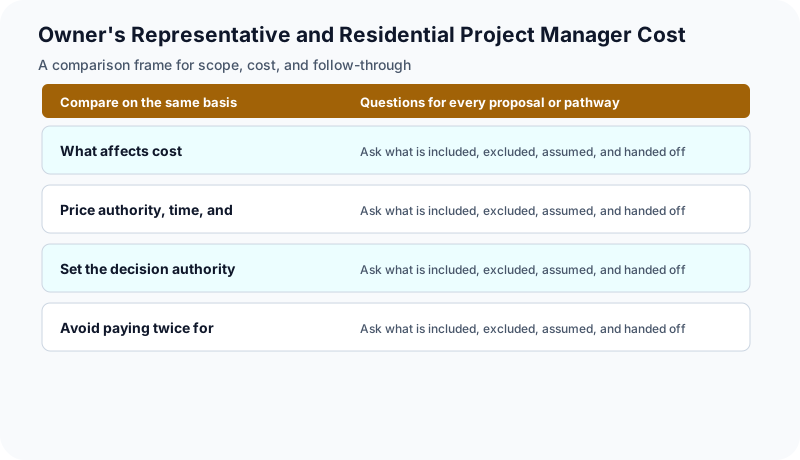
- Project size, duration, and complexity.
- Number of designers, engineers, contractors, and authorities.
- Owner’s desired meeting and reporting frequency.
- Preconstruction versus construction-phase involvement.
- Budget tracking, procurement, and payment-review depth.
- Site visits, travel, remote coordination, and documentation.
- Authority delegated to the manager and professional liability carried.
Fees may be hourly, fixed by phase, monthly, per visit, or a percentage. Current residential market rates are too inconsistent for a universal figure. Ask whether the manager’s fee is separate from design, contractor overhead, permit expediter, and inspection services.
Price authority, time, and reporting
An hourly engagement can fit a short advisory assignment but may be hard to budget if the project has no end date. A monthly fee can support regular coordination but should identify what happens during a pause or low-activity month. A fixed phase fee can make a defined bid comparison or closeout review predictable. A percentage fee should identify its cost basis and how it changes when construction scope changes.
Ask what the fee includes: meeting preparation, site visits, budget updates, contractor communications, change review, payment documentation, schedule reporting, and closeout. Confirm whether travel, rush work, extra meetings, and additional authorities are billed separately. Request a sample report or meeting log so you can see how the owner will receive decisions and unresolved issues.
Set the decision authority
An owner’s representative may advise, coordinate, or act as an agent, but those are not the same authority. State which decisions they can make, which require owner approval, and whether they may direct a designer or contractor. Ask who signs contracts, approves payment, accepts substitutions, and authorizes extra services.
If the representative also has a financial relationship with the contractor, designer, or supplier, disclose it in writing. Ask who selects trade contractors and whether the representative receives a commission, referral fee, or markup. The owner should understand whose interest the provider serves and who bears responsibility for any professional design or construction decision.
Avoid paying twice for overlapping roles
Compare the representative’s proposal with the architect’s construction administration, contractor project management, permit expediting, and independent inspection. Some coordination may overlap, but each role can address a different owner need. A representative can maintain the budget and decisions; an architect can interpret design documents; a contractor can coordinate means and sequencing; an inspector can review a specified condition.
Use a responsibility matrix to assign each task to one lead and identify who is consulted. If the representative will review contractor payment applications, clarify whether that means organizing backup, comparing progress with a schedule, or providing a professional certification. If they will inspect quality, define what credentials and methods apply.
When it may be worthwhile
The service can make economic sense when the owner is remote or time-constrained, the project has many interfaces, bids and changes need independent review, or decisions are costly to coordinate. It does not guarantee savings. A manager can improve information flow and decision discipline while still encountering hidden conditions, market changes, or owner changes.
Select the role before the project gets complicated
An owner’s representative can be most useful when hired before bidding or early in construction, while scope and decision processes can still be organized. If hired after a dispute begins, the provider may first need to reconstruct the budget, contracts, and approval history. Ask whether the fee includes that diagnostic work and what the first deliverable will be.
For a remote owner, specify the frequency of site reports and which issues require immediate escalation. For an owner with limited construction experience, ask how the representative explains options and records approvals. For a project with several consultants, ask how the representative will coordinate without substituting for each licensed professional.
Use concrete measures of value
Set expectations that can be evaluated: current budget and commitment log, schedule updates, documented decisions, open-issue list, bid comparison, or closeout checklist. Do not promise that the representative will save a fixed percentage or prevent every change. Their value is improved coordination and informed decisions, while design conditions, contractor pricing, and owner choices can still change the total.
Check experience and conflicts
Ask what residential project types the representative has managed, which contract structures they know, and how they document budget and change decisions. Request references for a comparable project and ask what the role did, not only whether the project finished on time. Confirm local knowledge if the representative will coordinate permits or authority meetings.
Ask whether the representative has a relationship with a contractor, designer, supplier, lender, or property manager. The owner should know about referral payments, commissions, or other incentives that could affect recommendations. Ask how confidential financial and contract information will be stored and shared.
Define an exit and record handoff
The agreement should state how either party may end the service, what fees are due at that point, and which records the owner receives. Require a current budget, open-issue list, decision log, schedule, and contact list at handoff. This allows a new representative or the owner to continue without reconstructing the project.
Ask whether the representative carries professional liability coverage and what services it covers. Insurance does not replace a clear scope or guarantee project outcomes, but it is part of assessing the provider’s professional arrangement.
Protect the owner’s decision rights
If the representative is authorized to communicate for the owner, state whether they can only relay information or may approve a scope, cost, payment, or schedule change. Require owner approval for decisions above a stated threshold if that suits the project. Give the representative written authority to request information, but do not create an unclear second chain of command for the contractor.
Ask how the representative will identify a conflict between the owner’s goals, the architect’s design, and the contractor’s price. A useful report should present options and consequences, not silently make the decision for the owner.
Keep the role aligned with the owner’s capacity
An owner who is available for routine decisions may need a representative only for bid review or periodic budget checks. A remote or time-constrained owner may need regular site and schedule reporting. Ask the provider to offer a limited option and a fuller option, then compare the extra fee with the owner’s ability to perform those tasks.
The representative should not make the project more complicated than necessary. Use a clear weekly or monthly reporting format and escalate only decisions that need the owner’s approval. If the reporting burden grows, adjust the scope in writing.
Review the reporting format during the first month and adjust the scope if it does not answer the owner’s decisions.
Questions to put in writing
- What decisions may the manager make without owner approval?
- Are they an adviser, agent, or contracting party?
- Who selects and directs contractors and consultants?
- Are budget, schedule, quality, safety, and payment duties separate?
- How often are site visits and reports provided?
- What conflicts arise if the manager also designs or builds?
- What happens when the project is delayed or paused?
For architect-specific construction support, see architect CA fees. For the contractual organization of the whole project, see project delivery methods.
Protect decision authority in writing
The owner and representative should agree how recommendations become decisions. A useful agreement identifies spending limits, approval steps, reporting frequency, document access, conflict disclosures, and the process for urgent field issues. If the representative also has a design, construction, or procurement role, state how that relationship affects advice and compensation. Ask whether the fee changes when the project is delayed, redesigned, or paused, and what handover materials the owner receives at the end. A clear governance arrangement can reduce confusion, but it does not remove the owner’s need to review major commitments or the contractor’s responsibility for its own work.