
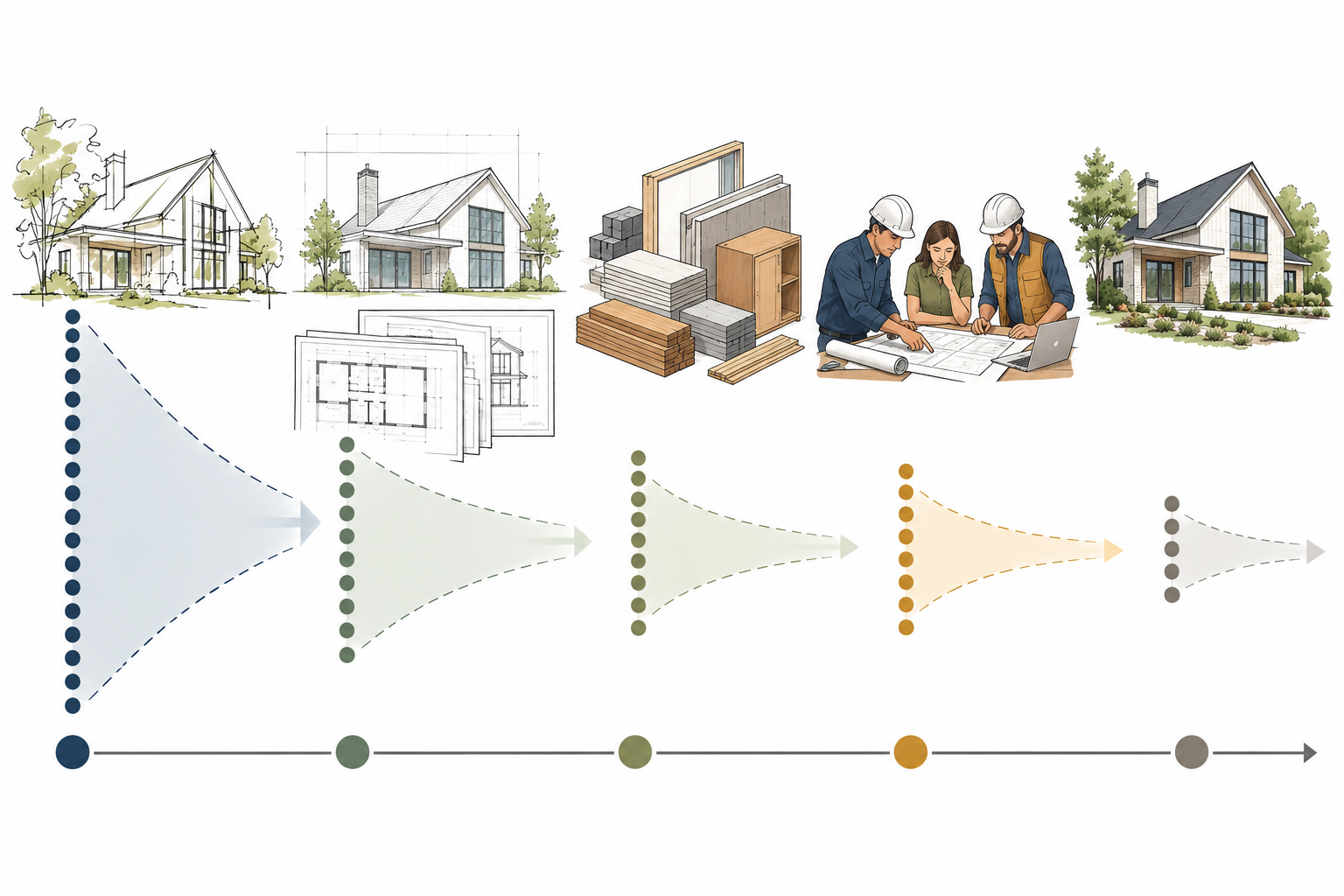
An estimate is a forecast based on the information available at a particular design stage. Preconstruction services can add scope review, quantity takeoffs, trade input, constructability checks, scheduling, procurement planning, and design-stage cost control. None is automatically a guaranteed bid.
Estimate types are not interchangeable
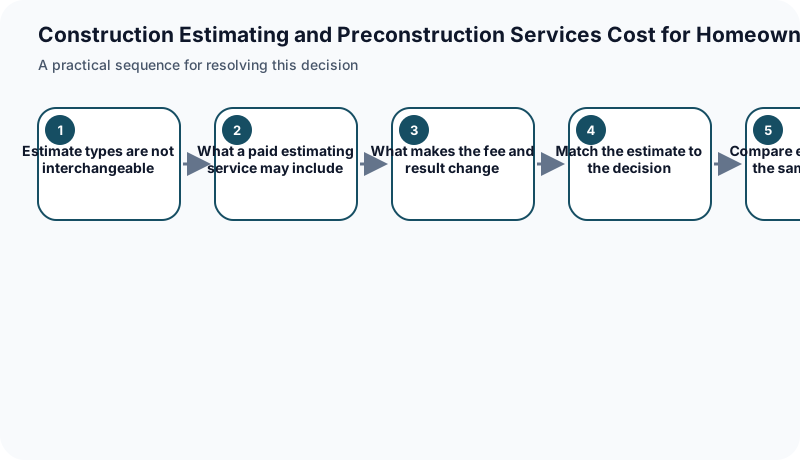
- Early order-of-magnitude estimate: A broad allowance used to test whether an idea is worth developing.
- Design-stage estimate: A cost check based on drawings that are partly developed.
- Quantity takeoff: A measured list of materials or work quantities, often priced separately.
- Contractor preconstruction: Trade input, constructability, scheduling, procurement, and sometimes an eventual proposal.
- Bid: A contractor’s offer under its stated assumptions, exclusions, and validity period.
The more complete the design and site information, the more specific the estimate can be. More precision in a spreadsheet does not eliminate market, scope, or existing-condition uncertainty.
What a paid estimating service may include
The provider may review drawings, measure quantities, apply labor and material pricing, identify allowances, compare options, and flag missing scope. An architect can use cost feedback during design. A contractor may provide preconstruction input before agreeing to build. An independent estimator may supply a separate check, but the contract should state its assumptions and level of detail.
Public residential pricing is fragmented. The fee can be hourly, a fixed phase fee, a percentage, a minimum charge, or folded into a later construction agreement. Ask whether the cost includes one estimate, updates after design changes, trade outreach, site visits, taxes, and a written report.
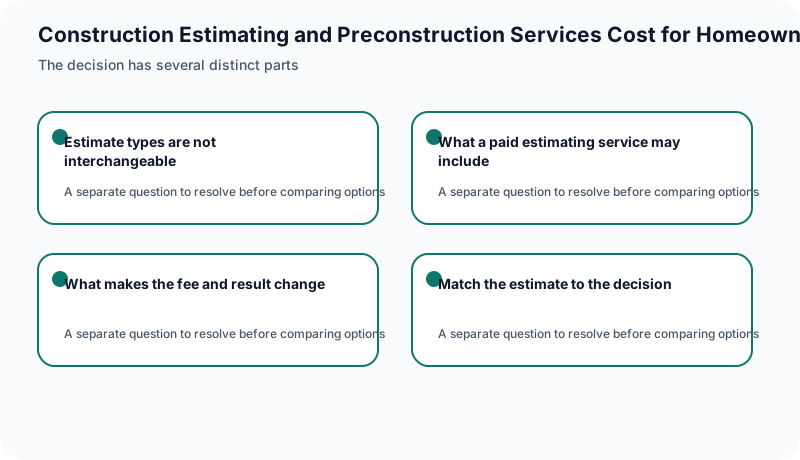
What makes the fee and result change
- Completeness and detail of drawings.
- Existing-condition uncertainty and need for field verification.
- Number of trades and consultants.
- Geographic market, access, logistics, and seasonal timing.
- Material selections, allowances, and performance requirements.
- Options, alternates, phasing, and value-engineering scenarios.
- Number of revisions and time between estimate updates.
The estimate should identify exclusions such as permits, design fees, engineering, temporary housing, financing, taxes, utility work, landscaping, and owner-supplied items. Compare like scope.
Match the estimate to the decision
An early allowance can tell you whether a concept deserves more design; it is not a contractor commitment. A design-stage estimate can help compare options while there is still time to change them. A bid based on a complete package can support contractor selection, but it remains subject to its terms, exclusions, and validity period. Ask the estimator to label the estimate type and intended use.
The estimate should identify its drawing issue, site assumptions, material basis, labor market, quantities, and date. Ask how the provider handles unknown existing conditions, escalation, taxes, permit fees, utility work, temporary protection, and owner-supplied items. A precise spreadsheet based on incomplete plans can be less useful than a broad range that clearly names its uncertainty.
Compare estimates on the same scope
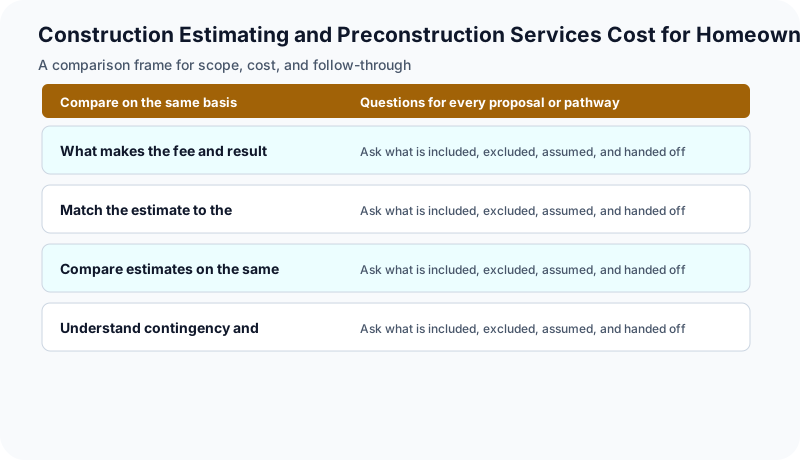
When two estimates differ, first align the scope. Check the plan issue, work area, finish level, allowances, demolition, disposal, protection, contractor overhead, general conditions, taxes, permits, and schedule. Ask each provider to list exclusions and optional items. A low total may simply omit engineering, site work, inspection support, or temporary accommodation.
Use alternates for meaningful decisions rather than hiding them in one blended total. For example, separate base scope from an optional finish upgrade or later phase. If a project may create a new dwelling unit, keep the authority’s possible growth charge, utility capacity work, and building permit fees as distinct allowances. Development charges and impact fees explains why a permit estimate alone may not resolve that item.
Understand contingency and confidence
Ask what a contingency covers and who controls it. A contingency for concealed conditions is different from a design allowance, a material-price allowance, and owner-requested changes. A contingency does not replace missing scope, and it should not be counted twice in both the estimate and the owner’s reserve.
The estimator should explain which quantities are measured, which prices are current quotes, and which are allowances. Ask what new information would narrow the range and what assumptions could make the estimate stale. If an estimate depends on a later survey, engineering report, or authority response, write that dependency beside the number.
Decide when an independent check is useful
An independent estimate may be worth paying for when bids are widely spread, the design is unusual, the proposed contract is large relative to the owner’s budget, or a decision must be made before full construction documents. It may be premature when the owner is still changing the basic program or the plans do not show enough information to quantify work.
Give the independent estimator the same documents and bid scope as the contractors. Ask whether they will compare each proposal, conduct a quantity takeoff, call trade contractors, or only review broad allowances. A consultant can identify missing assumptions without guaranteeing what a contractor will bid.
Update the estimate when the design changes
Record the drawing issue, site information, finish assumptions, and estimate date. If the owner changes the footprint, structural system, equipment, or finish level, ask which estimate lines must be updated. A targeted update may be enough; a major scope change can make the previous estimate misleading.
Ask the estimator how often labor and material prices are refreshed and what happens if a contractor’s quote expires. Keep a separate allowance for escalation only when the estimate explains its basis and time period. Do not add a blanket inflation percentage to an already current contractor proposal without checking whether escalation is already included.
Use estimating to make a decision
A design-stage estimate should help answer whether to advance, reduce, phase, or reconsider the scope. Ask for the cost driver behind each large line and which alternatives could change it. If the answer is that information is missing, identify how much it costs to obtain a survey, engineering study, or trade quote.
Estimates can also expose choices with different operating or maintenance implications. Ask the provider to separate first cost from optional performance upgrades and lifecycle assumptions. Do not accept “value engineering” as a vague promise to cut cost; request a defined option and its effect on function, durability, approvals, and schedule.
Keep estimates tied to a dated scope
Save the drawings, specification, site assumptions, estimate, and clarifications as one version. When a revised estimate arrives, mark what changed and whether previous allowances were removed or carried forward. This avoids counting a deleted scope item twice or comparing a new bid with an old design.
Ask the estimator to show a cost summary by work category and identify the largest allowances. Request a brief written explanation of material exclusions and owner decisions still needed. If a cost appears unusually high, ask whether it reflects quantity, labor, access, uncertainty, or schedule; that answer determines whether redesign can help.
Do not use an estimate as a contract
An estimate can support planning but may not include the contract terms, payment schedule, insurance, change process, or contractor commitment. Before signing construction, compare the final agreement with the priced scope and resolve differences. If the contractor relies on allowances, write down when each will be selected and how overages are approved.
Use a decision log for estimates
Record the estimate date, drawing version, included scope, owner decisions, allowances, exclusions, and provider. When a number changes, note whether the reason is a revised quantity, current price, changed scope, or corrected assumption. This makes the estimate useful for budget decisions and contractor discussions.
Ask the provider to identify which decision would most improve confidence. A survey or engineering report may narrow one risk while leaving market pricing uncertain. Do not pay for additional estimating detail unless it will change a decision.
Ask the estimator to label a preliminary amount clearly and state what additional documents are needed to turn it into a more reliable bid comparison.
If the estimate is tied to financing or a lender, ask the recipient for its required format and contingency treatment before commissioning the work.
Show the estimate’s validity date and ask the provider to identify any conditions that could make the amount stale.
When paying for another estimate helps
An independent check can be valuable when bids differ sharply, the project is large, the design is unusual, the contractor has a financial interest in the outcome, or a budget decision must be made before final documents. It is less useful when the drawings are too incomplete to price or the owner has not defined the desired scope.
Ask what decision the estimate will support and what confidence level is reasonable. If the result exceeds budget, redesign after bids covers next steps. If the bigger issue is the stack of early services, read preconstruction soft costs.
Improve estimate usefulness
Give every estimator the same dated drawings, specification assumptions, site information, and inclusions. Ask for quantities or a clear basis, exclusions, allowances, escalation assumptions, and a list of unresolved decisions. A total without that context is difficult to compare and can create false confidence. If the project is early, request ranges tied to explicit options rather than a single precise-looking figure. Decide who will update the estimate when design choices change and how long the pricing information is expected to remain useful. This separates the estimator’s professional fee from the construction budget and helps the owner tell whether a later increase reflects new scope, changed prices, or a more complete estimate.