
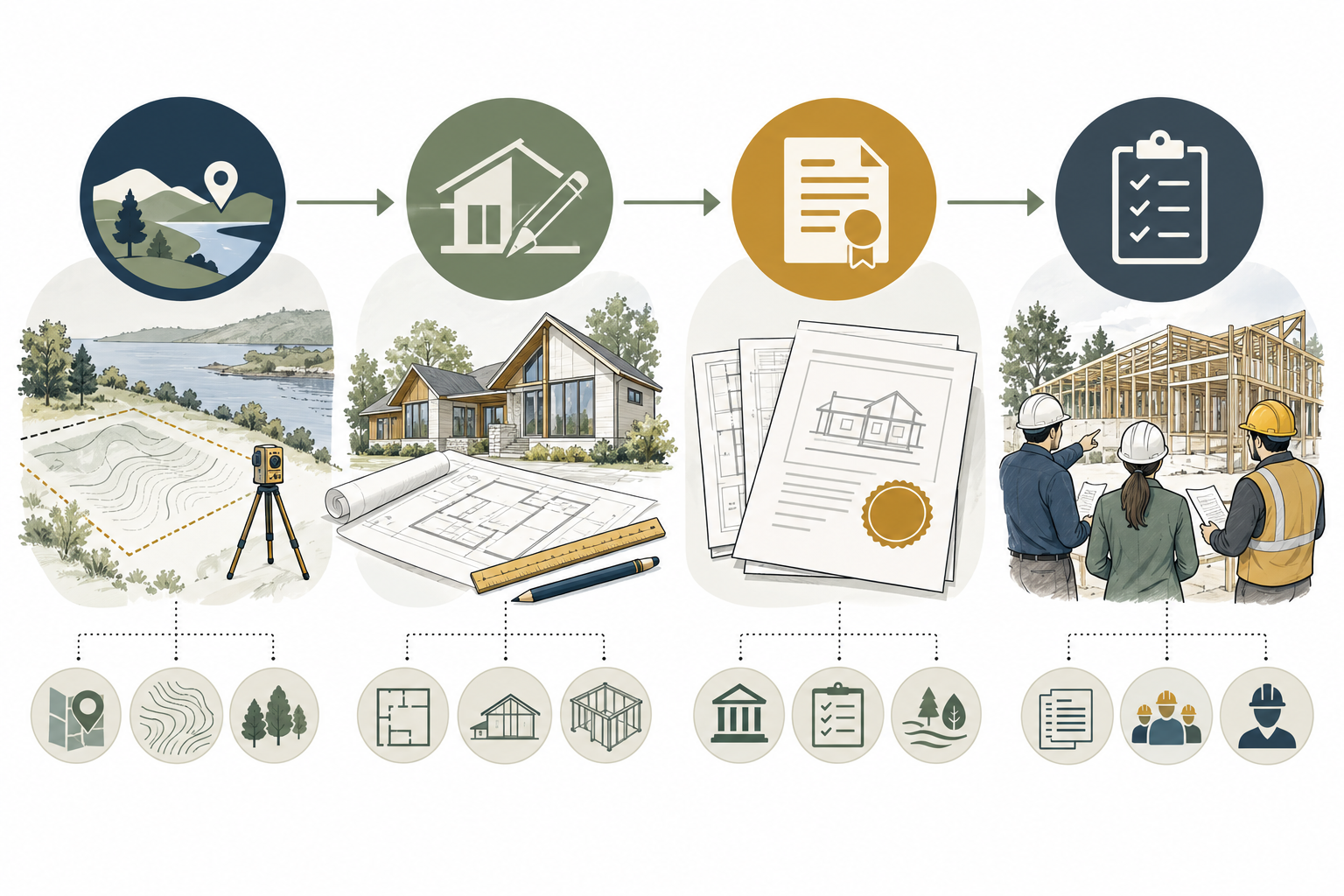
A contractor’s construction quote is not always the same thing as the amount of cash a project needs before it is finished. You may also pay for design, engineering, surveys, testing, permits, planning review, estimating, legal or consultant support, and project administration. These are often called soft costs because they are professional or administrative services rather than the physical work itself.
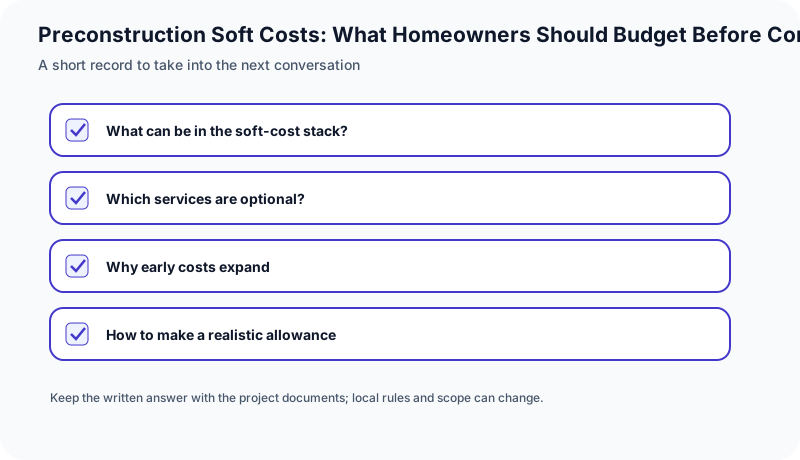
What can be in the soft-cost stack?
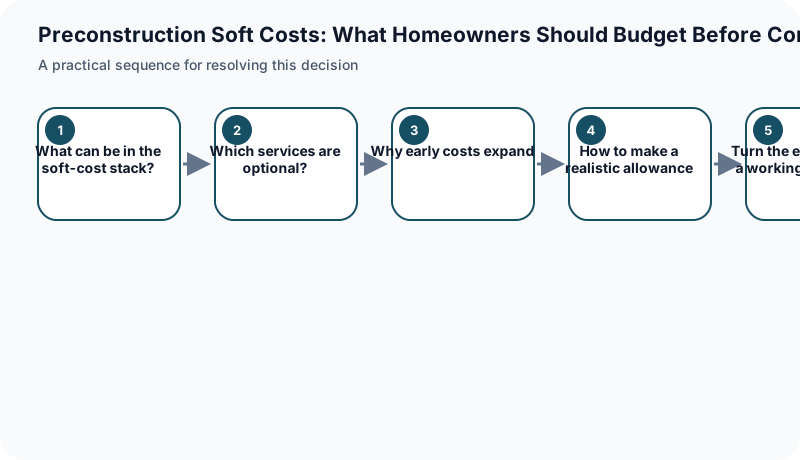
The stack depends on the project. A small interior repair may need only a permit and a professional inspection. An addition or new house can involve several of these lines:
| Possible cost | What it answers |
|---|---|
| Feasibility or zoning review | Can the idea fit the property and local rules? |
| Existing-condition documentation | What is actually there, and how accurately is it known? |
| Architectural design | How should the project be organized and documented? |
| Structural, MEP, civil, or geotechnical engineering | Can the proposed structure, systems, or site work be designed and supported? |
| Survey or site information | Where are boundaries, grades, utilities, and relevant features? |
| Permit and planning fees | What does the authority charge to accept and review the application? |
| Estimating | What might the documented scope cost in the current market? |
| Construction-phase administration | Who interprets documents, reviews submittals, or helps with payment and changes? |
| Owner-side coordination | Who protects the owner’s interests across designers, contractors, and authorities? |
The list is not a checklist that every project needs. Treat it as a prompt for asking what has been included, excluded, or left for later.
One allowance that is easy to miss is a growth-related public charge. Some authorities assess a development charge, impact fee, or system development charge when a project meets a local growth trigger. Whether one applies depends on the address, existing legal use, proposed scope, and local rules; the word “addition” or “ADU” alone cannot determine it. Keep this possible liability separate from a building-permit application fee, a utility connection, physical site work, and recurring service bills. Development charges and impact fees covers the separate applicability and relief decision.
For an early budget, use a named placeholder only when the project may add a dwelling, increase demand, or change use. Label it “authority determination pending,” record who will request that determination, and show the gross possible amount separately from any unconfirmed credit or incentive. Do not enter zero merely because the permit estimator does not show a charge, and do not use a large generic contingency to conceal an unverified local obligation.
Which services are optional?
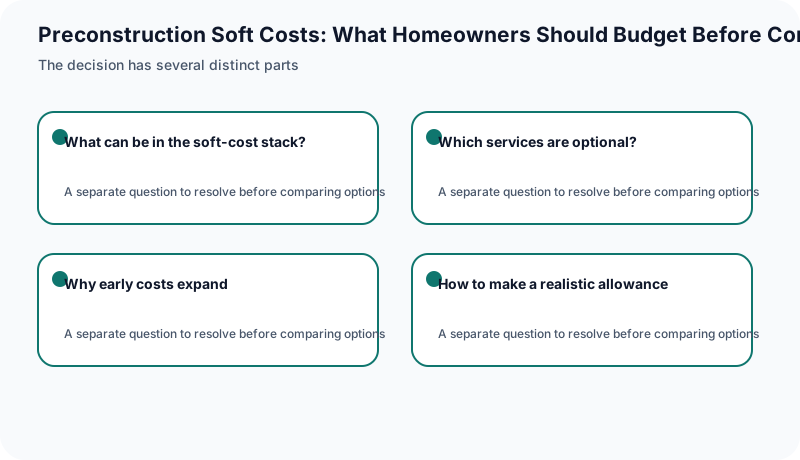
“Optional” usually means project-dependent, not unnecessary. A feasibility consultation may be sensible before an addition but excessive for replacing a like-for-like fixture. A topographic survey can be important for a sloped-site addition and irrelevant to an interior remodel. Independent construction inspection may add value when the owner cannot attend critical stages, but it does not replace municipal inspections or the design professional’s responsibilities.
The authority having jurisdiction decides its own application requirements. In Ontario, for example, the provincial guide describes permits, plans, fees, inspections, and other applicable approvals but directs homeowners to the responsible local authority. British Columbia’s overview similarly describes a typical package while emphasizing local requirements. These examples show why a national soft-cost percentage is a poor substitute for a project-specific scope.
Why early costs expand
Uncertainty is the main multiplier. An older house with incomplete records may need field measurements before design. A foundation alteration may require a structural inspection, calculations, and drawings rather than one short visit. A steep or poorly documented lot can add survey, geotechnical, or civil work. A zoning constraint can require a formal application, hearing, or revised design. A permit comment can create professional redesign and another review fee.
These costs can be connected without being the same cost. A survey does not become engineering. A permit fee does not buy permit drawings. A contractor’s estimate does not guarantee a bid. A structural report does not automatically include engineered repair plans.
How to make a realistic allowance
Start with a scope map rather than a single percentage:
- Define the decision you are trying to make now: feasibility, design, permit application, bidding, or construction administration.
- Ask each provider for deliverables, assumptions, number of meetings or site visits, revision limits, consultants, and exclusions.
- Separate government fees from professional fees and physical construction.
- Add a contingency for unknown existing conditions and for owner-requested changes, but do not use one contingency to hide missing scope.
- Keep U.S. and Canadian prices in their own market context. Do not convert a U.S. fee into Canadian dollars and present it as a Canadian estimate.
Turn the estimate into a working allowance
Keep a simple budget register with the service, amount or range, basis, decision needed, due date, responsible person, and confidence. A survey might be a quoted amount with a known feature list. A zoning review may be an open allowance until staff confirms the process. A possible infrastructure charge might remain a gross placeholder until the authority verifies the project class. This makes the uncertainty visible without treating every unpriced item as a contingency.
Update the register after each decision. When a provider confirms the scope, replace the early placeholder with the fee and exclusions. When the authority provides a charge calculation, record its rate date and payment milestone. When a contractor revises the scope, check whether consultant hours or municipal fees change too. If a risk is removed, remove the duplicate contingency rather than spending the reserve automatically.
What a low construction quote may leave out
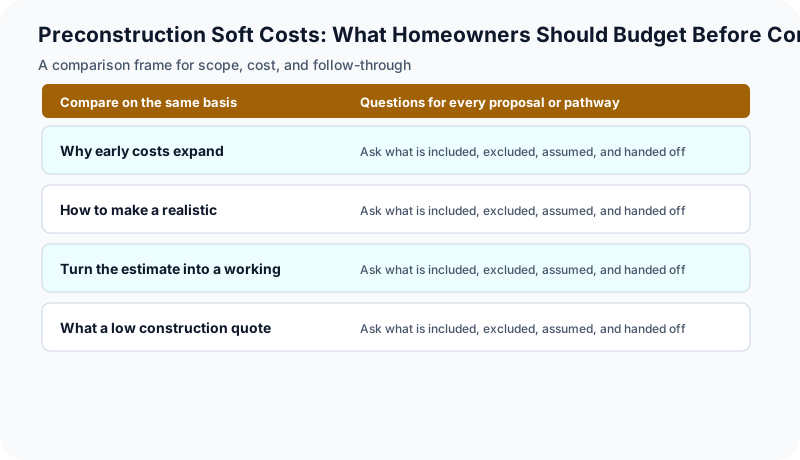
A low quote may be valid for the contractor’s stated work while excluding drawings, permit fees, engineering, temporary protection, testing, utility coordination, or construction-phase administration. Compare “total project cost” only after checking whether every proposal includes the same design stage, site information, permit handling, inspections, taxes, and closeout work.
The best soft-cost budget is therefore a set of named allowances tied to decisions and deliverables. It will be less tidy than a national rule, but it is much more useful when you are deciding whether to proceed.
Stage the allowance as the project becomes clearer
Early estimates should name what is known and what could change. A feasibility-stage allowance may be a range or an explicit unknown because the legal use, design, or service area has not been confirmed. After the authority reviews the site and scope, replace that placeholder with its written calculation, conditions, and due date. After permit issuance, reconcile the estimate against invoices and keep approved changes with the project record.
This staged method prevents three common errors. First, it avoids treating the earliest rough estimate as a guaranteed final bill. Second, it avoids carrying the same risk in both a municipal-fee allowance and a general contingency. Third, it makes clear which decision is blocking a reliable budget: a survey, title or permit-history record, utility inquiry, authority classification, or professional scope.
For each line, record the basis, decision owner, expected timing, confidence, and next action. A quote from an architect may cover plans and correction responses but exclude government fees. A contractor may include permit pickup but not project-specific development charges. An authority may identify a potential credit but require proof of prior use before applying it. These are different responsibilities and should not be collapsed into a single soft-cost percentage.
Check proposals against the same scope
When two professionals quote different fees, compare the same stage and deliverable. One may include a survey, authority meeting, or correction response while another assumes those tasks are owner-supplied. Ask each provider to identify the next fee that is likely after its scope ends. This prevents a low first-phase price from appearing to cover the full path to construction.
Write down the scope version and date beside every estimate. If the property information, design, unit count, or approval route changes, update the allowance register. Keep invoices and decisions with that version so a later estimate does not silently inherit outdated assumptions.
Compare complete project scenarios
For a remodel that does not change the home’s use, the early stack might include measurement, design, structural review, permit drawings, application fees, and inspections. An addition can add a survey, site or drainage review, zoning work, utility coordination, and more plan review. A new dwelling unit can require all of those plus a separate inquiry about growth-related charges, credits, service connections, and any conditional program. These are illustrations of possible scope, not universal packages.
When comparing options, show the incremental cost of each option. For example, a design with an extra unit should be compared with the base design using the authority’s confirmed classification and payment timing, not by assuming that the unit is either free of charges or automatically charged at a published maximum rate. If relief is conditional on a rental term or other recorded agreement, show the obligation alongside the apparent saving.
The strongest budget is not necessarily the one with the narrowest range. It is the one that tells you which unknown could change the proceed-or-redesign decision and what it will cost to resolve that unknown.