
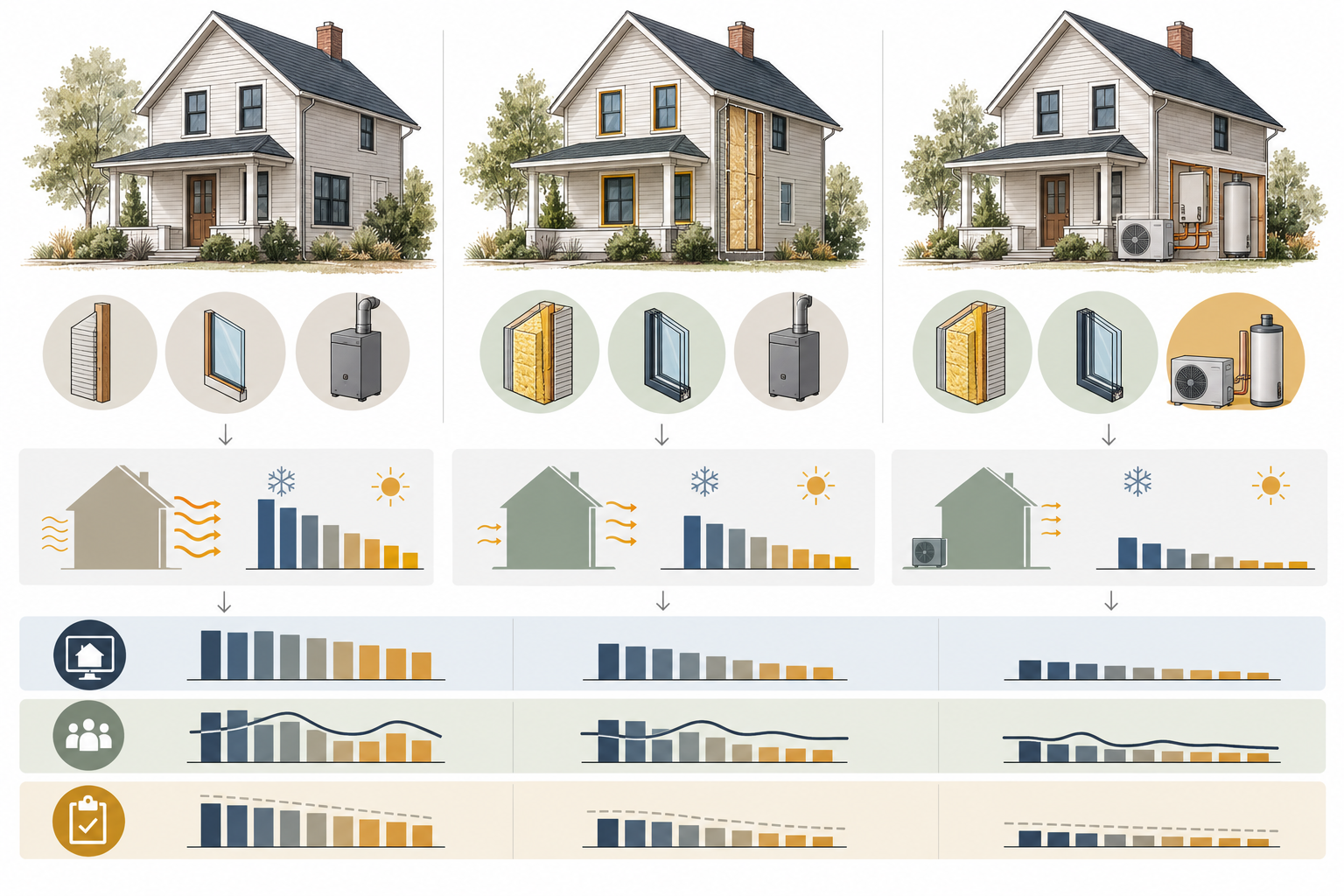
Home energy modeling estimates how a proposed building design or retrofit may perform under stated assumptions. It can support code compliance, high-performance design, equipment coordination, retrofit comparisons, or a certification program. It is not the same as an energy audit, an equipment quote, or a guarantee of future utility savings.
Different services use the same label
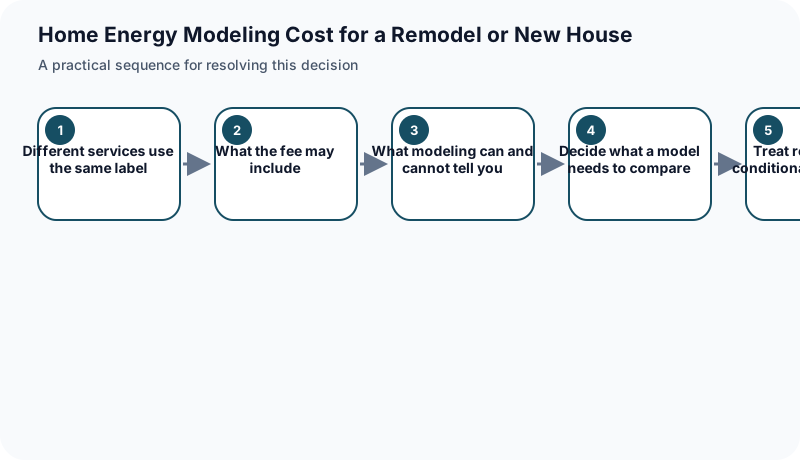
- An energy audit examines an existing home and identifies observed opportunities, often with testing and recommendations.
- A compliance calculation checks a design against a specified code or program method.
- A rating or certification model supports a program’s required inputs and verification.
- A retrofit model compares enclosure, equipment, fuel, or operating scenarios.
- A detailed simulation explores interactions among climate, envelope, systems, schedules, and controls with more inputs and assumptions.
Ask which of these you are buying. A simple compliance calculation should not be compared with a whole-building model prepared to test several retrofit strategies.
What the fee may include
The provider may collect plans, assemblies, windows, equipment assumptions, climate data, occupancy schedules, utility information, and program requirements. Deliverables may include modeled loads, compliance documentation, scenario comparisons, design recommendations, a report, or program submissions. Revisions can be needed when the floor plan, insulation, windows, HVAC, or controls change.
Public residential pricing is fragmented, so there is no reliable universal range. Cost depends on the model type, size and geometry, quality of inputs, number of scenarios, program deadlines, field verification, software, and revisions. U.S. and Canadian quotes should remain in their own market context.
What modeling can and cannot tell you
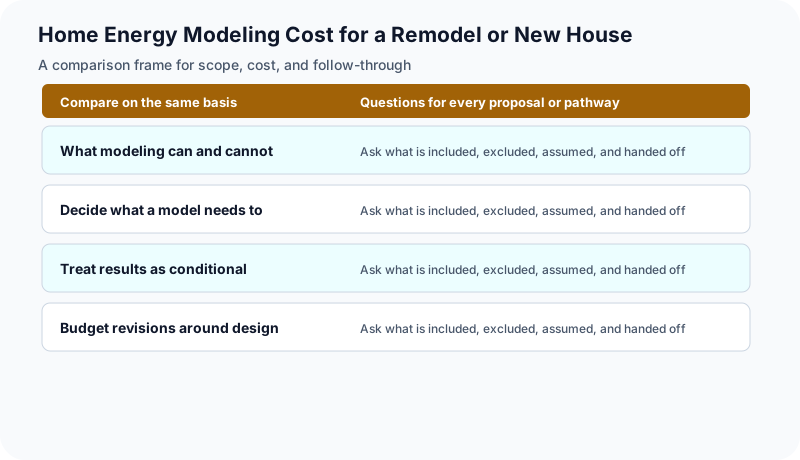
A model can make assumptions visible and help compare options. It can identify interactions such as the effect of enclosure changes on loads or the effect of electrification on system sizing. It cannot guarantee actual bills, comfort, equipment performance, or occupant behavior. Results are only as useful as the inputs and method.
Do not use a modeled result as permission to install equipment without complying with the applicable design, electrical, mechanical, fuel, or permit requirements. Modeling is analysis; installation and verification remain separate.
Decide what a model needs to compare
The cost depends partly on how many decisions the model will inform. A code calculation for one defined design may need fewer scenarios than a retrofit study comparing insulation, windows, heating equipment, fuel, and controls. Ask the provider to list the baseline case, each alternative, and the output that will be compared. If the owner is choosing between two designs, a single model of only the preferred design may not answer the economic question.
Inputs can include geometry, assemblies, air leakage, windows, shading, equipment, ventilation, occupancy, schedules, utility rates, and climate data. Some values may be measured, while others may be default assumptions. Ask which inputs materially affect the result and whether the provider will identify uncertainty. If the building is existing, a field visit or test may improve information but add cost.
Treat results as conditional estimates
A modeled annual energy result depends on the method, weather file, occupancy assumptions, setpoints, equipment performance, and user behavior represented. Ask the modeler to show which assumptions are fixed and how changing them affects the comparison. If utility-bill savings are reported, ask whether the model accounts for rate structure, fuel changes, operating schedules, and the cost of new equipment. A model is not a promise that future bills will match the modeled result.
For a decision between retrofit packages, compare both the modeled performance and the cost of the associated work. The energy modeler may not prepare contractor pricing or determine whether a system fits the electrical service. Keep modeling, MEP engineering, utility incentives, construction work, and commissioning in separate scopes. A lower modeled energy use does not prove a lower total project cost.
Budget revisions around design milestones
The fee proposal should say which design version is being modeled and how many updates are included. If the owner changes window area, insulation, orientation, HVAC, ventilation, or operating assumptions, the model may need another run. Ask whether the provider can update only affected inputs or must rebuild the whole model.
Coordinate the work before major design choices are locked. A model prepared early can compare options, but it may need updating as drawings become more detailed. A late model may be accurate to the design but arrive too late to change costly decisions. Ask for the required inputs and delivery date, and assign someone to provide them.
Use the model to compare an actual choice
The model is most useful when it compares a defined baseline with a small number of realistic alternatives. For example, an owner might compare a proposed enclosure upgrade with the same floor plan and equipment basis, or test how a system choice interacts with a planned addition. Ask the modeler to identify the variables that change and those held constant. If several options change at once, it may be difficult to know what caused the difference.
Ask whether the model will report loads, energy use, compliance status, relative performance, or an estimated bill. These outputs are not equivalent. A compliance result may show that a design meets a named method, while an annual bill estimate adds assumptions about schedules and rates. Ask which decisions the report does not answer, such as electrical service capacity, equipment installation cost, indoor air quality, or contractor availability.
Review the inputs before paying for revisions
Request an input summary before the final run. Check building area, orientation, window and wall assemblies, equipment, ventilation, occupancy, and schedules against the current design. Correcting a wrong input may be more valuable than adding another scenario. Ask the modeler to flag defaults and identify which measurements would materially improve the result.
Tie updates to design milestones. One revision after schematic design may be sufficient for an early comparison; a later permit version may require an update because geometry or equipment changed. Ask whether the model can be transferred to another professional and what file or report is delivered.
Compare the cost of more than one scenario
Ask the provider to show which design choices the model can fairly compare. A baseline and one alternative may be enough to decide whether to change insulation or equipment; a whole-home retrofit package may need several coordinated runs. Too many scenarios can add cost and make the result harder to interpret. Select the options that are still available to the project rather than modeling choices already ruled out by budget or site constraints.
For each scenario, ask whether the provider holds weather, occupancy, schedules, utility rates, and equipment assumptions constant. A useful comparison changes one group of inputs at a time or clearly explains when several changes are bundled. Ask for the reported uncertainty or sensitivity, not only a single annual energy number.
Plan how the model connects to design and construction
State who will update the model if the window schedule, wall assembly, or equipment changes. Ask whether the architect or engineer can use the results directly and whether the provider will attend a coordination meeting. The model may inform system sizing, but the MEP designer remains responsible for the engineering scope they accept.
If a certification or incentive is the goal, confirm who submits the model and what verification is required after construction. Keep the model fee, program fee, equipment and envelope construction, and post-installation testing separate. A modeled improvement does not itself prove that the installed building achieves it.
Make assumptions useful to the owner
Ask the modeler to include a short input and assumption summary with the result. The owner should be able to see what design version was analyzed, what was measured, which defaults were used, and which questions remain. If a contractor or utility will rely on the output, confirm they accept the method and file format before paying for a final run.
Keep the model file, report, and current drawings together. When the design changes, note whether the change affects a modeled input or is outside the model’s scope. This helps a later reviewer distinguish an old estimate from the current project.
If the model will support a rebate or certification, ask the program administrator to confirm its accepted method and deadline. Do not assume an energy model alone qualifies the owner for an incentive.
Questions for a proposal
- What decision will the model support?
- Which software, method, program, or code path is being used?
- What plans, field data, assemblies, and equipment information are required?
- How many scenarios and revisions are included?
- Are site verification, testing, certification, or program fees separate?
- What assumptions are uncertain or defaulted?
- Will the output be usable by the architect, engineer, contractor, utility, or program administrator?
An energy model may be coordinated with architectural and MEP work, but it does not replace either. A commissioning provider later tests installed performance; see residential commissioning cost. For physical upgrades, follow the relevant system category rather than treating the modeling fee as the retrofit cost.
Plan for model updates
A model is only as useful as the project information it receives. Identify who will provide envelope assemblies, window specifications, equipment selections, operating assumptions, and site conditions, and agree on how substitutions will be handled. A design change can affect results and may require another run; ask whether the proposal includes updates at a defined milestone or charges each time. Clarify the format of the deliverable and who interprets it for the owner. Where a program or code path requires a particular model, confirm the approved method and documentation directly with the program administrator or authority before commissioning the work.