
The least expensive person who can draw a plan is not always the right person to solve the problem. “Architect,” “residential designer,” and “drafter” describe different services in common use, but the latter two terms do not have one consistent legal meaning across the United States and Canada.

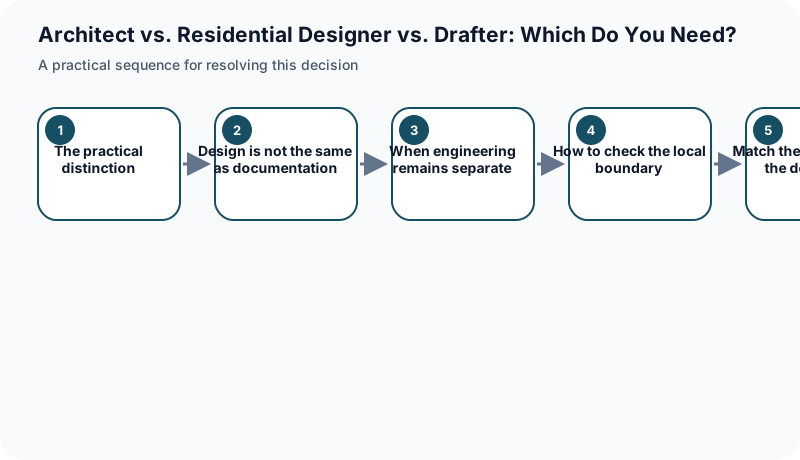
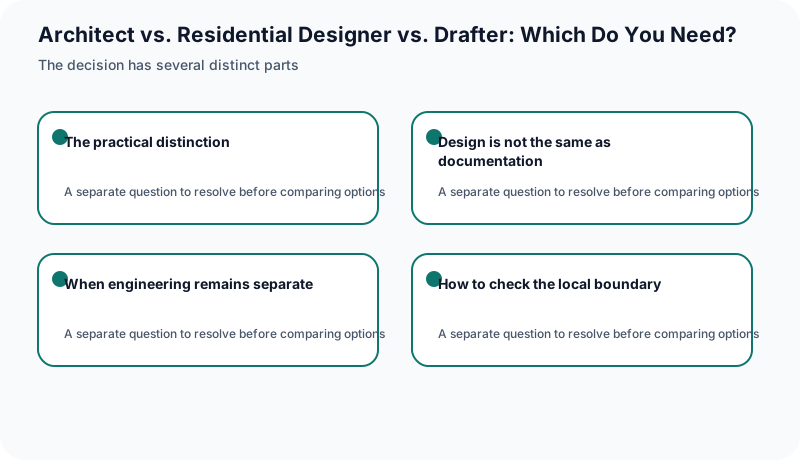
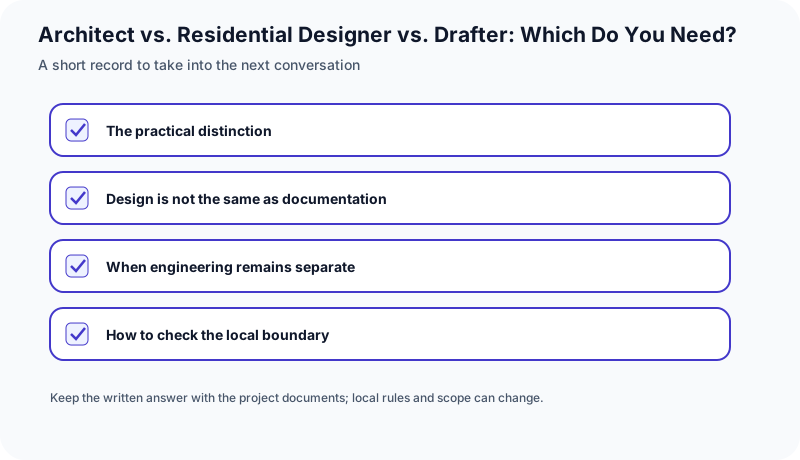
The practical distinction
| Provider | Often strongest at | Questions to confirm |
|---|---|---|
| Architect | Integrating program, site, design, documentation, consultants, and construction-phase services | Is the person licensed where the project is located, and what phases are included? |
| Residential designer | Home layouts, renovations, additions, and design documentation within the provider’s competence and local authority | What can the provider legally design or submit, and who supplies structural or other professional work? |
| Drafter | Turning measured information or an approved concept into organized drawings | Is the service documentation only, or does it include design judgment, code coordination, or permit responsibility? |
These are tendencies, not guarantees. A highly experienced designer may be a better fit for a modest project than a full-service architect. A drafter may be exactly what you need after the design and engineering decisions are already made.
Design is not the same as documentation
A drawing can look polished and still not answer the authority’s or builder’s questions. Design decides layout, materials, relationships, and performance goals. Documentation communicates those decisions through plans, sections, details, notes, schedules, and consultant information. Permit drawings may be sufficient for an application but not detailed enough for construction pricing or field coordination.
Ask for a written description of the drawing set, not merely “complete plans.” Include the number of sheets, existing and proposed conditions, structural information, energy or MEP information, site data, specifications, and revision limits.
When engineering remains separate
Removing a load-bearing wall, altering a roof, changing a foundation, adding significant loads, or designing site drainage may require a structural, civil, geotechnical, or other engineer. Hiring an architect does not automatically include that work. Hiring a drafter does not transfer professional design responsibility to the drafter.
The Ontario permit application form, for example, distinguishes the applicant from individuals who review and take responsibility for design activities. It is an Ontario example, not a universal rule. In the United States, NCARB explains that architecture licenses are issued by the jurisdiction where practice occurs. Confirm the roles and required credentials with the authority having jurisdiction.
How to check the local boundary
Before hiring, ask the permit office:
- Can an owner submit this kind of work?
- Does the project require an architect, engineer, or other professional seal?
- Are there exemptions based on size, occupancy, construction type, or scope?
- Must separate structural, energy, site, or trade documents be submitted?
- Does the local authority recognize the proposed provider’s credentials?
Then ask the provider to identify exactly which responsibilities they accept and which they refer to others. Do not treat a contractor’s verbal statement or an online plan package as the final legal answer.
Match the provider to the decision
For a small, clearly defined interior change, the main need may be accurate measurement and a coordinated permit set. A residential designer or drafter may be proportionate if the local authority accepts the documents and the provider is capable of the scope. For an addition on a constrained lot, the owner may need alternatives, site planning, building design, zoning coordination, and consultant management. An architect may be a better fit when those tasks need to be integrated, though a separate engineer can still be required.
For a structural alteration, first determine whether the work needs an engineering opinion or design. An architect may coordinate that work but does not automatically provide structural calculations. A drafter can document a design but is not necessarily responsible for deciding whether the structure is adequate. If a provider cannot explain who carries each professional responsibility, stop and clarify the arrangement before authorizing drawings.
For a stock or catalogue plan, distinguish the seller’s original design from the local adaptation. The seller may provide a starting package, while a locally qualified professional verifies site conditions, code, structure, energy and other jurisdictional requirements. The same person may not be able to take responsibility for every discipline. See stock home plan permit readiness for the adaptation scope.
Use a responsibility map
Before signing, write down who will:
| Task | Confirm in writing |
|---|---|
| Measure existing conditions | Who visits, what is measured, and what remains assumed |
| Develop the layout | Who makes design decisions and how many options are included |
| Coordinate structure and systems | Which professionals are engaged and who resolves conflicts |
| Prepare the permit set | Which forms, drawings, calculations, and schedules are included |
| Submit and answer comments | Who communicates with the authority and how many rounds are priced |
| Support construction | Who answers field questions and observes the work, if anyone |
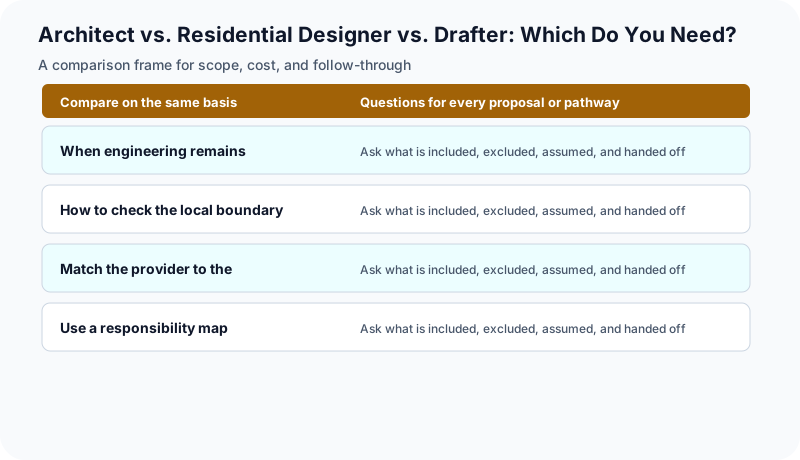
This map can reveal that a proposal includes a drawing but not design, a design but not permit submission, or permit documents but not construction details. Ask what additional person will need to be hired and whether the provider will coordinate with them.
Compare risk-adjusted value
The lowest hourly rate does not necessarily produce the lowest total cost. A provider with a narrow scope may be efficient when the project is simple, but the owner can incur later fees for coordination, missing documents, engineering, or redesign. A more comprehensive service may reduce handoffs, but paying for full design and construction support may be disproportionate to a small project.
Request comparable proposals based on the same written brief. Ask each provider to identify assumptions, exclusions, revisions, consultant allowances, approval responsibilities, and termination terms. If one proposal is much cheaper, ask which tasks are absent rather than assuming the difference is a discount.
A paid introductory consultation can test how the provider approaches the project. Ask for a short written summary of constraints, missing information, and the next decision. The purpose is not to obtain free design work; it is to see whether the professional recognizes when a question belongs to the authority, an engineer, a surveyor, or another specialist.
Finally, verify credentials using the relevant regulator or professional body and confirm that the person is authorized where the property is located. Credential rules are local and may depend on building type and project scope. A confident answer from a provider is useful context, but it does not replace confirmation from the responsible authority.
Interview providers with the same brief
Prepare a one-page project summary with the property, intended outcome, known constraints, approximate budget, desired timing, and next decision. Ask each provider to explain the first phase they recommend and the information they need before quoting the next phase. Their answers can show whether they understand the work or are proposing a standard package that may not fit.
Ask for a recent example of a similar scope and the kind of documents produced. You do not need confidential client material; a sample sheet list or redacted deliverable can clarify the level of detail. Ask how the provider coordinates with engineers and the local authority, and who remains responsible for decisions outside their practice.
Confirm credentials through the relevant regulator or professional body, but also confirm the actual person doing the work and signing the documents. A firm’s name or marketing title does not show who takes professional responsibility. For a residential designer or drafter, ask directly how they handle a project that exceeds their design scope.
Watch for gaps between the roles
Some project tasks sit between design and construction: checking existing conditions, coordinating a structural detail, answering a correction notice, reviewing a substitution, or documenting a field change. Ask who owns each of those tasks and whether the fee includes it. If the architect, designer, drafter, engineer, and contractor each assume another person will handle a question, the owner can face a delay or an added service fee.
Do not hire based on a label alone. Ask the person who will perform the work to explain how they handle a project that exceeds their scope, which other professional they would involve, and how they will tell you when that happens. A clear handoff is often more valuable than an impressive title.
When the lower-cost option makes sense
A drafter or designer may be appropriate when the project has a clear scope, uncomplicated conditions, and a local path that accepts the proposed documents. Full architectural service may be more proportionate when you need alternatives, site planning, difficult existing conditions, consultant coordination, a complex approval path, or construction-phase support.
The cheapest proposal can become expensive if it stops at attractive concept drawings and you later pay for missing site work, engineering, permit corrections, or redesign. Compare the full chain of deliverables in permit drawings cost and the professional fee scope in architect fees.
Choose the provider who can responsibly answer the project’s actual questions, document the limits of the service, and identify when another professional or the local authority must take over.
Compare the service before hiring
Give each candidate the same brief and ask for a written list of deliverables, exclusions, fee basis, and assumptions. Check which professional is permitted to take responsibility for the project in its jurisdiction, whether a seal or registration is required, and who will answer authority comments. A portfolio can show design quality, but it does not establish that a provider can submit or sign every document your project needs. If the answer depends on building type, location, or complexity, confirm that limit with the authority before comparing prices.