
Post-construction cleaning removes the dust and residue left after building work. It is different from hauling demolition debris and different from ordinary recurring house cleaning. The final cost depends on the condition, the size and type of space, the number of cleaning phases, the surfaces included, and whether the contractor already owes a defined closeout condition.
Cleaning levels are not standardized
Use the terms as a framework, then make the actual scope explicit:
| Stage or service | What to clarify |
|---|---|
| Jobsite debris removal | Who removes scraps, packaging, containers, and heavy debris? |
| Broom-clean closeout | What does the contractor leave swept or cleared, and what remains? |
| Rough clean | Dust and larger residue after major construction, before final fixtures or touch-up work |
| Detailed clean | Horizontal and vertical surfaces, floors, fixtures, cabinets, and accessible windows where included |
| Touch-up or final clean | A later pass after punch-list work, deliveries, or remaining dust |
| Specialty cleaning | Adhesive, labels, grout haze, paint residue, high glass, delicate finishes, or other add-ons |
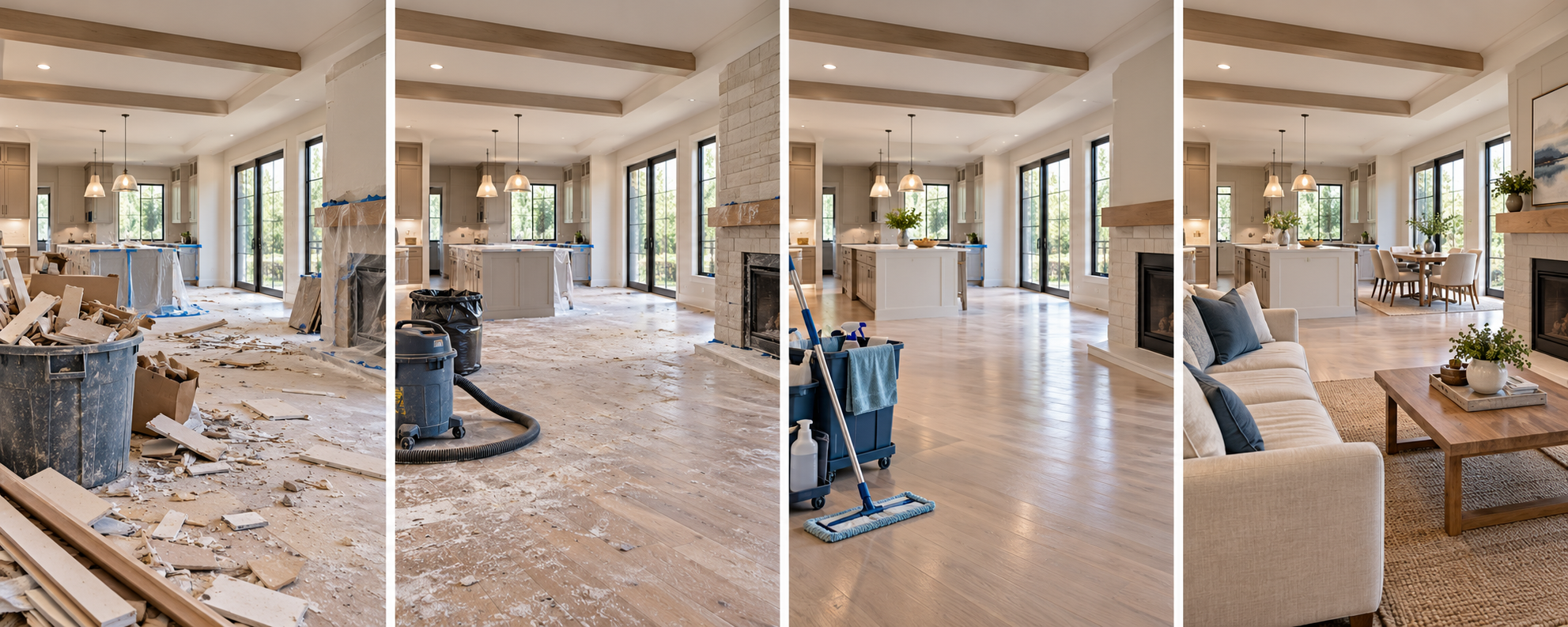
These labels can mean different things to different contractors. A square-foot or hourly price is not comparable unless the tasks and condition are comparable.
What affects the price
- floor area and number of rooms;
- renovation versus new construction condition;
- dust on walls, ceilings, cabinets, fixtures, and ledges;
- floor type and residue;
- windows, glass, appliances, and interior of cabinets;
- adhesive, labels, grout, paint, or construction residue;
- occupied-home access and protection;
- number of workers and cleaning phases;
- debris removal that is or is not included;
- specialty equipment, ladders, high surfaces, and difficult access.
An initial clean may need a second visit after punch-list work. Ask whether the proposal includes that possibility or prices it separately.
Contractor cleanup versus a separate cleaner
The construction contract may require removal of its own debris and a defined “clean” condition. A separate cleaner may handle the detailed finish work. Ask the general contractor to identify:
- What debris, packaging, and surplus material it removes.
- What surfaces it wipes, vacuums, sweeps, or washes.
- Whether windows, cabinets, fixtures, floors, and appliances are included.
- What condition is required before final payment or handover.
- Which cleaning is excluded because another trade or specialist owns it.
If the contractor’s scope is vague, hiring a cleaner may duplicate work or leave you responsible for a task you assumed was included. Put the closeout condition and responsibility in writing.
Dust and hazardous-cleaning boundary
NIOSH describes routine cleanup, containment, pathway control, and communication as part of managing indoor environmental quality during occupied construction and renovation. That does not make an ordinary cleaner qualified to remove lead, asbestos, mold contamination, silica hazards, PCBs, or disaster-contaminated material.
If hazardous material may be present, stop comparing ordinary post-construction-cleaning rates and obtain hazard-specific guidance. In the United States, EPA describes containment and cleanup requirements in particular lead-related renovation contexts; those requirements are not universal Canadian rules or a substitute for qualified abatement.
Questions before booking final cleaning
- Is this debris removal, rough cleaning, detailed cleaning, touch-up cleaning, or a combination?
- Which rooms, surfaces, windows, cabinets, floors, fixtures, and residues are included?
- Is the price based on area, labor time, condition, or a fixed scope?
- What happens after punch-list work or another delivery creates new dust?
- Who protects finished surfaces while cleaning?
- Are hazardous materials, high work, exterior areas, and specialty residues excluded?
- What condition will be accepted at final handover?
For dust control during the work, read construction dust containment cost. For hauling and disposal, compare dumpster, junk removal, and contractor hauling.
Published ranges are useful only with their market and phase attached
Available U.S. and Canadian consumer guides illustrate how much the stated cleaning phase changes the number. HomeGuide’s U.S. page dated December 29, 2025 gives $0.15–$0.60 per square foot for interior post-construction cleaning. It separates rough cleaning at $0.15–$0.40, standard cleaning at $0.20–$0.60, and touch-up cleaning at $0.20–$0.60 per square foot. HomeStars’ Canadian guide, updated August 21, 2026, reports $300–$1,000 for a residential post-construction clean and $0.15–$0.50 per square foot, depending on scope and whether rough cleaning, final cleaning, or both are included. It also lists city estimates for a standard final clean on a 1,200–2,000-square-foot unit.
These are separately attributed guide estimates, not a combined North American price range. Neither source discloses a transparent sampled quote set or a common task specification. HomeStars prints a dollar sign without an ISO currency code, and both guides leave important details such as local taxes, exact residue level, access, and individual surface tasks unresolved. Use the figures as a prompt to request local quotes, not as a promise that a project of a given area should cost a particular amount.
Build a comparable scope before choosing by price
Ask each cleaner to price the same rooms and phase. A rough clean may focus on larger dust and debris before finish trades are done; a detailed clean may add fixtures, cabinets, vertical surfaces, and glass; a touch-up pass may address new dust after punch-list work. Those names are not universal specifications. List the actual surfaces and tasks, note which rooms are complete and accessible, and state whether windows, inside cabinets, appliances, floors, high surfaces, and adhesive or grout residue are included.
Then clarify how the service is priced. A square-foot quote may assume an ordinary level of residue and open access. An hourly proposal may vary with the cleaner count and time onsite. A fixed bid can still exclude specific rooms or add-ons. Request an allowance or change process for unexpectedly heavy dust, leftover construction debris, additional visits, or work delayed by unfinished trades. Compare the total cost for all expected phases rather than treating one initial visit as complete closeout.
Sequence cleaning with the rest of the project
Professional cleaning is easiest to compare when the construction sequence is settled. If painters, installers, or delivery crews return after the cleaner, they may create new dust or marks. A final clean before punch-list work may need a later touch-up; a rough clean may be the more useful earlier scope while trades are still active. Ask who calls the cleaner, who confirms the space is ready, and who pays for a return visit caused by schedule changes or follow-on work.
The homeowner should also distinguish construction cleanup from routine housekeeping. Clearing packaging, scraps, and heavy debris may belong to the contractor or hauling service, while the cleaner may handle fine dust and finish surfaces. A contract that says only “broom clean” may not include detailed cleaning, but do not assume that phrase has a universal meaning. Ask the contractor to define the handover condition and identify which items remain for a separately hired service.
Separate ordinary residue from hazardous cleanup
Ordinary post-construction estimates do not price lead, asbestos, silica, mold, PCBs, or other regulated-material work. A standard cleaning company and an abatement or remediation contractor may have different qualifications, work plans, containment, disposal, and clearance requirements. If a hazard is suspected or confirmed, stop using ordinary cleaning rates as the budget for that work and obtain qualified, jurisdiction-specific guidance.
Likewise, visible dust does not tell you whether the project needs specialty cleaning. The work history, materials disturbed, and affected areas matter. NIOSH’s occupied-construction guidance discusses containment, housekeeping, pathways, and communication as parts of indoor environmental management; it is not a consumer cleaning specification or a price list. Keep safety and abatement decisions with the appropriate professionals while making sure the construction contract describes who restores a safe, usable handover condition.
Compare the whole closeout, not just the cleaner’s invoice
A lower cleaning proposal can be offset by a contractor’s separate debris or touch-up charge, an extra visit, or a narrower included surface list. A higher proposal may include a second phase or difficult access that another quote excludes. Put each responsibility beside the corresponding price: contractor debris removal, broom-clean condition, rough clean, detailed final clean, post-punch-list touch-up, exterior cleaning, and specialty work. Mark an item “not included” when no one has priced it so it does not disappear from the project budget.
For an occupied renovation, include how the cleaned area will stay protected from remaining work. For new construction, coordinate the final clean with inspection, delivery, and move-in dates. The best comparison is the one that promises the same rooms, surfaces, timing, and condition at handover—not merely the same square-foot rate.
Agree on the handover condition before work is complete
A cleaner’s proposal should connect to a visible handover condition. Identify the rooms to be cleaned, the finish work that must be complete first, and how the homeowner or contractor will confirm the result. If a surface is not accessible, a fixture is not installed, or another trade returns after cleaning, state how that work is handled. A brief touch-up may be appropriate for minor residue, while a new round of work can require a separate visit. Record any exclusions such as exterior glass, high surfaces, construction debris, or delicate finishes in the agreement. This makes the final invoice easier to compare with the promised outcome.