
Ordinary renovation dust can migrate through doorways, paths, cracks, and HVAC air movement. Containment is the planned combination of work-zone separation, airflow control, filtration, housekeeping, and occupant communication. The price rises with the size and duration of the work zone, the number of openings, and how much of the home remains occupied.
What a containment scope can include
- temporary plastic or rigid barriers and sealed transitions;
- protected entry and debris paths;
- isolation of nearby rooms or air pathways;
- local exhaust or filtered air equipment;
- HEPA filtration where appropriate to the project;
- a negative-pressure arrangement designed by the contractor for the work;
- daily vacuuming, surface cleaning, and filter or consumable replacement;
- inspection and repair of barriers over a multi-day project;
- communication about access, work hours, ventilation, and occupancy.
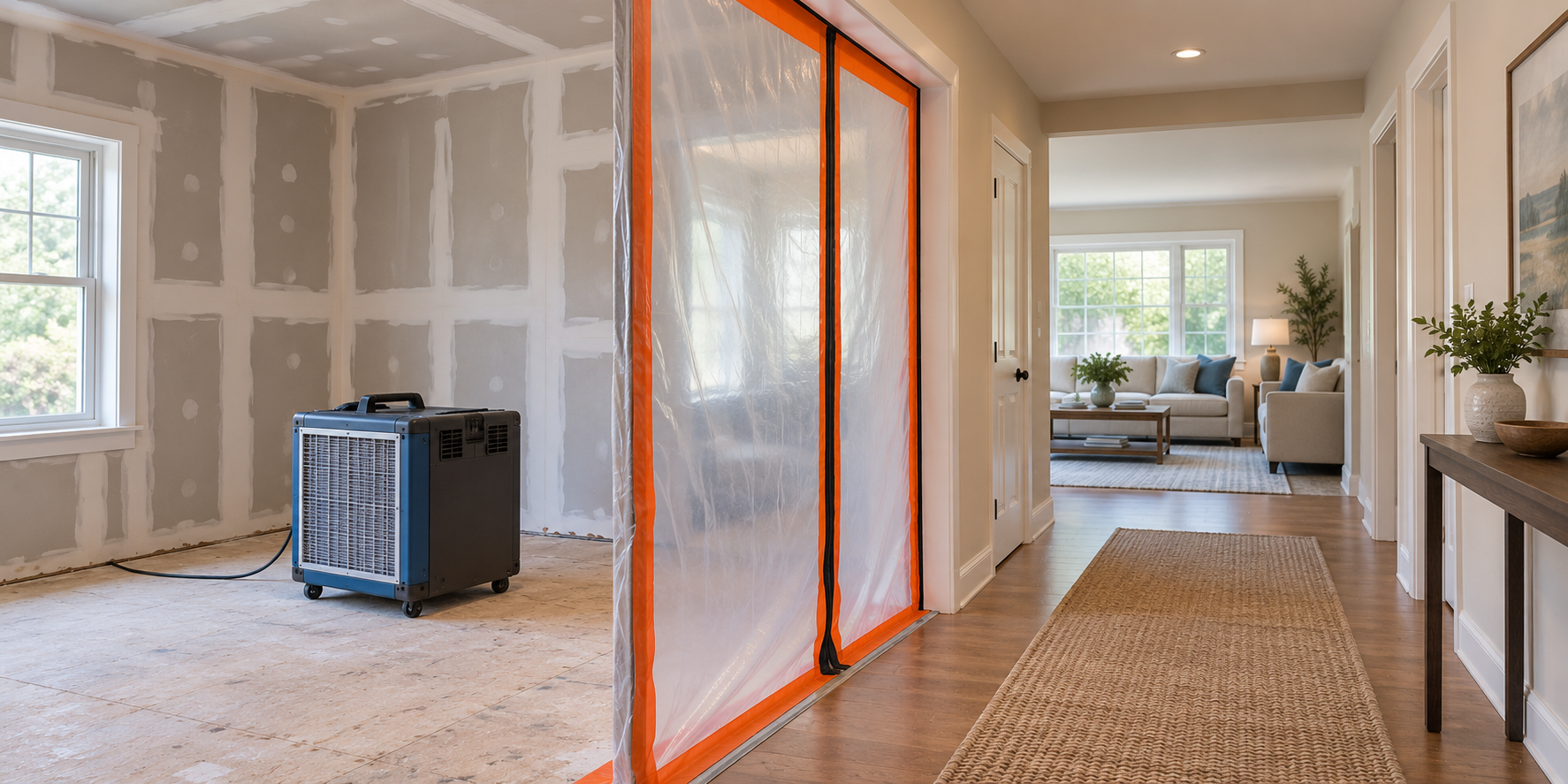
The presence of a HEPA machine does not by itself prove that a project has effective containment. Equipment placement, airflow, openings, maintenance, and the source of the dust all matter.
What moves the cost
| Driver | Why it adds work |
|---|---|
| Work-zone size | More barrier, sealing, filtration, and cleaning area |
| Number of openings | More doors, paths, rooms, and transitions to maintain |
| Occupied conditions | More separation, communication, scheduling, and daily cleanup |
| Project duration | More inspections, filters, consumables, and maintenance |
| Dust intensity | More local control, cleanup, and equipment time |
| Access route | Longer protected paths and more careful debris movement |
| Existing HVAC layout | More planning around air pathways and occupied rooms |
Evidence supports these as planning mechanisms, not a universal price per square foot or a national containment rate. Ask for a local scope-based quote.
Negative pressure in plain language
Negative pressure generally means arranging airflow so air moves into the work area rather than carrying dust outward. The contractor must design and monitor the arrangement for the building and work. Homeowners should not improvise fan placement, seal exits, alter HVAC systems, or assume that a closed door provides containment.
NIOSH identifies planning, isolation or containment, pathway control, and communication as important during occupied construction and renovation. That guidance supports a project conversation; it is not a complete residential design or operating protocol.
The hazardous-material boundary
Ordinary construction dust is not the same as lead, asbestos, silica, PCB, mold, or disaster contamination. If the material or building condition raises one of those concerns, stop using an ordinary-dust allowance as the safety plan. Hazard-specific testing, containment, worker protection, transport, disposal, and abatement may apply.
In the United States, EPA distinguishes renovation or partial demolition from total demolition in its lead guidance and recommends lead-safe practices during total demolition. These are U.S.-specific boundaries. They do not establish Canadian requirements, and they do not authorize a homeowner or general cleaner to manage hazardous material.
Questions for a containment quote
- What area is isolated, and how are residents and workers separated?
- Which barriers, doorways, HVAC openings, and debris paths are included?
- What filtration or exhaust equipment is planned, and who maintains it?
- How often are barriers inspected and surfaces cleaned?
- What happens if the work expands or the material changes?
- Is hazardous-material testing or abatement explicitly excluded?
- Who is responsible for final cleaning and verification of the ordinary work area?
For physical finish protection, see temporary protection during remodeling. For closeout cleaning, read post-construction cleaning cost.
The scope depends on what is happening around the work
Containment for a brief task in an empty room differs from control of repeated work beside occupied bedrooms, a shared hallway, or a business that must remain open. The contractor should identify the work area, pathways, adjacent spaces, occupancy, expected duration, and the phases that can create dust. Those facts influence the barrier layout, filtration or other controls, checks, cleanup, and communication. A square-foot allowance that omits those assumptions is difficult to compare.
Ask whether the proposal covers setup, supplies, equipment rental, ongoing operation, inspection or maintenance by qualified personnel, repairs, changes as work moves, and final removal. A barrier that is installed once may need attention after trades enter, materials pass through, or the work area changes. The budget should account for the duration and number of phases, not only the initial construction of an enclosure.
Occupied homes add coordination and downtime questions
When some rooms remain in use, the project needs a clear boundary between active construction and occupied space. Residents may need a designated route, a way to access essential rooms, notice before noisy or dusty work, and a plan for keeping barriers in place. The contractor may need to work in shorter phases or pause while a barrier is reset. Those coordination choices affect labor and schedule even when the physical containment materials are inexpensive.
Ask who informs occupants about changes, how access is managed, which areas are unavailable, and what condition is expected at the end of each workday. If the project includes pets, children, people with health sensitivities, or shared tenants, make the operational constraints known to the contractor so the project professional can address them. This article does not set a health threshold or replace professional environmental assessment.
Containment, surface protection, and cleaning are separate scopes
A floor cover protects a finish from impact or tracked debris. A containment system is intended to manage migration of particles from a work zone. Final cleaning removes residue after the work, while hazard-specific remediation follows a different scope entirely. The estimate may include one of these services and exclude the others. Ask for the limits and handoff points between demolition, dust containment, routine housekeeping, and post-construction cleaning.
Do not assume that a finished-looking barrier is effective, that a machine label defines a complete plan, or that a cleaning line includes hazardous dust. The qualified project team determines appropriate controls for the actual work and applicable requirements. If there is a suspected regulated material, ordinary remodeling containment and cleanup estimates may not apply.
A small room and a phased renovation
A short, contained task in an unoccupied room may need a limited setup and a single removal. A phased kitchen renovation beside a living area may require repeated access, changes to the work boundary, ongoing housekeeping, and a final cleaning after several trades. The latter can have more labor and duration even if the room area is similar. A hospital, daycare, or other sensitive setting may require additional professional planning beyond ordinary residential scope; do not infer a suitable control level from a homeowner article.
The homeowner can still compare bids by asking what areas are covered, what the contractor assumes about occupancy and schedule, how the barrier is maintained, who authorizes changes, and what cleanup or verification is included. Request a separate amount for extended duration or additional phases if possible. Then compare that with the construction schedule and temporary utility or equipment costs that may continue while the area is isolated.
Safety claims need the right evidence and scope
NIOSH’s guidance for occupied construction and renovation discusses management of indoor environmental quality, including containment, pathways, housekeeping, and communication. It supports treating these as coordinated project considerations; it is not a universal specification for a home project. EPA lead guidance applies in its defined U.S. contexts and does not establish Canadian requirements. Asbestos, silica, mold, PCBs, and other hazards require their own professional assessment and applicable rules.
Ask the contractor to state which party designs and maintains the containment plan and what happens if the boundary is damaged or the work changes. Do not use a generic cost estimate to approve a safety-sensitive method. If the site conditions or work materials raise a hazard question, pause ordinary price comparison until qualified people identify the appropriate scope.
Make the proposal easy to evaluate
Request a description of the work zone and adjacent occupied areas, setup and removal, operation and maintenance, filter or consumable assumptions if applicable, number of phases, cleanup, access arrangements, and duration. Ask which changes generate additional labor, equipment, or service charges and who records them. Confirm whether barriers, temporary protection, routine cleaning, final cleaning, and hazardous remediation are included or excluded.
Compare the proposal with temporary surface protection and post-construction cleaning so those separate costs are not counted twice or missed. The right comparison is the full occupied-project scope and schedule, not only the apparent price of the barrier or machine.
Revisit the plan when work boundaries move
A containment allowance is based on a defined work area and occupancy condition. If demolition expands into an adjoining room, a barrier is removed for a delivery, or a family member begins using a nearby space, the original scope may no longer describe the project. Ask who can approve a change and how its cost, schedule, and protection measures will be recorded before the crew proceeds. A contractor may need to revise the work plan, but a homeowner should not decide that a control is adequate based on appearance. Keeping the room list and schedule current helps distinguish a legitimate scope change from a duplicate charge for work already included.