
Prefabricated and custom tile showers are different installation systems, not simply cheap and expensive versions of the same product. The comparison should include the base or pan, wall system, substrate, waterproofing, drain, enclosure, labor, access, repair strategy, and the condition of the existing room.
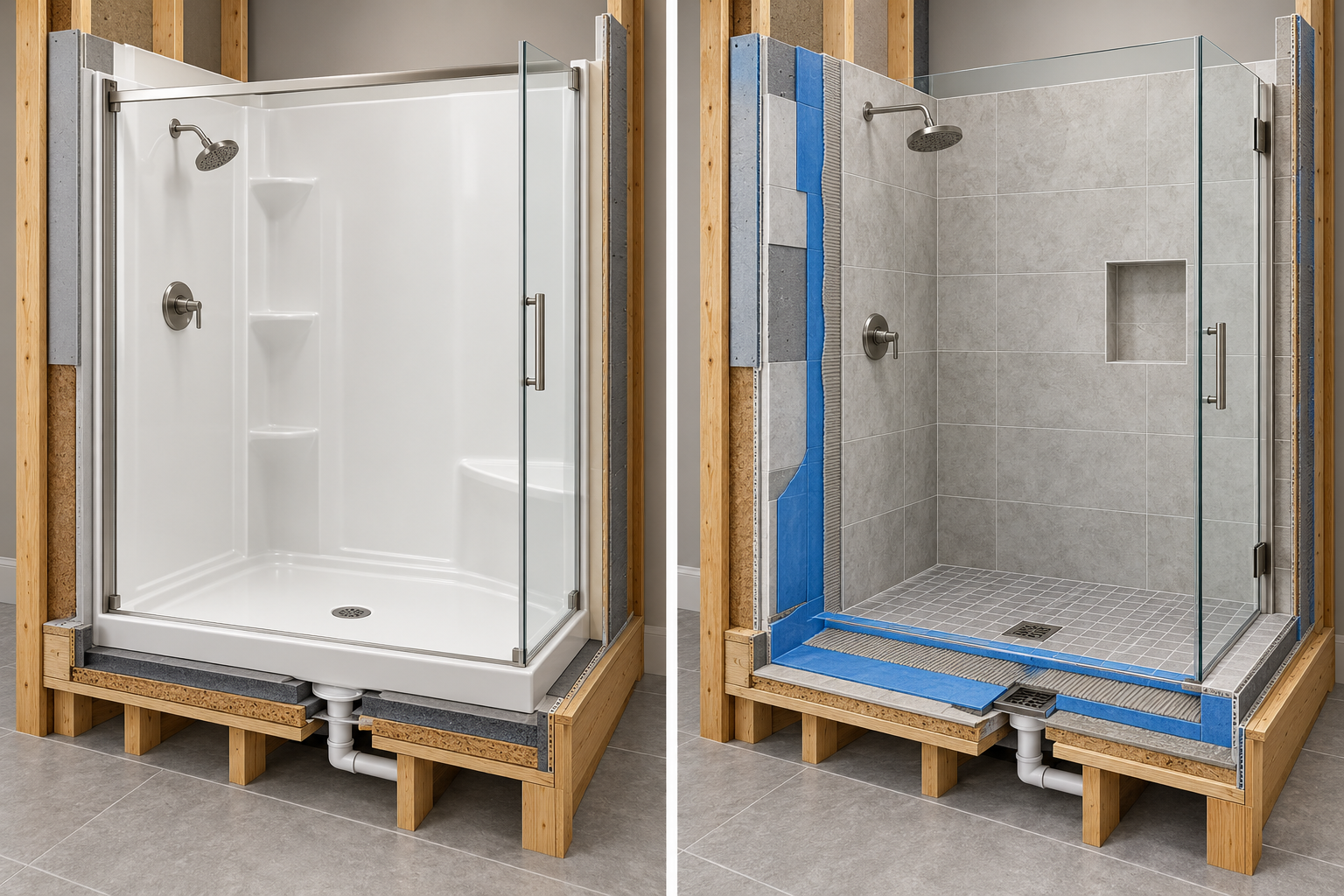
Bounded planning example
For the same hypothetical shower opening, a U.S. planning comparison might use $12,000 for a prefabricated system and $23,000 for a custom tile system. A separate Canadian case could use C$16,000 and C$30,000. These are rounded assumptions that keep demolition, waterproofing, fixtures, and enclosure scope visible; they are not market averages or currency conversions.
Side-by-side comparison
| Factor | Prefabricated system | Custom tile system |
|---|---|---|
| Upfront scope | Product fit, base or panels, trim, drain, fixtures, and installation | Substrate, waterproofing system, tile, grout, details, drain, fixtures, and installation |
| Shape and finish | Limited by available products and dimensions | More flexible for unusual rooms, niches, seats, and finishes |
| Labor pattern | Less site finishing in some installations, but fit and access remain important | More detailing, layout, setting, grouting, and finish coordination |
| Waterproofing | Depends on the product and installation method | Requires a defined assembly behind the tile; tile itself is not waterproofing |
| Future repair | Replaceable components may simplify some repairs | Individual finishes may be repairable, but underlying access can still be difficult |
No construction type is universally more waterproof or longer-lived. Product quality, installation, substrate, detailing, maintenance, and use determine the result.
Compare complete installed scope
Ask bidders to price the same demolition, protection, base or pan, drain, wall preparation, waterproofing, fixtures, door, accessories, ventilation, and restoration. A prefab quote that excludes floor repair is not comparable with a tile quote that includes a new waterproofing assembly. A product-only price says little about the finished project.
Waterproofing questions
The Schluter handbook is primary evidence for the Schluter systems it documents. It treats membranes, seams, corners, penetrations, drains, substrates, and transitions as an assembly and recommends system-specific quality checks. Apply the same question to any proposed product: what system is being used, what surfaces does it cover, how are interfaces handled, and what is checked before finish installation?
Design and accessibility
Custom tile construction can make it easier to coordinate a seat, niche, unusual footprint, or curbless transition, but those features still require suitable structure, drainage, and waterproofing. A prefab system may offer a low-threshold base or integrated features without solving every circulation or transfer need. Specify the user’s actual requirements instead of treating the construction label as an accessibility rating.
Decide by scenario
Choose a prefab system when a compatible product fits the room, predictable installation matters, and the desired features are available. Choose custom tile when the room, finish, layout, or accessibility outcome needs a tailored assembly and the project can support the added detailing. Keep a third option—repair or retain the existing shower—when its condition is credible.
The lower material price is not automatically the lower project cost. Compare complete scope, uncertainty, maintenance, future access, and the cost of correcting a failed installation.