
The right budget depends on what the room needs to accomplish. A refresh can improve appearance while retaining sound fixtures and assemblies. A partial remodel replaces selected components. A full remodel coordinates most of the room. These labels are useful working definitions, not universal industry classifications.
Published labels use different rules
Survey and permit labels can help describe a project, but they do not replace the functional scope above:
| Source convention | How it draws the line | Why it is not a universal refresh/remodel rule |
|---|---|---|
| American Housing Survey | Counts substantial changes such as replacing a bathtub or retiling a shower or floor; excludes painting and simple toilet or sink replacement. | It is a survey definition of reported work, not a contractor’s scope label. |
| Houzz Bathroom Trends Study | “Major” means the shower was upgraded; “minor” means it was not. | A shower can be upgraded in an otherwise limited project, and other work can be substantial without changing the shower. |
| Harvard’s Joint Center for Housing Studies (JCHS) analysis of AHS | Its major class starts above USD 15,000 for professional work or USD 6,000 for DIY work. | A cost cutoff does not identify which assembly or room systems changed. |
| Houzz & Home primary-bath study | Its major primary-bath threshold replaces at least the vanity/cabinetry, countertop, and toilet. | This is a different survey’s replacement rule, not the bathroom-study shower threshold. |
| San José permit guidance | The city’s residential minor-remodel definition covers multiple fixture replacements involving new electrical, plumbing, or mechanical work when fixture locations and quantities stay the same and walls, windows, or framing are not structurally changed; a qualifying project may use its online permit path. | It is a local permit classification; the city’s conditions do not define project scope elsewhere. |
Use your own scope list to decide whether work is cosmetic, component-level, or a coordinated remodel. Then check the wet-area condition and ask the local authority which permit path applies to the actual work.
Bounded planning example
Consider a hypothetical bathroom with sound plumbing and waterproofing. A U.S. comparison might set a refresh at $6,500 for paint, hardware, lighting, and a vanity update; a partial remodel at $14,000 for one major wet-area or flooring package; and a full remodel at $24,000 for coordinated fixtures, finishes, and access. A separate Canadian planning case could use C$8,500, C$18,500, and C$31,000 respectively. These are rounded scope assumptions, not market averages or currency conversions; concealed damage moves the project to another case.
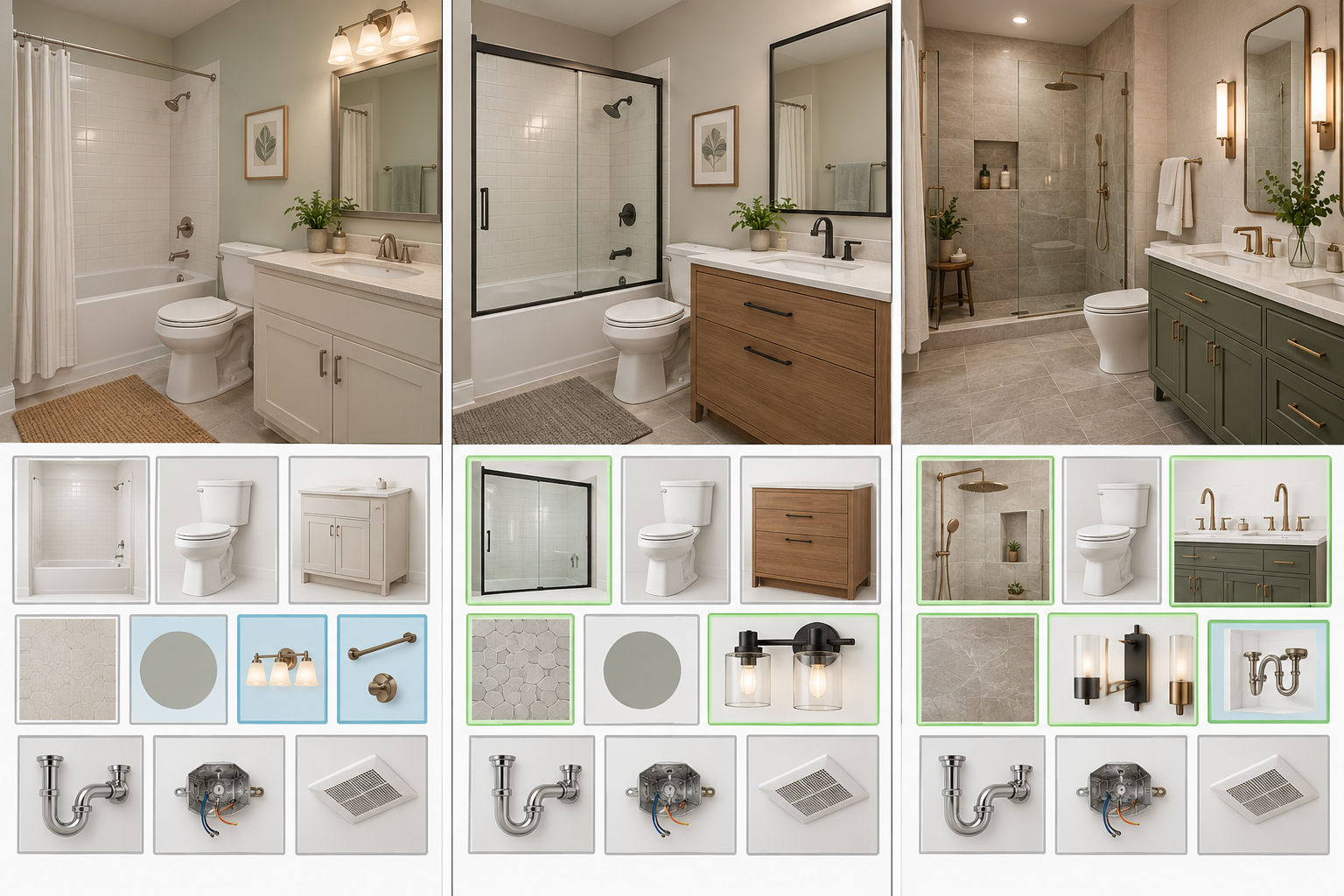
Three practical scope levels
| Scope | Usually changes | Usually leaves in place |
|---|---|---|
| Refresh | Paint, hardware, accessories, selected lighting, minor finish work, or a sound vanity | Wet-area assembly, layout, major plumbing, and most fixtures |
| Partial remodel | One major fixture or finish system, such as a vanity, tub surround, floor, or shower | Unaffected room systems and often the existing layout |
| Full remodel | Several fixtures, finishes, and supporting systems in one coordinated project | The room envelope, unless the project expands into major remodeling |
The labels should never hide the condition of the wet area. A new finish may be appropriate when the underlying assembly is sound; it is not a substitute for diagnosing a known leak or deteriorated substrate.
What a refresh can solve
A refresh fits a bathroom that functions, remains dry, and has finishes that are worn or dated rather than failing. Repainting, replacing cabinet hardware, changing a mirror, or renewing a sound vanity can improve the room without opening walls or floors. Minor caulk or grout maintenance may also fit this scope when there is no sign of movement, recurring moisture, or damaged backing.
The economic advantage is limited disruption and less coordination. The risk is spending on visible work that will soon be removed if a concealed defect is already present. Before approving surface work, ask what evidence supports retaining the pan, waterproofing, substrate, and plumbing connections.
When partial work is the better answer
Partial remodeling is useful when one system drives the decision. Examples include replacing a failed vanity, upgrading a shower enclosure, or replacing a bathroom floor while the tub and walls remain serviceable. Price the interface: removal, protection, trim, transitions, plumbing alignment, and restoration often matter more than the replacement product alone.
Partial work is less attractive when the retained items are likely to be opened or damaged by the new work. Replacing a tub surround may be the right scope, but preserving an old tub or waterproofing edge should be an explicit decision rather than an assumption.
When a full remodel is justified
A larger renovation becomes rational when several components are at the end of their useful condition, the layout no longer works, or the wet-area assembly must be rebuilt. Accessibility needs, repeated leaks, poor ventilation, damaged flooring, and coordinated fixture changes can also make a single-room package more economical than a sequence of isolated jobs.
That does not mean every bathroom with an old finish needs to be gutted. A full remodel should explain which systems are being opened, which are being retained, and why.
Cost and disruption trade-offs
| Choice | Upfront burden | Main risk |
|---|---|---|
| Refresh | Lowest when retained conditions are sound | Paying for surface work that conceals or delays a deeper repair |
| Partial remodel | Moderate and concentrated on one system | Interface work or future removal of retained finishes |
| Full remodel | Highest coordination and temporary loss of the room | Scope growth after demolition and finish removal |
Ask for a base scope and an option scope. If the quote uses allowances for hidden damage, request quantities, unit prices, photos, and approval rules. A lower initial price is not a saving if it omits the work needed to keep the room dry and functional.
A decision checklist
Choose a refresh when the room is dry, the wet-area assembly is credible, and the change is primarily cosmetic. Choose partial work when one identifiable component has a distinct problem and interfaces can be controlled. Choose a full remodel when multiple systems must be coordinated or when selective work would leave a known failure behind.
If moisture is recurring, identify and correct its source before treating appearance. EPA guidance distinguishes moisture control from downstream mold or material repair. If hazardous materials, extensive restoration, or a new room are involved, bring in the appropriate specialist category rather than forcing the work into a refresh label.