
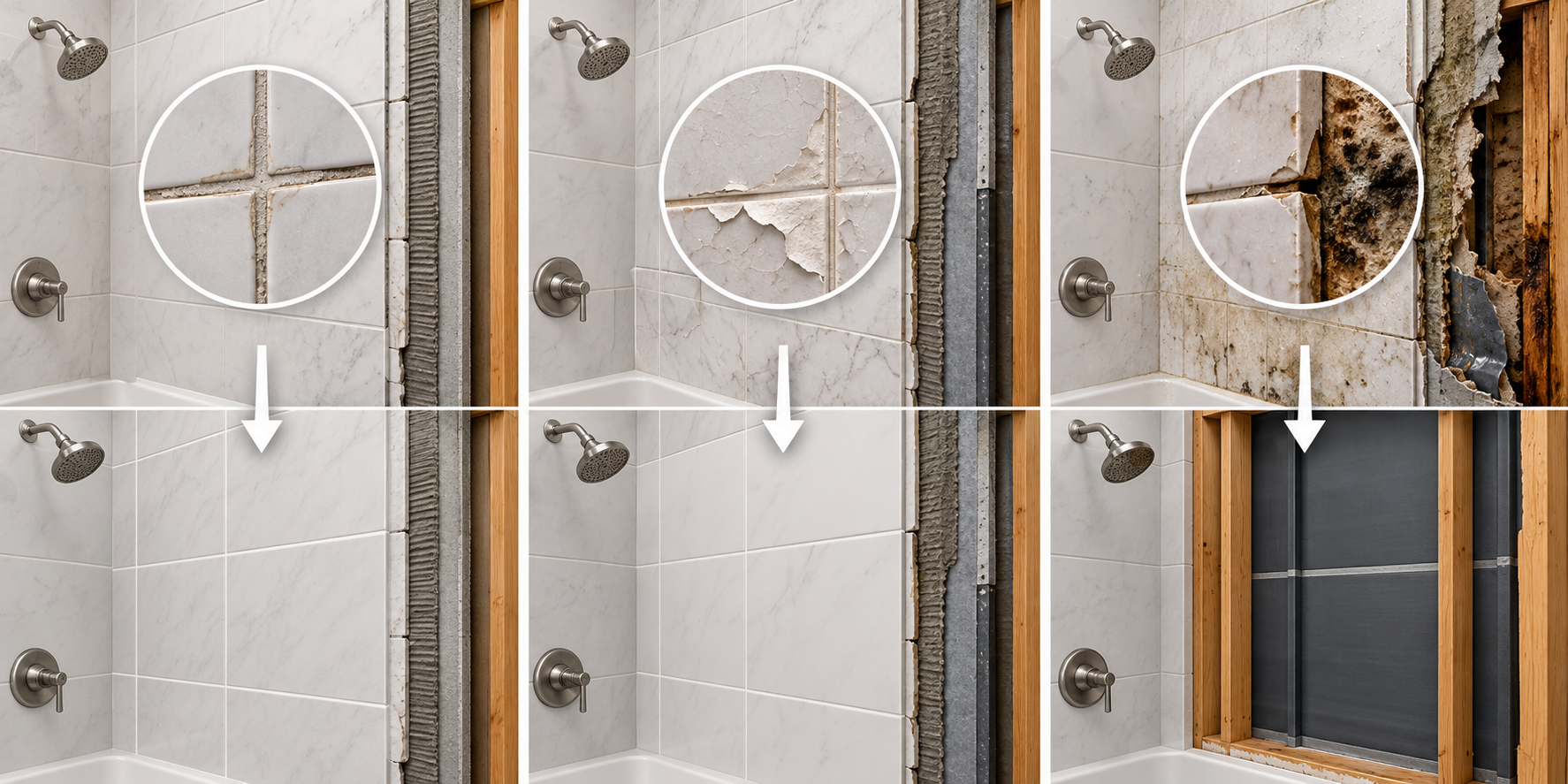
Regrouting and retiling are surface interventions. They can improve appearance and address some finish deterioration, but neither automatically repairs a failed pan, waterproofing layer, drain, substrate, or plumbing connection. The correct choice depends on the condition behind the visible grout and tile.
Bounded planning example
For a hypothetical U.S. shower with stable tile and no evidence of concealed damage, a worked regrouting case might use $1,500. Retiling with substrate retained could use $9,000, while a waterproofing rebuild could use $20,000. A separate Canadian comparison could use C$2,000, C$12,000, and C$26,000. These are rounded scope assumptions, not market averages or currency conversions; diagnosis determines which case is defensible.
What regrouting can address
Regrouting may fit when grout is worn or discolored, the tile is stable, joints are suitable for the replacement product, and there is no sign of recurring moisture or movement. Sealant joints at changes of plane and penetrations need separate attention. A quote should state preparation, removal depth, replacement material, curing, access, and what is excluded.
What regrouting cannot establish
Cracked grout does not by itself prove that waterproofing failed, and intact grout does not prove that the assembly is sound. A leak, soft wall, movement, loose tile, persistent dampness, or damage below the shower calls for diagnosis rather than a cosmetic promise. EPA guidance emphasizes fixing water sources and controlling water penetration.
When retiling is justified
Retiling fits when the visible tile or finish is the problem and the substrate and waterproofing can be responsibly retained or repaired. It becomes a broader rebuild when removal reveals damaged backing, the membrane or pan has failed, penetrations are compromised, or the retained assembly cannot be verified. A manufacturer handbook describes membranes, seams, corners, drains, substrates, and transitions as connected system details.
| Condition | More appropriate question |
|---|---|
| Worn grout, stable tile, dry adjacent areas | Can a surface maintenance scope solve the appearance problem? |
| Loose or cracked tile | What caused movement, and is the substrate sound? |
| Recurrent leak or dampness | Which layer or connection is the source? |
| Broad finish failure | Would retiling require a new substrate or waterproofing assembly? |
Compare the cost paths
Ask for a regrouting scope, selective tile repair, full retiling, and—when evidence warrants it—a pan or waterproofing rebuild. Keep concealed-work allowances separate with photos and approval rules. Do not perform demolition or leak testing based on generic online instructions when the condition may affect structure, wiring, plumbing, or hazardous materials.
Choose regrouting when it addresses a bounded surface condition. Choose retiling when the finish must change and the retained assembly is credible. Choose deeper assessment or reconstruction when the water-control system is the unresolved problem.