
Refinishing and replacement solve different bathtub problems. Refinishing or reglazing can renew a worn surface while retaining the tub, surround, plumbing, and layout. Replacement removes the old unit and may disturb the wet-area assembly. The cheaper upfront choice is not automatically the lower lifecycle cost.
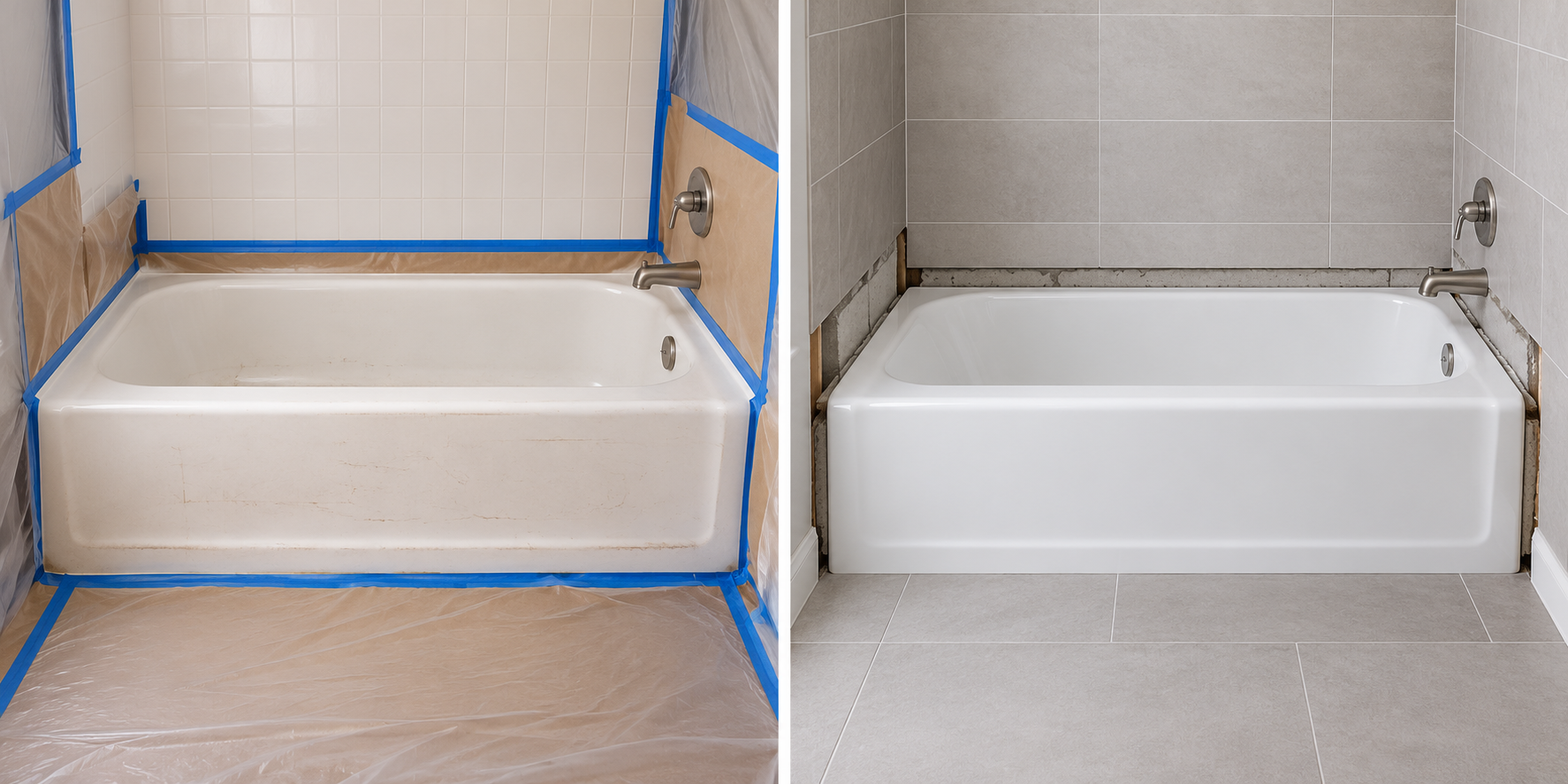
Bounded planning example
For a sound U.S. tub with a cosmetic surface problem, a worked refinishing case might use $1,500 for preparation, coating, protection, and return-to-use conditions. A same-footprint replacement with limited surround repair could use $10,000. A separate Canadian comparison could use C$2,000 and C$13,000. These are rounded planning assumptions, not life-expectancy claims, market averages, or currency conversions.
When refinishing fits
Refinishing is most plausible when the tub is structurally sound, the shape and size still work, the damage is primarily cosmetic, and the surrounding waterproofing is credible. The quote should identify preparation, repairs, coating system, curing or return-to-use conditions, ventilation, masking, and what the service excludes.
Coating work can involve chemicals and fumes. Use a qualified service and follow the product’s safety and ventilation requirements. This guide does not provide coating or demolition instructions.
When replacement fits
Replacement is stronger when the tub is cracked, badly damaged, unstable, incompatible with the user’s needs, or already part of a planned surround and waterproofing rebuild. Removal can add access, handling, disposal, wall, floor, plumbing, and finish work. If the new tub is part of a shower, the pan, surround, drain, seams, and penetrations should be priced as a complete wet-area assembly.
Compare the decision
| Question | Refinishing | Replacement |
|---|---|---|
| Condition | Sound unit with surface wear or limited damage | Damage, fit, use, or assembly condition calls for a new unit |
| Disruption | Usually narrower, but requires preparation and curing time | Removal, access, installation, and possible wall or floor restoration |
| Future remodel | May be wasted if the surround or layout will soon change | Can coordinate with a broader remodel |
| Durability | Depends on preparation, coating, installer, use, and maintenance | Depends on product, installation, interfaces, and retained surrounding work |
| Long-term cost | Service life is not established by one universal figure | Larger initial scope may avoid repeating compatible work later |
Published longevity claims are highly condition- and system-dependent. The available market evidence does not establish one reliable service-life threshold or lifecycle savings calculation. Ask the refinisher to state the preparation and warranty assumptions, and ask the replacement bidder to show all surrounding work.
A practical choice
Choose refinishing when it solves the actual problem and the household does not expect a near-term layout or wet-area rebuild. Choose replacement when the tub condition, access, function, or surrounding assembly makes a surface coating an incomplete solution. Compare the net disruption, repeat mobilization, temporary bathing arrangement, and residual condition—not only the first invoice.