
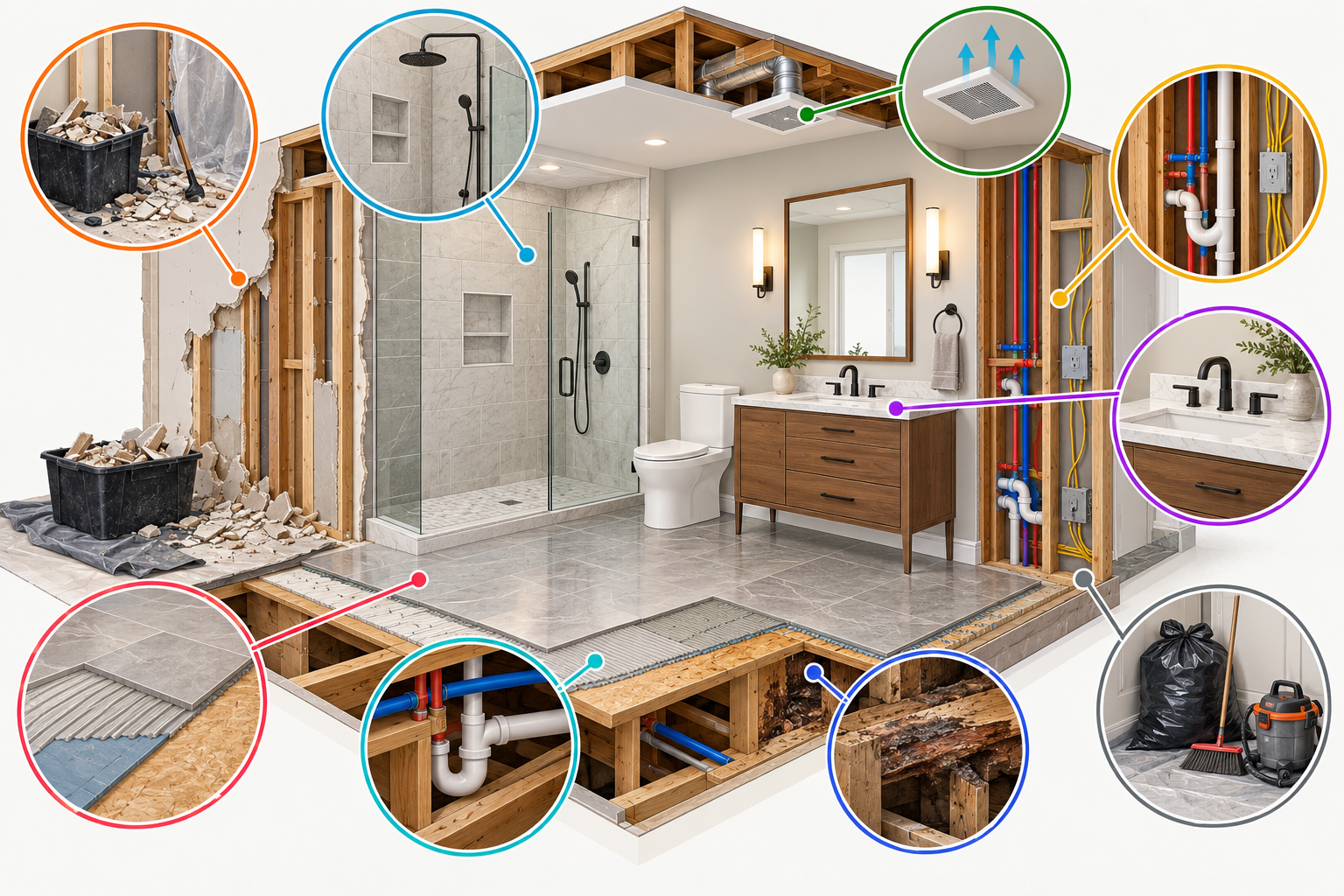
A full bathroom remodel is a coordinated room project, not a fixed package with one North American price. A quote can include demolition, new wet-area construction, fixtures, finish work, plumbing or electrical changes, ventilation, access, disposal, and repairs discovered after finishes are removed. Commercial US and Canadian cost guides provide useful market signals, but their project definitions and samples differ. Use the scope below to make those signals comparable to your own quotes.
Bounded planning example
For a hypothetical 8-by-10-foot bathroom that keeps its layout, assume a U.S. planning case of $22,000 for demolition and protection ($3,000), a new shower assembly ($7,000), fixtures and vanity ($5,000), flooring and finishes ($4,000), and coordination and cleanup ($3,000). A separate Canadian planning case could use C$30,000 with the same scope categories. These are deliberately rounded assumptions for comparing a quote’s inclusions, not market averages or a conversion between currencies. Add any concealed-damage allowance separately.
What counts as a full remodel?
For this guide, a full remodel replaces most visible bathroom finishes and several fixtures while keeping the project within the existing room envelope. It may include a new tub or shower, vanity, flooring, lighting, paint, and coordinated rough plumbing or wiring. It does not automatically mean removing every wall or creating a new bathroom.
The first question is whether the existing wet-area assembly can be retained. New tile does not prove that the substrate, seams, penetrations, pan, or waterproofing are sound. If those layers must be rebuilt, the project belongs in a higher-complexity budget case even when the room is small.
A practical budget map
| Project case | Typical scope pattern | Main price pressure |
|---|---|---|
| Limited full refresh | Existing layout and wet-area assembly remain usable; fixtures and finishes are replaced | Product choices, labor minimums, removal, and access |
| Coordinated remodel | Tub or shower, vanity, flooring, finishes, and selected rough work are renewed | Wet-area assembly, fixture coordination, disposal, and restoration |
| Infrastructure-heavy remodel | Walls or floors open; layout, waterproofing, ventilation, or concealed damage require correction | Demolition, rough-ins, access, contingency, and multiple trades |
These are planning cases, not universal dollar bands. A modest room with a failed shower assembly can cost more than a larger cosmetic renovation. Ask bidders to identify which case their proposal assumes.
Where the budget goes
Request separate lines for design or planning, protection and access, demolition, disposal, rough plumbing, electrical work, ventilation, waterproofing, substrate repair, tub or shower, doors and hardware, vanity and countertop, flooring, tile, paint, cleanup, permits where applicable, and contingency. The split between labor and materials changes with the finish level and the amount of custom work; a percentage copied from another project is not a reliable budget.
Waterproofing deserves its own question. A manufacturer system treats membranes, seams, corners, penetrations, drains, transitions, and substrates as an assembly. Ask what system is proposed, which surfaces are included, and how the installer will verify the work. Do not treat grout or tile as the waterproofing layer.
US and Canadian cost context
US and Canadian market guides should be read in their own currencies and definitions. A Canadian renovation estimate is not a US estimate converted by exchange rate. Labor markets, product availability, taxes, permitting, travel, and construction practice can differ by province, state, municipality, and housing type.
Use published figures only to set an initial question. Then request local quotes with the same room dimensions, fixture count, wet-area scope, access assumptions, and finish allowances. If the source definition is not clear, the figure is not comparable.
Several U.S. surveys add context, but their totals do not describe one matching project or a current contractor quote:
| Source-defined measure | Reported spend | What the measure represents |
|---|---|---|
| Houzz & Home Study, 2025 primary-bathroom renovations | USD 15,000 median | Registered Houzz users; DIY and professionally supported projects; weighted to Houzz-user populations. |
| American Housing Survey, 2021–2023 bathroom-remodel projects | USD 5,000 median | Owner-occupied U.S. households; the survey counts substantial tub, shower, or floor changes and excludes painting and simple toilet or sink replacement. |
| Harvard’s Joint Center for Housing Studies (JCHS) analysis of 2021 AHS bathroom projects | USD 8,018 average overall; USD 3,795 minor and USD 26,873 major | Its “major” class uses spending cutoffs above USD 15,000 for professional work or USD 6,000 for DIY work, not a functional scope definition. |
| Houzz Bathroom Trends Study, 2025 bathroom projects | USD 25,000 median when the shower was upgraded; USD 9,000 without a shower upgrade | 2026 online survey of 1,619 registered U.S. homeowner Houzz users who had completed, were doing, or planned a remodel/addition; its major/minor split is based on shower upgrade status, not on the AHS or JCHS definitions. |
These U.S. figures use different years, populations, questions, and definitions; the Houzz Bathroom Trends study also measures a different population and major/minor cut from the Houzz & Home study above. Do not average them, treat them as matched installed-price estimates, or apply them to Canada. Statistics Canada’s bathroom-remodel index rose between April 2025 and April 2026 by 0.6% in Vancouver to 3.9% in Quebec City across 15 named metropolitan areas. That index measures contractor-price movement for a representative project; it is not a dollar cost or a Canada-wide composite. Keep the surveys, index movement, and hypothetical planning cases separate from local quotes.
Existing layout versus reconfiguration
Keeping the toilet, vanity, and bathing fixture in place usually limits opening, drain, supply, vent, floor, and wall work. Moving them can trigger additional design, rough-in, framing, electrical, flooring, and restoration work. A layout change may be sensible for accessibility or function, but it should be priced as a coordinated change rather than a simple fixture upgrade.
The contingency question
Concealed damage is especially important around showers, tubs, floors, and plumbing penetrations. Ask for a documented allowance or unit prices for damaged substrate, framing, subfloor, or finish restoration. The contract should state who photographs the condition, what approval threshold applies, and whether work pauses before the allowance is exceeded.
When the project crosses a boundary
Creating a bathroom in an addition or substantially converting unrelated space is a major-remodel or addition decision. Independent plumbing, electrical, environmental-hazard, disaster-restoration, and whole-home accessibility work may be related without becoming part of the bathroom article’s core scope.
The most useful bathroom-remodel budget is a defined base scope plus explicit options and concealed-condition controls. It is more reliable than a precise average attached to an undefined “full renovation.”