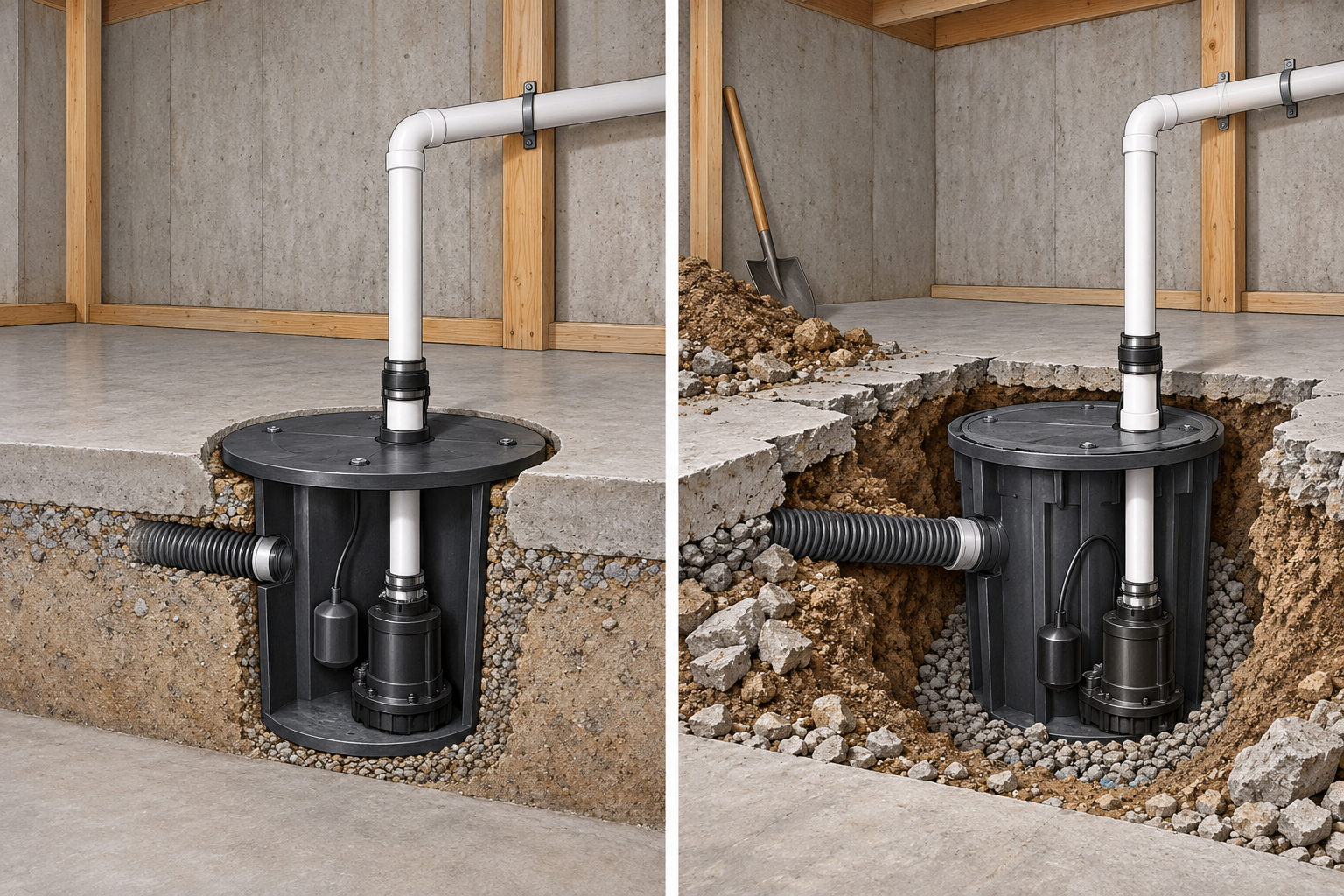
Sump Pit or Basin Installation and Replacement Cost
The sump pit is the collection point that lets a pump remove water from a low area. It is not just a container sold with a pump. A new or damaged basin can involve slab cutting, excavation, drainage connections, a lid, sealing, concrete repair, and finish restoration before pump and backup costs are added.
New pit versus basin replacement
A new pit may require choosing a location that receives drainage, cutting the slab, excavating, setting the basin, connecting the collection system, and restoring concrete. Replacing a damaged basin may be smaller if the opening, drainage, discharge, and power are reusable. Relocation can become a new civil and drainage project.
NRC Canada guidance discusses locating a sump near an exterior wall where positive drainage and site conditions permit, and recommends a sealed, adequately supported cover subject to authority review. These are guidance points, not a universal placement or sizing rule.
Cost components
Request separate prices for:
- concrete cutting, excavation, and disposal;
- basin, lid, seals, and drainage connections;
- primary pump, check valve, alarm, and discharge;
- electrical work and inspection assumptions;
- backup pump, battery, or alternate power;
- concrete, flooring, wall, and contents restoration.
Standalone basin pricing is not consistently published, so no dependable universal basin-only range is available. Compare the functional scope and the condition the installer will test after the work.
Why the pit is a system component
The basin collects water at a low point, receives one or more drainage paths, houses the pump and float, and provides access for testing. Its location and inlet arrangement affect how water reaches it. A basin that is too difficult to service, poorly covered, or disconnected from the drainage problem can add cost without providing the intended protection.
NRC Canada guidance discusses placing a sump near an exterior wall where positive drainage and site conditions permit, using a sealed and adequately supported cover subject to authority review. It also emphasizes case-by-case pump capacity and discharge. These points explain what to ask about; they are not universal placement, depth, or sizing rules for an existing home.
Cost scenarios
New pit: concrete cutting, excavation, basin, lid, collection connection, pump, discharge, power, testing, and slab or finish repair may all be required.
Basin replacement: the opening and drainage may be reusable, but a damaged or poorly sealed basin can reveal problems with the lid, inlet, pump, discharge, or surrounding concrete.
Relocation or enlargement: moving the pit changes the drainage path and may require new trenching, concrete, discharge, wiring, and restoration. A larger basin is not automatically a solution to insufficient pump capacity or high inflow.
Backup addition: secondary pump, battery, alarm, or alternate power should be priced with access and serviceability in mind.
Ask for line items for excavation and disposal, basin and lid, seals, drainage, pump, check valve, discharge, electrical work, alarm, backup, concrete, flooring, wall restoration, and inspection. Confirm how the system will be tested and what water conditions remain outside its scope.
The most useful basin budget describes the water-management chain from entry to discharge and leaves the pump, alarm, lid, and cleanout accessible after the room is finished.
What the basin is expected to receive
Before pricing a pit, identify whether it receives a foundation-drain connection, an interior perimeter system, a crawl-space collection route, or only a localized low point. The basin does not create drainage by itself. Its size, location, inlet arrangement, lid, pump, controls, and discharge should fit the water path and the available service access.
Ask how water reaches the pit and how high it can rise before the pump starts. Ask whether the lid must be sealed or removable, whether the pit needs an alarm, and how a check valve or backup is arranged. Local plumbing, electrical, and inspection requirements control; a cost article cannot select the installation for a particular property.
Installation scenarios
- New basin for an existing collection route: access, opening, basin, lid, pump, discharge, power, and restoration are the main layers.
- Basin with new drainage: trenching, pipe or channel, stone or filter material, connections, concrete, and system testing add to the scope.
- Replacement of a poor basin: a damaged, undersized, poorly covered, or inaccessible basin may require surrounding concrete and connection work.
- Relocation or backup: moving the pit or adding redundancy changes the collection path, controls, discharge, and maintenance plan.
Ask which scenario the quote represents. A larger basin is not automatically the answer to high inflow or a weak pump, and a new lid does not correct an inadequate discharge.
Serviceability and finished spaces
The cover should remain reachable, and the pump, float, alarm, check valve, and discharge should be inspectable. If a finish is installed around the basin, record dimensions and leave the required clearance. Ask how the basin is protected from debris, how the pump is removed, and what happens if the collection line needs cleaning.
Before closing the floor, photograph the location, connections, power, and discharge. Keep the equipment model and test result with the home records. A basin that is easy to service can reduce future emergency cost; a hidden basin can turn a routine replacement into demolition.
Compare the whole chain
Request separate line items for opening and disposal, basin and lid, drainage connection, pump and controls, check valve, discharge, power, alarm or backup, concrete, flooring, wall restoration, testing, permits, and exclusions. The right budget is the one that connects entry to discharge and makes the limits visible.
Ask what the basin changes
A new basin may improve collection at a low point, receive an interior drain, replace a damaged pit, or support a new pump and backup. It does not by itself increase the capacity of a failed foundation drain or correct water that never reaches the opening. Ask what evidence shows that the proposed location and size fit the water path.
The quote should say whether the basin is sealed, removable, ventilated, or otherwise configured for the intended assembly. Keep the lid, float, pump, alarm, check valve, cleanout, and discharge reachable. If the floor or enclosure is later finished, record the exact location and required access before concealment.
Test and document the system
Ask the installer to test flow, float operation, pump start and stop, check-valve behavior, discharge, alarm, and backup where included. Record which parts are new and which are reused. Keep the equipment model, installation date, and maintenance instructions with the home records.
Compare a basin-only quote with a complete pit and pumping scope carefully. A lower total may omit drainage connections, power, discharge, restoration, or testing. The best value is a basin that receives the intended water, supports a serviceable pump, and leaves the entire path understandable after the floor is closed.
Account for access and restoration
The opening, depth, soil or concrete, material handling, and finished-room protection can determine the budget. Ask whether the price includes disposal, dust control, contents movement, restoration of concrete or flooring, and protection of nearby utilities. If the pit is in a crawl space or below an enclosure, include low-clearance labor and future access.
Ask what happens if the proposed location encounters a footing, utility, groundwater, or a different substrate. A measured unit price and change-order rule are more useful than a vague contingency. Photograph the basin and connections before the area is closed, and record the route to the discharge.
Test the complete chain
The handoff should confirm water reaches the pit, the pump starts and stops, the check valve behaves as expected, the discharge is open, the alarm works, and any backup is tested. Ask what normal maintenance looks like and how the lid can be removed. A basin is a component, but the homeowner is buying a functioning path from water entry to destination.
Keep the location, model, installation date, photographs, and test result with the home records. If the pit is later covered by flooring or an enclosure, preserve the access dimension and route. That small record reduces the cost of the next service call.
Also record the water source the basin was intended to receive and the conditions it was not designed to handle. That boundary helps prevent an ordinary basin service from being mistaken for a broader foundation or flood correction.
The record should include the required access clearance.
Document the lid and cleanout location as well.