Wet Basement Inspection Cost: What a Moisture Diagnosis Should Check
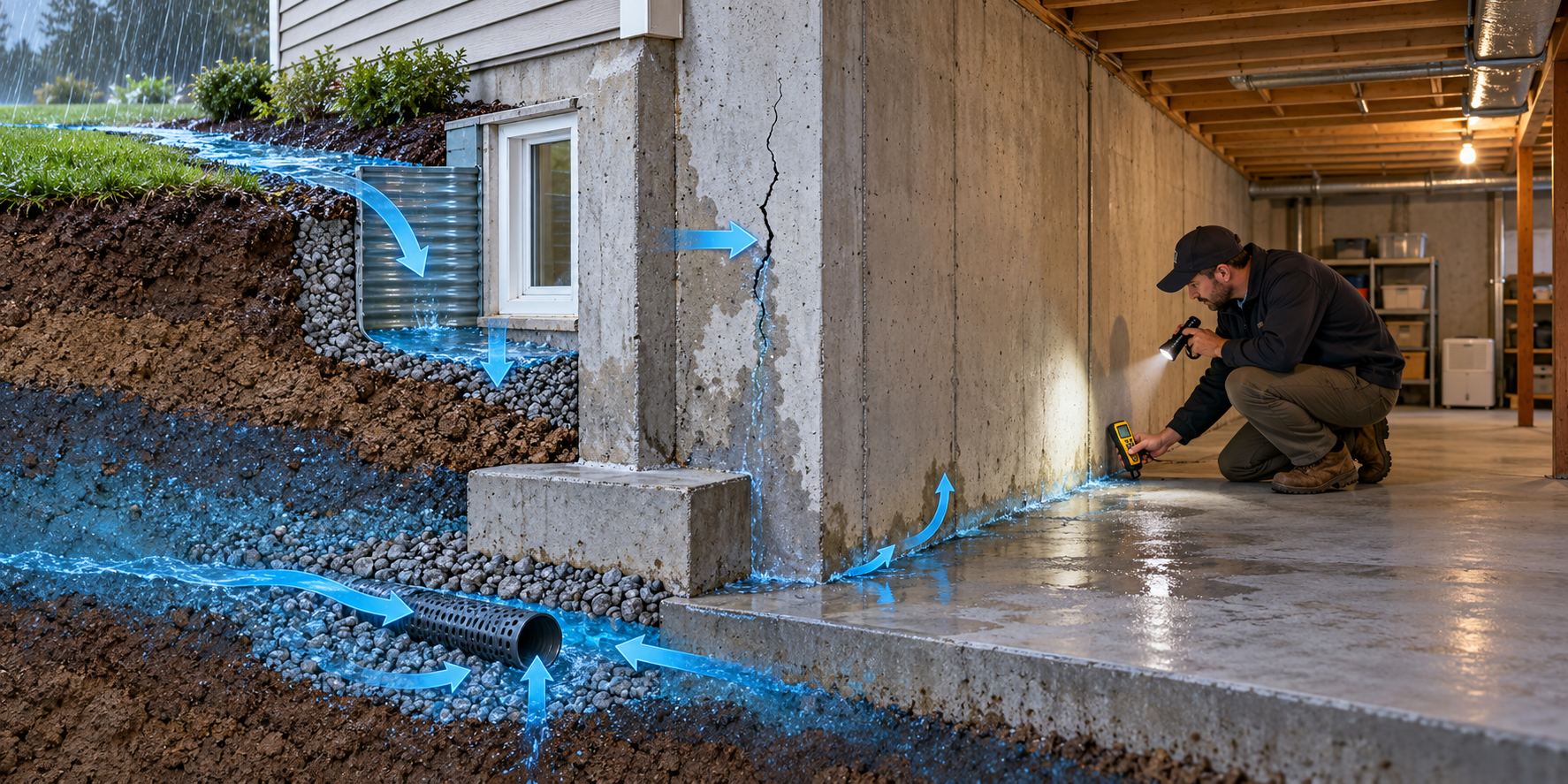
A useful wet-basement inspection identifies likely water pathways before a contractor prices a remedy. The same damp mark can result from rainwater, groundwater, a failed foundation drain, condensation, plumbing, or a window well. A diagnosis is therefore different from a sales estimate for a particular waterproofing system.
What the service may cost
No reliable comparable U.S. or Canadian fee dataset was established for this category. A provider may charge a flat inspection fee, an hourly diagnostic fee, or a fee that is credited toward later work. A free estimate may still be useful, but it can be tied to the provider’s preferred system and may not be an independent diagnosis. Ask what is included before comparing prices.
The fee should be judged against the decision it supports. A short visual visit may be appropriate for a clearly localized issue. Recurring water, multiple pathways, a finished basement, or a proposed excavation project justify asking whether moisture measurements, drainage review, or a written differential assessment are included.
What the inspector should examine
Expect the inspection to document, where accessible:
- when the water appears and whether rain, thaw, or plumbing use changes it;
- staining, efflorescence, damp surfaces, cracks, wall-floor joints, and slab seepage;
- grading, downspouts, window wells, foundation-drain access, and discharge paths;
- the sump pit, float, pump, check valve, alarm, backup, and visible discharge line;
- basement humidity and signs of condensation on cool surfaces;
- crawl-space soil vapor or standing-water conditions if that area is connected to the problem.
The evaluator may use a moisture meter or other non-invasive tools. These tools indicate conditions at the time and location measured; they do not prove the source or certify that a concealed assembly is dry. Opening finishes, camera work, engineering review, plumbing tests, or radon testing are separate scopes unless specifically listed.
Use clues without treating them as a diagnosis
Water after a storm points attention toward surface runoff, window wells, foundation drainage, or groundwater, but it does not identify one failed component. Condensation on a cool wall with high indoor humidity suggests a different cost path from water emerging at a floor joint. Soil can introduce liquid moisture or vapor into a crawl space, and vapor can condense on framing.
The written report should distinguish observations from conclusions and list what remains unknown. It should state whether the recommendation is localized sealing, drainage, a sump change, exterior work, humidity control, or referral to another specialist—and why.
When another specialist is needed
Ask for structural evaluation when movement, significant cracking, bowing, settlement, or other foundation distress is part of the concern. A plumbing professional may be needed when the timing follows fixture use or a concealed supply or drain leak is plausible. Mold, sewage, active flood damage, radon, and hazardous conditions require their own qualified assessment. Do not treat a waterproofing proposal as a substitute for those evaluations.
Questions before paying for a proposal
- Is this a diagnostic inspection, a contractor sales estimate, or both?
- What areas and systems will be examined?
- Are measurements, photographs, and a written report included?
- Which findings are observations and which are assumptions?
- Are specialist referrals included when the issue is structural, plumbing-related, environmental, or flood-related?
- If a repair is proposed, what problem does it solve and what problems remain outside its scope?
Match the inspection to the decision
The right scope depends on what you are deciding. If water appears once at a clearly identifiable opening, a focused visit may be enough to document the condition and compare a localized repair. If several walls, the slab, a sump, or a finished room are involved, a short sales visit may not answer the more important question: which system is actually failing?
Before booking, describe the pattern rather than asking only for a “waterproofing inspection.” Note the date, weather, snowmelt, duration, location, height of staining, smell, indoor humidity, and whether plumbing fixtures were used. Photographs from the event can be more useful than a later dry-wall inspection. Bring prior repair invoices, pump-service records, foundation-drain information, and any plans for finishing the space.
What the fee may and may not include
An inspection fee may cover a visual review and written summary, while measurements, destructive access, camera work, engineering, radon testing, or laboratory analysis are separate. A contractor may waive a fee when it expects to perform the repair. That can be a reasonable commercial arrangement, but ask whether the recommendation is limited to that contractor’s system and whether you receive the observations if you do not proceed.
The useful comparison is not simply “free” versus “paid.” Compare the deliverable:
- a room-by-room record of visible conditions;
- the water events and conditions that were considered;
- the systems that were inspected and the areas that could not be reached;
- a distinction between observed moisture and inferred source;
- a prioritized list of likely next steps;
- assumptions, limitations, and specialist referrals; and
- a clear statement of whether a quote is for diagnosis, repair, or both.
A report that only recommends an expensive system without explaining the observed pathway gives you less decision value than a shorter report that clearly states what is known and unknown.
Common diagnostic cost paths
The least expensive path is often a visual moisture assessment when the issue is recent and localized. A more involved evaluation may add moisture measurements, humidity logging, inspection of the sump and discharge, or review of drainage around the foundation. Opening a finished wall or floor, tracing a concealed plumbing leak, testing for radon, or evaluating a structural concern changes the service and should be priced separately.
The inspection does not need to identify every possible cause to be useful. It should narrow the decision. For example, it may establish that a proposed interior drain would not address a plumbing leak, that a dehumidifier is relevant to condensation but not to water through a crack, or that exterior grading should be corrected before a foundation system is priced. Those conclusions can prevent paying for a system that is larger, smaller, or simply different from the problem.
When to obtain more than one opinion
An independent moisture or building-science opinion can be valuable when the first proposal is a large system, when two contractors recommend different methods, or when the proposed work would remove finishes or require excavation. It is also reasonable to seek a structural professional when there is movement, bowing, settlement, displaced masonry, or a crack pattern that cannot be explained by water entry alone.
The goal is not to collect an arbitrary number of free quotes. It is to compare recommendations that begin with the same observed conditions and state different assumptions openly. A waterproofing quote should be easier to evaluate after the diagnosis has described the pathway it is intended to correct.
The decision after the inspection
Use the report to sort the next step into one of four groups:
- Monitor or maintain: the condition is limited, understood, and not currently requiring a capital project.
- Correct a local source: a downspout, window well, joint, crack, or discharge detail is the dominant issue.
- Install or repair a water-management system: drainage, a sump, membrane, or related work is needed because water is recurring or system-wide.
- Refer or sequence other work: structural, plumbing, environmental, restoration, site-drainage, or flood-resilience work changes the project.
Those categories are not diagnoses that a reader can assign remotely. They are a way to ask whether the proposed price buys an answer, a repair, or a broader system. Keep the inspection cost visible in the project budget, but judge it by whether it reduces the risk of approving the wrong work.
What the inspection should establish
Before comparing inspection prices, write down the decision the visit is meant to support. A first visit may only need to determine whether the problem is active, seasonal, or historical. A pre-finish inspection may need to establish whether the room is dry enough to close in and whether a proposed wall assembly would hide a continuing problem. A quote review may need a second opinion on whether a full perimeter system is justified.
Useful deliverables can include a room-by-room moisture map, photographs of visible conditions, notes about recent weather, readings at representative surfaces, likely entry points, and a list of limitations. If the inspector recommends excavation, drainage, a sump, crack repair, or restoration, the report should explain the observation that led to that recommendation. It should also distinguish a suspected mechanism from a confirmed one.
The inspection is not a guarantee that every concealed condition has been found. A finished wall, insulation, stored contents, or inaccessible crawl-space area can limit what can be observed. Those limitations belong in the scope and should not be treated as evidence that the unobserved area is sound.
Separate diagnosis from repair pricing
An inspection fee and a repair proposal answer different questions. The inspection asks what is happening and what needs to be investigated next. The proposal asks what a contractor will do, with what materials, over what measured area, and with what restoration. One company may combine both services; that does not make the line items directly comparable.
When a proposal includes an inspection at no charge, ask whether the diagnostic scope is still independent enough to consider alternatives. When an independent inspector recommends a repair, ask whether the contractor has priced the same mechanism and extent. A low initial fee can be followed by a large project, while a higher fee can be worthwhile if it prevents an unnecessary excavation or identifies a plumbing source.
Keep the inspection report, photographs, readings, and proposal together. If the problem changes after a rain event or after a temporary repair, the record helps determine whether the original hypothesis still fits.
When to seek another opinion
A second opinion is especially useful when the proposed solution is much broader than the visible symptom, when the mechanism is uncertain, or when two contractors recommend incompatible approaches. It is also reasonable before opening a finished basement, replacing a drainage system, or approving work that will be difficult to reverse.
The second visit should receive the first report only if you want a review of that reasoning. Otherwise, ask the second professional to document independent observations before seeing the recommendation. Compare the observations and assumptions, not just the totals. If both reports identify the same water path but disagree about how much work is needed, the remaining question is scope. If they identify different sources, pay for the next diagnostic step before choosing a remedy.
A practical decision after the visit
Classify the result as one of four outcomes: monitor with a defined trigger, perform a targeted repair, correct a larger water-management system, or investigate a different source. “Monitor” should state what to record and when to call again; it should not mean ignoring recurrent water. “Targeted” should identify the visible condition and the limit of the repair. A system recommendation should identify the water path, collection method, discharge, and restoration.
The inspection has done its job when the next quote can be measured against a shared scope. If the report cannot explain why the proposed work matches the observed mechanism, the most useful next expenditure may be clarification rather than construction.