
No membrane is the universal value winner. Installed costs commonly overlap because roof preparation, insulation, walls, drains, penetrations, access, and contractor minimums can matter more than the membrane price. Compare exact assemblies on the same measured roof.
The three approaches
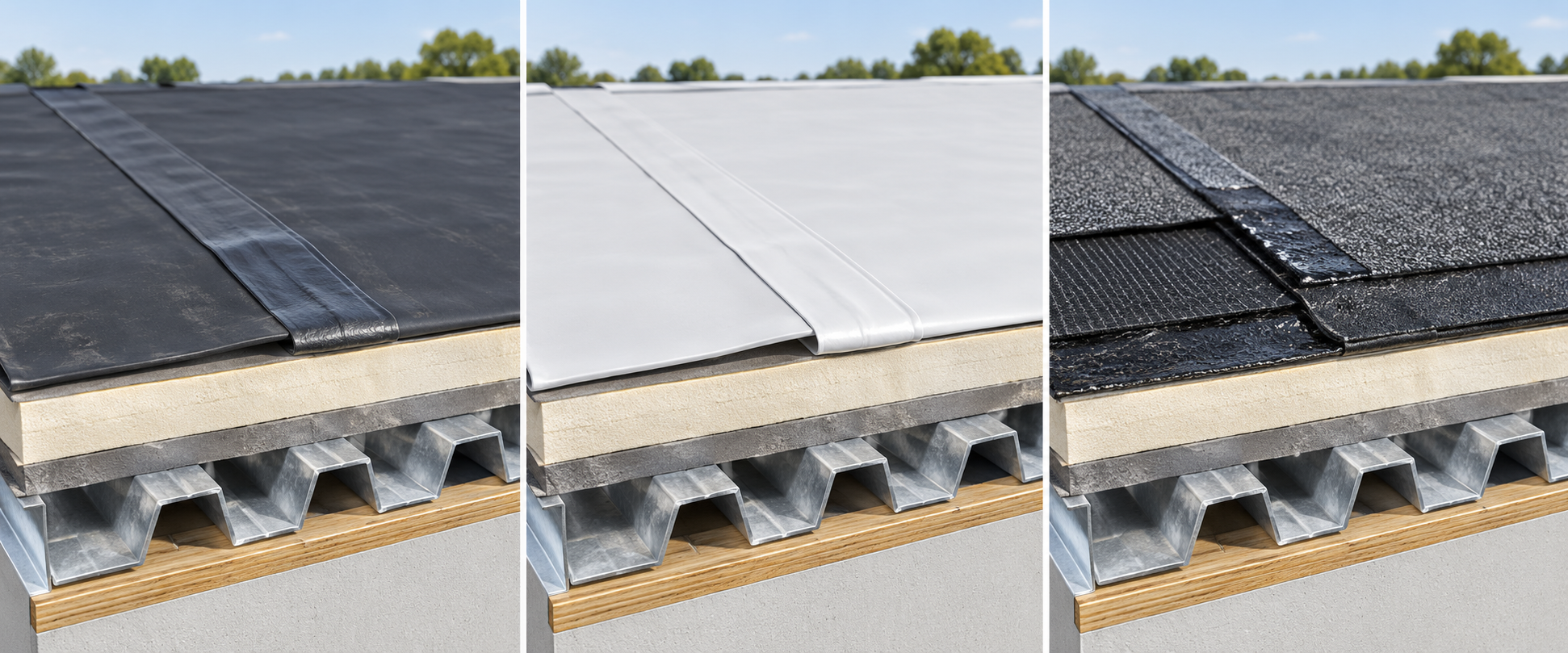
EPDM is a synthetic rubber sheet commonly available in dark membrane. Systems can be adhered, mechanically attached, or ballasted where appropriate, with seams and details made using system-specific components.
TPO is a thermoplastic single-ply membrane, commonly light colored, with heat-welded seams. Attachment, thickness, reinforcement, and accessories vary by manufacturer.
Modified bitumen uses asphalt modified with polymers and reinforced into sheets. Installation approaches can include self-adhered, cold-process, hot asphalt, or torch application, subject to product and site constraints.
These descriptions are taxonomy, not a specification.
Cost differences
EPDM can be economical on simple fields, but perimeter and penetration detailing remains substantial. TPO may carry welding equipment and trained-labor requirements while offering a reflective surface option. Modified bitumen may fit smaller detail-heavy roofs or local contractor practices, but installation method changes labor and risk controls.
Small residential jobs often carry high per-square-foot costs because contractors mobilize a complete crew and system for limited area. Local installer familiarity can outweigh a modest material-price difference.
Substrate and attachment
All three require a suitable, dry, stable substrate and compatible layers. Existing membrane, deck, insulation, vapor behavior, cover board, and local requirements affect attachment. Do not select a membrane before knowing whether the project is tear-off, recover, or restoration.
Ask how the system resists wind at the field, perimeter, corners, and penetrations. Exact fastening or adhesive patterns are design- and product-specific.
Seams and penetrations
EPDM seam quality depends on preparation and compatible tapes/adhesives or system components. TPO uses welded seams whose quality depends on equipment, settings, weather, and workmanship. Modified-bitumen laps depend on the selected installation method.
Every system still has vulnerable transitions. A simple field with many curbs and drains may cost more than a larger uninterrupted field.
Climate and surface
Reflective TPO or coated systems can reduce roof-surface heat in hot sunny conditions; dark EPDM can have different heat behavior. Building insulation, heating climate, shading, aging, and product rating affect energy outcomes. Do not select solely on color or promise universal savings.
Cold-weather flexibility, hail, foot traffic, chemicals, ponding, and snow should be discussed for the exact product and site. Broad category claims are inadequate.
Repair and future service
All three can be repairable when the material remains compatible and accessible. Availability of trained local contractors and system components matters. Ask how the contractor would locate moisture, repair a puncture, rebuild a drain, and handle a future addition.
A slightly cheaper system with no local service network may have worse ownership economics than a familiar alternative.
Decision scenarios
Simple residential addition: EPDM may offer an efficient field solution if details and installer experience align.
Hot sunny roof where reflectance matters: A rated light-colored TPO or coating approach may be evaluated with building energy context.
Small urban roof with many details: Modified bitumen may fit local practice, but installation method, fire controls, fumes, and occupied-building constraints matter.
Existing compatible membrane in good condition: Restoration or recover may outperform full tear-off if moisture investigation supports it.
How to choose
Compare manufacturer/system, membrane specification, attachment, substrate preparation, insulation, cover board, seam method, walls/edges, drains, penetrations, warranty, contractor experience, and future repair access. Do not use an unsupported universal lifespan to calculate “cost per year.”
The strongest choice is the assembly your roof conditions require and a qualified local contractor can install and service well.
Ask each bidder to solve the same roof
Provide the same moisture findings, measured area, drainage constraints, insulation goal, penetrations, access, and tear-off assumption. Then request alternate systems or separate specialist bids. Otherwise one proposal may include tapered insulation and new edge metal while another prices membrane only.
Detail-level comparison
Ask how each system handles parapet walls, drains/scuppers, skylights, curbs, pipes, edges, and transitions to steep roofing. Request sample detail references from the proposed manufacturer. Field membrane price is less informative on a small roof with a high perimeter-to-area ratio.
Installation disruption
Adhered systems, welded seams, asphalt-based methods, and tear-off have different equipment, odor, noise, temperature, and weather constraints. Occupancy and neighboring property can change the practical choice. Exact product safety and installation controls remain the contractor’s responsibility.
Reflectance and color
Dark EPDM and light TPO are common reference cases, but coatings and product variants complicate the comparison. Model energy value only after insulation, climate, shading, and rating are considered. A cool surface may be useful without being the main reason to choose a weaker local service ecosystem.
Future recover and coating
Ask whether the new assembly has a credible restoration or recover path and what conditions would preserve it. Compatibility cannot be guaranteed decades ahead, but current manufacturer options and detail design provide context. Avoid paying a premium solely for an unsupported claim that one system will always be recoatable.
Decision matrix
Score exact installed cost, moisture/substrate fit, local installer depth, details, climate/product rating, repair access, warranty, disruption, and future intervention. Weight them for the property. A simple “EPDM lasts X, TPO lasts Y” comparison hides the factors most likely to control homeowner cost.
Hold the project constant before choosing material
Ask bidders to price the same tear-off or recover assumption, moisture removal, deck and insulation, drainage, perimeter, penetrations, access, temporary protection, and warranty level. Then identify what truly changes with EPDM, TPO, or modified bitumen: membrane, attachment or adhesive, seam method, flashing components, equipment, labor, weather window, and local service ecosystem.
A lower membrane allowance can be offset by substrate preparation, multiple plies, cover board, custom details, or installer travel. A higher proposal may include wet-material removal or drainage work missing from another. Reconcile these lines before treating the difference as a material premium.
Use exact products. Thickness, reinforcement, surface, sheet size, attachment, and approved assembly differ within each family. A generic family comparison cannot establish suitability for one roof.
Three property scenarios
On a simple open roof with strong local service for several systems, installed scope, contractor quality, and repair access may decide more than membrane family. Controlled alternates can reveal whether one system has a meaningful installed-cost advantage.
On a detail-heavy roof with many curbs, walls, and drains, compare how the installer constructs and later repairs those details. Field-sheet attributes cannot compensate for poorly resolved transitions. Request detail drawings or product-standard examples tied to the actual proposal.
On an occupied or access-constrained property, odor, flame or heat work, welding equipment, adhesive conditions, noise, staging, and weather windows can change disruption and schedule. These constraints may justify a different assembly even if its field material costs more.
Repair ecosystem and ownership horizon
Ask who locally services the exact system after the original workmanship period, how seams and punctures are diagnosed, whether matching membrane and accessories are widely distributed, and what future coating or recover paths are currently documented. A theoretically durable system with no credible local repair path can create high emergency and travel costs.
For a long-term owner, documentation, inspection access, drainage maintenance, repair methods, and future equipment changes deserve weight. For a short horizon, choose a coherent accepted system and clear warranty without assuming a premium is fully recovered through sale. In either case, retain installation photographs before details are covered.
Tradeoffs without a universal winner
EPDM can offer large flexible sheets and established repair methods in suitable assemblies; TPO uses heat-welded seams and often a light surface; modified bitumen provides an asphalt-based multi-layer or sheet approach with its own application choices. These descriptions do not rank exact products or installers.
Choose the proposal that best resolves substrate, moisture, insulation, drainage, details, climate/product suitability, and service access at an acceptable total cost. If two systems remain viable, request priced alternates from the same contractor and let the actual installed increment and ownership preferences decide.
Compare seams and details as installed work
Count field seams, factory or fabricated transitions, perimeter length, drains/scuppers, curbs, pipes, walls, and penetrations. Ask how each exact system forms and tests those details and what weather conditions constrain installation. The family with fewer field seams may still have more difficult transitions on one geometry.
Do not grade seam methods generically. Adhesive, tape, heat welding, asphalt-based laps, reinforcement, and surfacing have product-specific preparation and quality controls. Ask the bidder how workmanship is checked and documented and how one defective seam is repaired after closeout.
A controlled-alternate example
One contractor may offer EPDM over a specified cover board and another TPO with added insulation and drain work. Their totals do not reveal a membrane-family premium. A useful comparison asks a qualified bidder to carry the same substrate, insulation, drainage, perimeter, and detail counts, then show system-specific changes.
If modified bitumen is the locally strongest service option but creates different disruption or application constraints, include those explicitly rather than excluding it on generic age or color claims. The result should show actual local tradeoffs, not an internet ranking.
Decision thresholds after investigation
If moisture, substrate, or retained-layer findings make the preferred assembly ineligible, switch to the prepriced fallback. If two systems remain eligible and the price difference is modest, installer capability, detail quality, and repair ecosystem can decide. If the difference is large, identify the exact system feature or scope responsible before paying it.
A complete comparison does not require predicting which membrane lasts longest. It requires selecting a compatible, detailed, serviceable assembly with controlled concealed-condition risk and an ownership plan.
Compare lifecycle scenarios without fixed lifespans
Build a low-service case with routine drainage/condition checks and bounded detail repair; an expected case with a puncture, seam or flashing intervention; and a difficult case involving moisture, equipment change, or broader recover/replacement. Apply each to the exact proposed systems using local repair capability and warranty remedy, not universal age tables.
A lower first cost can remain strongest when the system is well supported and details are straightforward. A higher cost can be justified when it reduces a property-specific installation constraint, improves a named detail or disruption issue, or has a materially stronger local service path. It should not rely solely on color, polymer family, or an unsupported longevity gap.
Quote and closeout checklist
Require moisture/substrate basis, full assembly, attachment, insulation/slope, drainage, perimeter/detail counts, exact products, installation conditions, quality-control method, repair procedure, warranty split, fallback threshold, and closeout photographs. Keep leftover compatible material where appropriate and identify who can service it. These lines turn a product comparison into an ownership decision.
Compare warranty remedies
Manufacturer, system, contractor workmanship, and maintenance terms can differ even when headline years match. Ask whether labor, membrane, insulation, details, consequential interior work, inspection, transfer, and ponding or maintenance exclusions apply. The longest term should not override stronger substrate investigation or detail workmanship.
If a warranty requires an authorized installer or periodic service, include that availability and cost in the ownership case. A clear local workmanship remedy can be more useful for a residential puncture or flashing issue than a broad product term whose claim process does not cover the likely intervention.
Final regret test
For the preferred system, state the most plausible downside: difficult weather window, local service scarcity, detail complexity, puncture/repair, surface aging, or future recover limits. Confirm that the installed-cost advantage or property-specific benefit remains worthwhile. Then record why the other eligible systems lost. This produces a comparison that can be revisited when contractors or products change.
Uncertainty boundary
Product lines, installer availability, warranties, and future compatibility can change. Base the choice on current exact assemblies and local service, then retain a fallback repair strategy. This uncertainty is not a reason to stop at generic membrane descriptions; it is a reason to compare detail quality, documentation, and serviceability more carefully.