
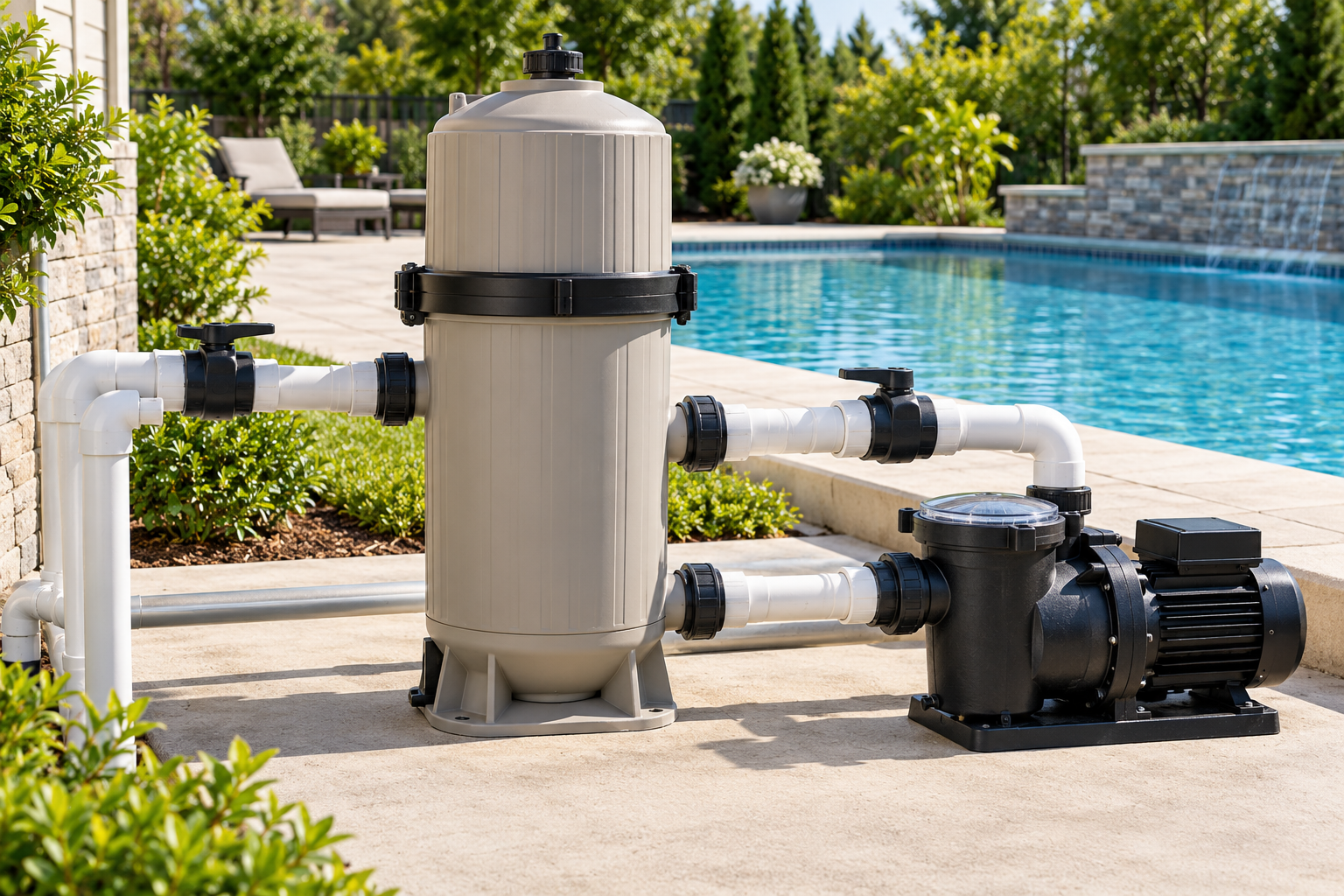
A filter replacement quote should distinguish the filter vessel from media, valves, plumbing, installation, disposal, and any pump or equipment-pad changes. Equipment-only prices are not comparable with an installed project that needs replumbing or difficult access.
Cost orientation
A current U.S. specialist observation places pool-filter installation around $250–$2,000. Use it as a scope-bounded signal, not a universal filter price: vessel size, media, valves, plumbing, pump matching, access, disposal, and startup determine where a quote falls. A change in filter type may add changeover and recurring-maintenance costs. Obtain separate local evidence for Canadian projects.
What “filter replacement” can include
The filter vessel is only one possible scope. A replacement may include the tank or housing, cartridge or media, multiport or other valve, unions and plumbing, pressure gauge, relief or drain components, pump pairing, equipment-pad adjustments, access, removal, disposal, testing, and startup. Ask whether the proposal replaces the vessel, the media, the valve, or the complete filtration arrangement.
Start with the reason for replacement. A cracked pressure-containing vessel, obsolete valve, damaged cartridge housing, recurring maintenance problem, undersized filter, poor pairing with the pump, or parts-availability issue can lead to different recommendations. A dirty or cloudy pool does not automatically prove that the filter is the problem; water chemistry, circulation, leaks, and operating practice may also need evaluation.
Compare filter types in the context of the system
Cartridge, sand, and DE systems have different cleaning, media, water, footprint, discharge, labor, and maintenance implications. The replacement decision should consider the existing plumbing and valves, the pump and required flow, available space, service access, local discharge rules, and the owner’s tolerance for maintenance. Do not choose a vessel from pool volume alone or assume a larger filter solves every circulation problem.
Ask the installer to document the equipment model, connections, control or valve changes, pressure or flow assumptions, and manufacturer compatibility. If the replacement changes filter type, identify which new cleaning or disposal tasks the owner or service provider will assume. Local rules for backwash or discharge can affect the practical choice and are not established nationally by the category evidence.
Repair or replace the filter
Repair may make sense when the failure is a replaceable gasket, gauge, valve component, cartridge, or other isolated part and the vessel remains safe and serviceable. Replacement is more plausible when the tank is cracked, the valve is obsolete, media is no longer supported, several parts are failing, or the system is mismatched to the pump and pool’s intended operation.
Do not treat a pressure-containing component as a casual DIY project. Have the professional explain depressurization, access, reconnection, leak checking, and startup responsibilities. The quote should state what is tested after installation and what condition would require further plumbing or equipment work.
How to compare proposals
Request the selected model, filter type, media or cartridge specification, valves, plumbing, pump compatibility, access, disposal, pressure or leak testing, startup, warranty, and ongoing maintenance assumptions. Ask whether the proposal includes the first media charge, replacement media, filter cleaning, and any discharge or drainage work. If the contractor recommends a larger or different filter, ask what problem it solves and which other components must change.
The right filter is the one that fits the hydraulic system, site, maintenance plan, and local disposal conditions—not simply the one with the lowest equipment price.
Make the future maintenance obligation visible
Ask who will clean or replace the cartridge, supply or handle media, manage backwash or discharge, record pressure, and provide seasonal service. Local discharge restrictions can change the practical choice. If the owner hires a service company, include filter care in the contract and identify extra charges. If the owner performs routine care, confirm the access, lifting, storage, and disposal requirements.
Use the U.S. $250–$2,000 installation observation only as a scope-bounded signal. It is not a universal filter price or Canadian estimate. Request local CAD pricing where applicable and preserve the distinction between equipment, installation, changeover, and recurring service.
Distinguish a vessel failure from a water-quality complaint
A filter is one part of circulation and water care. A high pressure reading, cloudy water, weak return flow, repeated cleaning, or a complaint that the pool is hard to maintain can have more than one cause. Ask what was observed and which checks support the recommendation before treating the tank itself as failed. The service provider should state whether the issue is a damaged vessel, a serviceable component, an unsuitable system pairing, or a water-care condition outside the filter.
For a like-for-like replacement, compare the existing filter’s model, connections, service access, and replacement part support with the proposed unit. Confirm which old valves, unions, pressure gauge, plumbing, and base remain in use. For a change in filter type or capacity, ask which operating problem the change is intended to solve and what changes to pump, valves, discharge, cleaning routine, or equipment footprint follow. Do not select capacity solely from pool volume without the system’s required flow and manufacturer direction.
A filter that is easy to purchase but difficult to open, lift, clean, or drain can transfer cost to every service visit. Ask the installer to show the lid-removal and cartridge or media handling space on the pad. If service work requires moving another component, include that labor in the ownership comparison. This is especially relevant where equipment sits close to a wall, fence, heater, or other fixed obstruction.
The final handoff should identify the pressure or startup observations the technician considered normal, the product’s cleaning guidance, the media or cartridge part number, and any local discharge conditions. That record is more useful than a generic calendar that may not fit the selected system.
Read the operating symptom before selecting a larger vessel
A high filter pressure, low return flow, cloudy water, repeated cleaning, or a split vessel may call for different assessments. Ask the provider to state the measured or observed condition and whether it is consistent with a failed tank, a valve or media issue, pump behavior, a restriction, or water treatment. A proposal for a larger vessel should identify the limitation it addresses and the equipment assumptions behind that choice.
If the owner changes from one filter type to another, consider how the operating system changes beyond the purchase. Connections, valve arrangement, pump pairing, discharge, service clearance, cleaning work, spare media, and local disposal can all affect the result. Have the contractor explain which components remain and which need replacement. This avoids paying for capacity or features that do not match the pool’s actual use.
A pressure vessel is not ordinary household equipment. Have a qualified professional perform the work and verify startup, leak condition, pressure observation, and operation. Keep the model, valve, media, pump pairing, service access, and local discharge notes in the installation record.
Key points
- Price the vessel, media, valves, plumbing, access, and installation together.
- Filter failure symptoms can originate elsewhere in the circulation system.
- Compatibility requires pump, valve, flow, and product information.
- A filter-type change is an ownership decision, not just a replacement part.