
“Mobile home” is common reader language, but it does not identify every factory-built home. In the United States, a manufactured home is built under the federal Manufactured Home Construction and Safety Standards. On July 11, 2026, Public Law 119-101 amended the federal definition to include qualifying manufactured homes built with or without a permanent chassis. “Mobile home” often describes older housing or the same type of home informally; the everyday label alone does not establish a home’s construction date, code, or legal classification. A modular home is a different category, even when it arrived on a truck in sections.
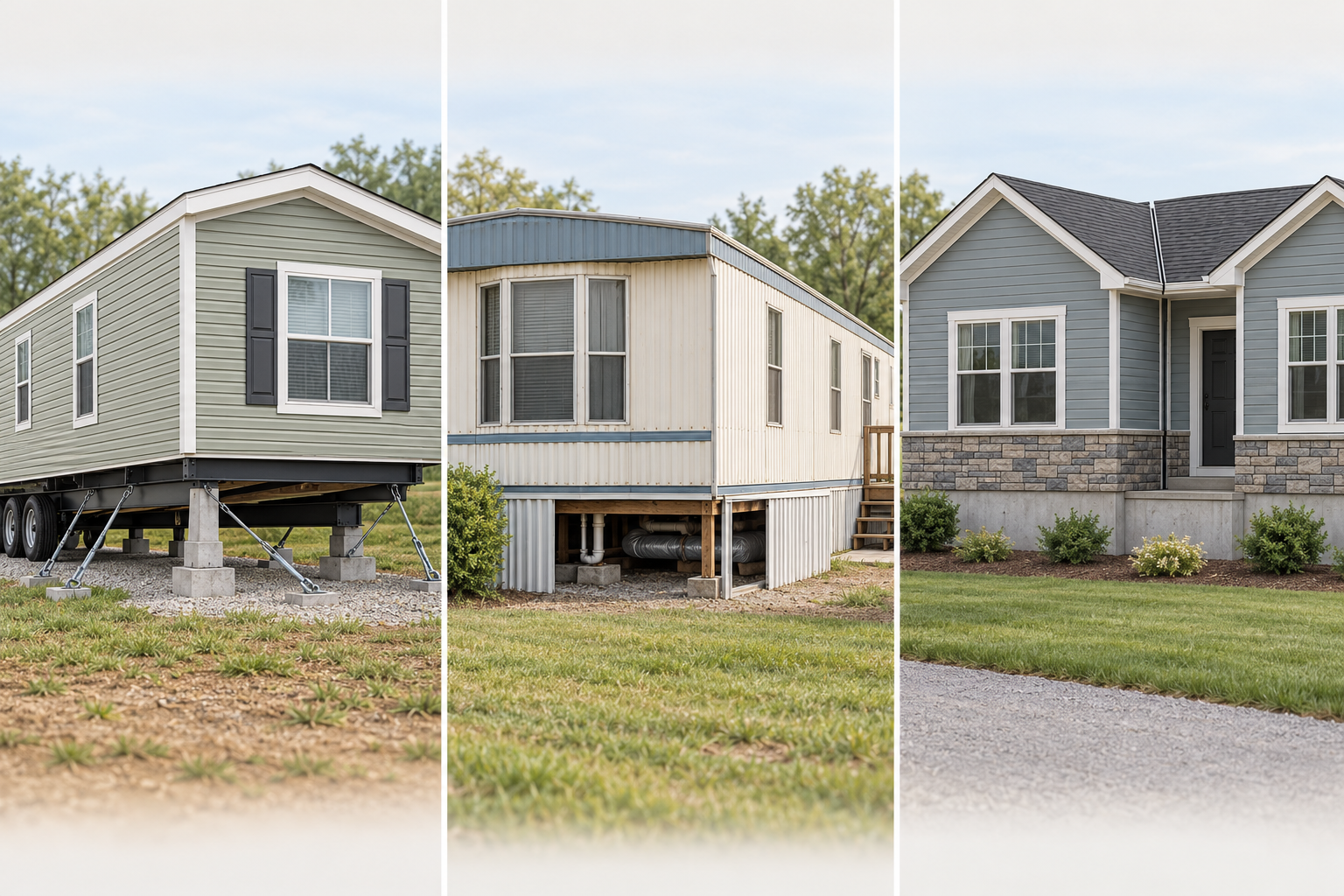
Why the classification changes the quote
Home type can affect:
- which labels, records, and installation instructions a contractor needs;
- whether the chassis, piers, foundation, anchors, or section connections are part of the diagnosis;
- whether replacement equipment, windows, doors, or roof work fits the existing assembly;
- which authority reviews site work, alterations, utilities, or additions;
- whether the quoted work is factory-built-specific or ordinary site-built work.
It does not mean every repair needs a specialist. A modular house that follows ordinary local construction after setting may use conventional roofing, plumbing, electrical, or finish trades. A manufactured home may still use ordinary trades for many components, but the access, connection, documentation, and support assumptions can change the labor and risk.
Manufactured homes
The federal definition was amended by Public Law 119-101 to cover manufactured homes with or without a permanent chassis. The Act also directs HUD to issue revised standards for homes built without a permanent chassis, including distinguishing certification labels, data plates, and manufacturer-invoice notation. Those directions do not identify what label or document an owner of a particular home should expect today; check current HUD guidance and ask the responsible authority or lender about the specific home. HUD’s public homeowner page still contains older chassis wording, so do not rely on that sentence to restate the amended federal definition. Installation remains a separate site-side system involving access, soil, support, anchoring, drainage, enclosure where applicable, and utility hookups. The home’s manufacturer instructions and the authority for the installation state or locality still matter.
Older homes may be called mobile homes, especially in everyday conversation. Do not turn the name or age alone into a legal conclusion about relocation, eligibility, or alteration. Confirm the home’s records and the current local requirements.
Modular homes
Modular housing is factory-built, but it is not automatically a HUD Code manufactured home. Ontario guidance, for example, describes CSA A277 factory quality control and inspection while leaving foundation, anchorage, grading, and other site-completion matters to be verified at the property. A B.C. bulletin distinguishes CSA Z240 as a product standard from CSA A277 as a factory-certification standard. Those are jurisdiction-specific examples, not a universal Canadian rule.
For a modular repair or remodel, ask whether the issue involves a module joint, site completion, transportation damage, or a normal building assembly. This keeps a factory-built distinction useful without applying manufactured-home rules where they do not belong.
What to verify before accepting a quote
Gather the certification labels, data plate, serial or VIN, section count, year, manufacturer, installation location, foundation or pier information, and available manuals. Ask the contractor to state whether the scope assumes a manufactured home, modular home, seasonal unit, or another classification. For Canada, identify the province and municipality before relying on a certification or inspection statement.
For foundation, anchoring, structural, fuel, electrical, plumbing, roof-load, or alteration work, have a qualified local professional confirm the home-specific requirements. A classification guide can identify the questions; it cannot substitute for the documents, site inspection, or authority having jurisdiction.
Use the classification as a quote check
Ask each bidder to identify the home type and the information used to scope the work. A quote based on a conventional site-built assumption may miss transport joints, underfloor connections, support systems, or manufacturer restrictions. A quote that treats every factory-built home as a HUD Code manufactured home may add irrelevant requirements to a modular or seasonal unit. Request the assumption in writing and compare it with the home’s labels, plans, and location.
The physical chassis is still relevant to some work even though it is no longer required by the amended federal definition. A mover, installer, or engineer may need to inspect the actual frame, lifting points, attachment, and condition. Conversely, the absence of a permanent chassis does not by itself make a home modular or establish how it is titled, financed, taxed, insured, or permitted. Each of those decisions has its own program or jurisdiction rules.
For a purchase or major renovation, create a short record before bids: home type as shown by available certification, manufacturer and model, serial or VIN, number of sections, approximate age, province or state, site address, foundation, and known alterations. Mark uncertain entries rather than guessing. Send the same record and photographs to each bidder so estimates are based on comparable assumptions. If one bidder says a missing document changes the scope, ask what verification would settle the issue and whether that work is included.
Use the law’s July 2026 definition for the federal classification question and current local sources for the project decision. The Act’s new no-chassis standards do not make Canadian CSA categories interchangeable with U.S. manufactured housing, and they do not turn a modular home into a manufactured home. In Canada, identify the province and municipal authority before applying an Ontario or B.C. example. The best result is a quote that names the assembly and approval boundary it relies on, then lists the cost consequences if that assumption proves wrong.
What the categories mean for cost
The category is a starting assumption for a quote, not a price multiplier. A manufactured home may need a trade to check its factory documentation, chassis or frame, sections, and site installation before the main repair is priced. A modular house may instead be reviewed through its building permit, module connection details, and local code path. A seasonal or park-model unit can have different occupancy and transport limits. The trade and local authority can tell you which items actually apply; do not pay for work that exists only because a bidder guessed at the classification.
The costs most likely to be missed are the interfaces: lifting or stabilizing a home to access a component, opening and restoring the belly or a section joint, documenting a repair for a lender, obtaining design or permit review, and coordinating the factory-built unit with a site-built addition. Ask the contractor to list these as separate lines. If a quote combines them under “special installation,” request the task, quantity, and acceptance requirement behind that line. You can then compare the bid with one from a conventional trade on equivalent scope.
A repair can also reveal that the classification was only one of several assumptions. A wet floor may require a plumber and floor specialist; a roof overlay may require checking the actual roof and load information; a new heat pump may depend on ducts and electrical service. A label or title record does not establish that those assemblies are in good condition. Budget an inspection or opening allowance when the assembly cannot be seen, then ask for a change-order process before work begins.
A practical intake record before bids
Use a one-page intake sheet rather than asking a contractor to infer the home from a listing description. Include:
- the classification shown on documents, plus any uncertainty or conflicting description;
- manufacturer, model, serial or VIN, sections, known year, and available certification marks;
- the current site, foundation or supports, utilities, and any leased-lot arrangement;
- the project goal, symptoms, location, and whether the issue followed a move or alteration;
- known permits, previous repairs, inspection reports, manuals, and photographs;
- whether the project is routine maintenance, a repair, a structural change, relocation, or a transaction requirement.
Ask every bidder to return the same basic answers: which source they used to identify the home; which portion of the work is factory-specific or site-specific; what is excluded; and what finding would change the price. If an authority, lender, title professional, or insurer has already stated a requirement, attach the written request and ask the bidder to price the work that satisfies it. Avoid paying for a broad redesign when the actual transaction only asks for a specific record or inspection.
Keep each country’s evidence in its lane
U.S. federal manufactured-home standards and installation programs do not establish Canadian requirements. Canada also does not have one national approval checklist for every factory-built home. The Ontario and B.C. examples cited here show how factory certification and site-completion questions may be divided; they are useful prompts for the province and municipality, not rules to transfer elsewhere. For every project, name the state or province and the authority with jurisdiction before relying on a permit statement.
The 2026 federal statutory change concerns the U.S. definition and the standards HUD is directed to develop for homes built without a permanent chassis. It does not convert a modular home into a HUD Code manufactured home, set the property’s title, or guarantee mortgage, insurance, tax, transport, or permit treatment. Those are separate decisions. If one of them is the reason for a project, obtain the relevant agency or professional’s requirement in writing and keep it with the quote. That record helps prevent a classification discussion from turning into unnecessary work or a costly assumption.