
A squeak is a symptom, not a diagnosis. Movement can occur between the finish and subfloor, between subfloor layers, around fasteners, or in a larger assembly. The cost depends first on finding the moving interface and then on whether the repair can be reached without damaging the finished floor.
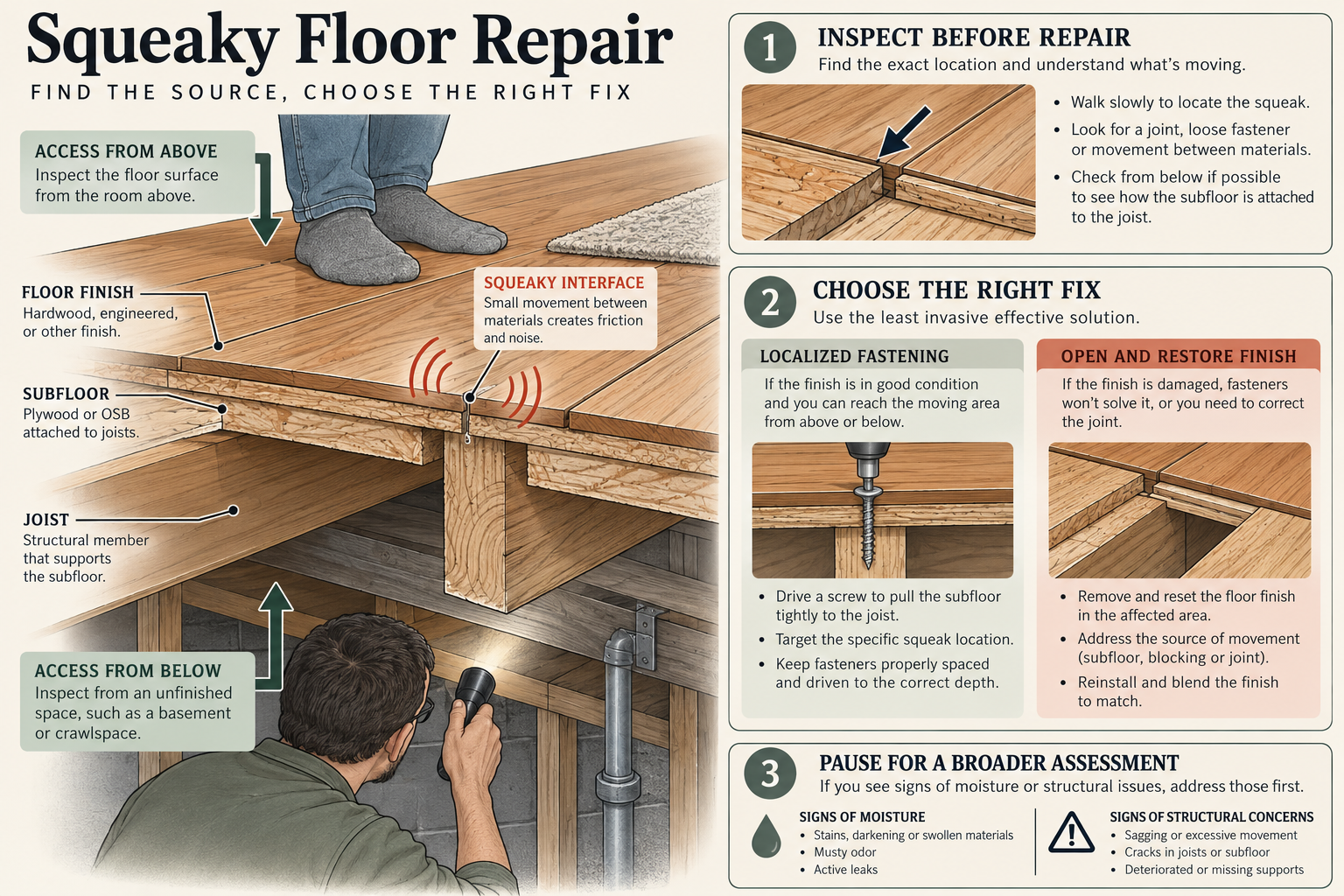
What changes the repair scope
Access from an unfinished basement or crawl space can make inspection and correction less disruptive. A finished ceiling below, carpet, tile, or a continuous hardwood floor can require more protection or localized opening. The quote may also include a service-call or minimum-charge component because a small symptom still requires travel, setup, diagnosis, and cleanup.
Available market data does not establish a reliable national U.S. or Canadian squeak-repair price. Ask whether the estimate covers diagnosis, access, fasteners or other materials, finish repair, and a second visit if the first correction does not identify the source.
When the floor may need more than a squeak repair
Widespread movement, a soft area, moisture damage, rot, settlement, or a change in floor elevation deserves more careful assessment. Repairing a noise without addressing damaged framing, a wet subfloor, or structural movement may not last. Do not assume that a quiet floor is proof that the assembly is structurally sound.
Comparing quotes
Give the contractor a description of when the squeak occurs, whether it is localized, and what spaces are accessible from below. Request a scope that distinguishes investigation from repair. If the finish must be opened, ask how the patch will be matched and whether the cost includes restoration.
The best budget question is not “What is the price to stop the noise?” It is “What condition is being corrected, how will it be reached, and what remains outside this estimate?”
Common causes behind the symptom
A squeak can come from movement between the finish and the subfloor, between subfloor layers, around a fastener, at a stair or transition, or in the framing below. Seasonal movement can make a sound appear or disappear as moisture conditions change. A single noise does not identify the repair, and a quiet floor does not prove that the assembly is structurally sound.
The first useful service is therefore observation. The contractor should identify where the sound occurs, whether it repeats under a specific load, whether the surface moves, and whether the space below is accessible. A quote that jumps directly to a universal fastening method may be inexpensive, but it may not address the source.
Simple, moderate, and complex repair paths
A simple path may involve a localized attachment issue in an accessible area. The contractor can inspect from below or through an accessible finish, make a limited correction, and confirm whether the movement has changed. The quote should still say whether the visit includes diagnosis and a return visit.
A moderate path may require lifting carpet, removing a small finish area, opening a ceiling below, repairing a subfloor seam, or restoring a patch. The finish restoration can cost more than the fasteners or repair material.
A complex path involves widespread movement, moisture damage, soft areas, settlement, damaged framing, or a squeak that cannot be isolated. The project may need structural or moisture assessment before a finish contractor can price a durable repair.
Above versus below
Access from an unfinished basement or crawl space can reduce visible finish disruption, but the space may be tight, damp, insulated, or crowded with utilities. Access from above may be more direct but can require removing carpet, planks, boards, tile, or trim. On hardwood or tile, matching and blending can make a small opening expensive. On carpet, a patch may be visible if spare material is unavailable.
Ask exactly how the contractor plans to reach the moving interface. If the plan depends on a particular access condition, include that condition in the quote. Do not assume that a contractor can reach the area from below because a basement exists; joists, insulation, ductwork, wiring, and finished ceilings can change the route.
When a squeak suggests a larger question
Escalate the assessment when the floor feels soft, slopes or changes elevation, has visible water damage, moves across a broad area, or has a new crack pattern. A squeak alongside rot, pest damage, settlement, or a persistent leak is not an ordinary noise-reduction project. The correct cost decision may be subfloor repair, structural investigation, moisture correction, or a later finish replacement.
The absence of a visible defect is not evidence that none exists. Conversely, a squeak by itself is not proof of structural danger. The useful boundary is to price the observed symptom separately from the investigation needed to explain it.
What a fair quote should say
Ask whether the bid includes:
- diagnosis and the locations to be inspected;
- access from above or below;
- fasteners, adhesive, shims, or other materials;
- removal and restoration of finish materials;
- furniture moving and protection;
- a moisture or structural referral if needed;
- minimum service charges and return visits; and
- the condition that would trigger additional work.
If a contractor offers a fixed price, ask what that price assumes and what it does not promise. A durable repair is more valuable than a quiet floor achieved by concealing movement or covering damaged material.
How to prepare for a diagnostic visit
Mark the locations where the sound occurs and note whether it happens when walking, shifting weight, opening a door, or when the temperature or humidity changes. Identify whether the floor feels soft or moves, whether the sound is in a stair or threshold, and whether the space below is accessible. This information can reduce wasted visits, but it does not replace an inspection.
Tell the contractor what finish is present and what disruption is acceptable. A homeowner may prefer a small visible patch over removing a continuous hardwood area, or may prefer a larger repair if it avoids repeated visits. The desired result should be part of the scope.
How a repair can expand
An accessible subfloor attachment repair may remain small. A repair from above may require finish removal, matching, and restoration. If the floor is soft or wet, the work may move into subfloor replacement. If the movement is broad or structural, the finish repair should wait for the appropriate assessment. Each expansion is a different cost decision, not simply a larger version of the first fastener line.
Ask for a stop point. The contractor should identify what evidence would cause the work to pause, what can be safely completed under the original price, and how additional work will be approved. This is more useful than a fixed promise that every squeak will disappear.
Temporary versus durable value
Some homeowners need a noise reduction before a sale, tenant turnover, or planned renovation. Others want a durable repair that addresses the assembly for the long term. The budget and acceptable finish disruption can differ. A temporary cosmetic measure should be described honestly and should not be represented as structural correction.
Pre-approval questions
Ask for the inspection area, access route, proposed repair, finish restoration, moisture or structural exclusions, furniture, protection, minimum charge, return visit, and change-order process. If a contractor cannot identify the moving interface, compare diagnostic options rather than buying an unexplained repair.
The best squeak budget tells the homeowner what is known, what is being tested, how the floor will be reached, and when a finish complaint becomes a subfloor or structural question.
Match the investigation to the access
An inspection from below may reveal a moving joint, loose panel, or accessible connection without disturbing the finished floor. When there is no usable access below, the contractor may need to work from above, remove a small area of finish, or use a limited exploratory opening. The quote should state which route is assumed and whether restoring the opened finish is included.
Access affects more than labor hours. A carpeted floor may allow one type of localized opening and restretching; a hardwood floor may require careful board work and finish blending; a tile floor may not have a practical small-opening path. If the repair method depends on a crawl space, basement, or unfinished ceiling below, ask whether that space is clear and safe to enter. Do not assume that a contractor can reach the noisy area from the nearest room.
What a durable repair has to explain
The visible squeak is a symptom, so a quote should describe the interface the contractor believes is moving and the evidence supporting that view. The proposed work might be localized fastening, correction of a loose panel, a finish repair, or a diagnostic opening. It should also say what it will not address, such as a damaged joist, settlement, rot, active moisture, or widespread subfloor failure.
Avoid a fixed “squeak removal” promise when the cause has not been identified. A contractor can reasonably price an inspection or a defined exploratory visit, then provide a repair price after the interface is visible. If the homeowner prefers a fixed first-stage price, ask for a written limit on openings, fasteners, finish restoration, and return visits.
When to compare repair with replacement
If the squeak is isolated and the finish is otherwise in good condition, localized correction may provide good value. If the floor is noisy across a broad area, flexes under ordinary walking, shows staining, or has a history of moisture, the economic decision may be larger than one squeak. Compare the cost of opening and restoring several areas with the cost of removing the finish, repairing the subfloor, and installing a new surface.
The lowest invoice is not necessarily the best outcome. A quick treatment that leaves movement below the finish can create a second repair, while a large replacement can spend money on a surface without addressing structural movement. Ask the contractor to identify the stopping point and the condition that would require a different specialist.