
Age alone does not answer the refinish-versus-replace question. The better comparison is the condition and construction of the existing floor against the result and cost of a new system.
When refinishing may fit
Refinishing may make sense when the boards are broadly sound, the remaining wear layer is sufficient, the damage is mostly in the finish, and the layout and appearance are worth preserving. Local repairs can sometimes be combined with sanding, but matching depends on the existing color and finish.
When replacement may be more defensible
Replacement becomes more attractive when boards are extensively damaged, the floor has limited remaining wear layer, moisture or movement has caused widespread failure, matching material is unavailable, or the desired change requires a different system. Engineered construction must be checked rather than assumed to have unlimited sanding capacity.
Compare complete project scopes
Refinishing can include repairs, sanding, stain or color work, finish coats, protection, furniture handling, and cure-time planning. Replacement can include removal, disposal, subfloor or leveling work, new material, installation, transitions, and finishing. A low replacement price that excludes preparation is not a fair comparison with a complete refinishing bid.
Available sources do not establish a universal replacement threshold or national U.S./Canadian price range. Request side-by-side scopes and ask what condition would make the contractor change the recommendation.
A 2026 Ontario flooring provider lists $3–$8 per square foot for refinishing and $10–$25 per square foot for solid hardwood replacement, with tear-up and disposal shown separately. The guide uses $ without a currency code and does not disclose a sample method; it also compares scopes that are not fully equivalent. Treat it as one provider’s illustration of why inclusion boundaries matter, then compare local refinishing and replacement bids that cover the same room, preparation, and restoration work.
Ask before deciding
Confirm floor construction, prior sanding, moisture or movement concerns, remaining material, matching expectations, repair visibility, and the desired service life of the result. Choose the option that solves the actual condition and the homeowner’s intended use, not the one that follows an age rule.
Four possible interventions
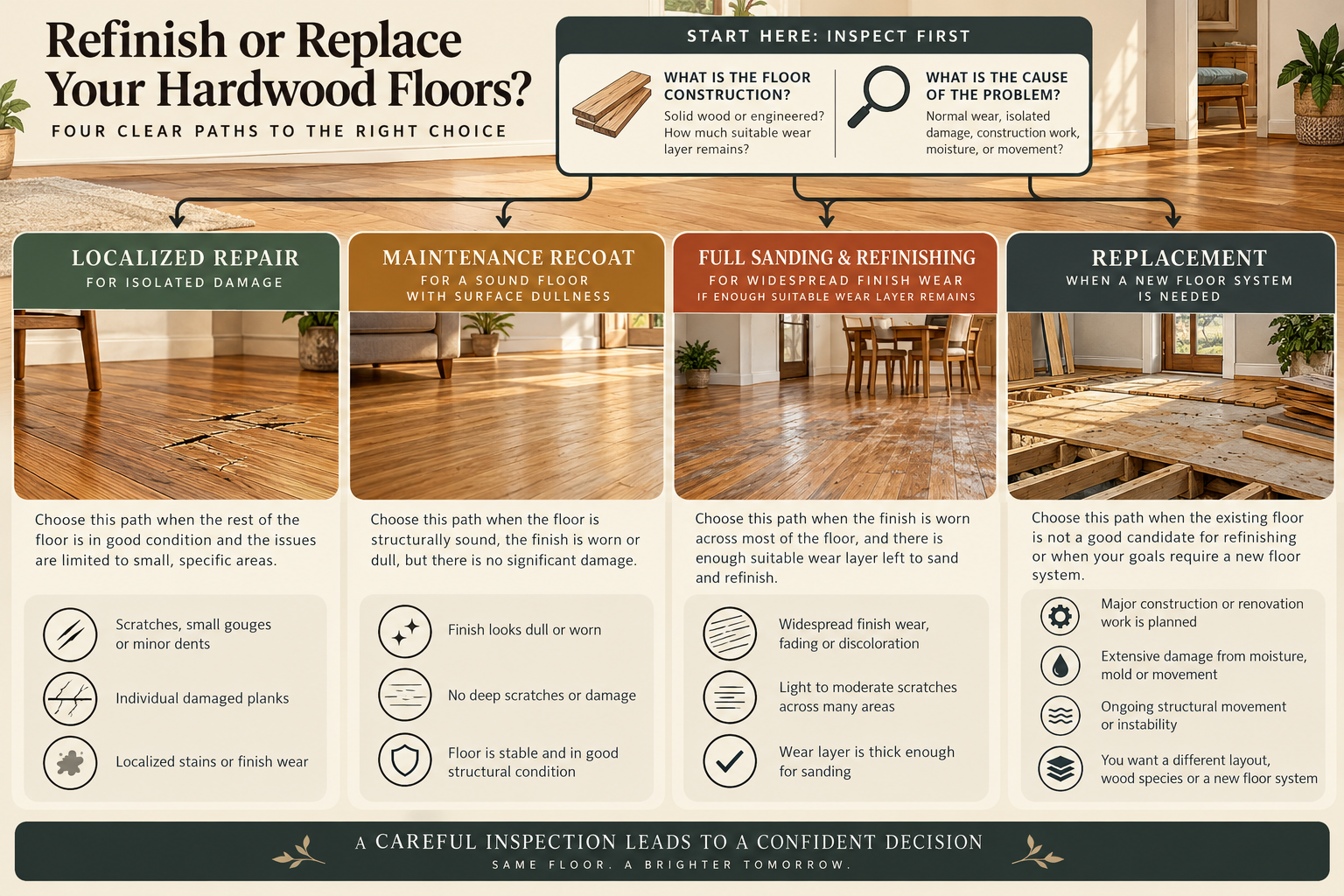
The choice is not always “refinish or replace.” A sound floor with light surface wear may need a maintenance coat. Localized damage may need board repair and blending. A worn but refinishable floor may justify full sanding and a new finish. Replacement becomes a separate path when the existing construction, condition, layout, or desired result makes refinishing a poor fit.
Each path has a different cost pattern. A recoat has less material removal and disruption but cannot correct deep damage. Local repair saves material but may be difficult to match. Full refinishing uses the existing floor but adds sanding, repairs, finish coats, dust control, and occupancy planning. Replacement adds demolition, disposal, substrate preparation, new material, installation, transitions, and often trim or door work.
Conditions that favor a recoat or repair
A recoat is more plausible when the problem is limited to surface dullness or light wear and the existing coating is compatible with the proposed finish. Local repair can fit when the damage is isolated, matching material is available, and the surrounding floor can accept blending. These options are less attractive when finish failure, movement, moisture, or widespread staining is present.
Ask the contractor to state what the treatment can and cannot change. A new surface coating cannot correct a wet subfloor, loose boards, structural movement, or deep discoloration that remains in the wood. A patch can be technically successful while remaining visible; decide whether that outcome meets the project goal.
Conditions that favor full refinishing
Full sanding can make sense when the floor is constructed with enough refinishable material, the damage is widespread but primarily in the finish or upper wood, and the homeowner values keeping the existing floor. It may support a new color or more uniform sheen, but it still requires repairs before finishing and does not guarantee that every board will look identical.
Construction and prior sanding matter. Solid and engineered floors do not have the same wear-layer reserve. The floor’s age alone does not establish that it is ready for another sanding, and the absence of visible damage does not prove that it is. A contractor should inspect the actual floor and explain the condition.
Conditions that favor replacement
Replacement may be more rational when the floor has little remaining refinishable material, widespread structural or moisture damage, repeated failed repairs, severe dimensional movement, or an appearance that cannot be reached responsibly through refinishing. It may also fit when the homeowner wants a different layout, height, material, or performance characteristic.
Replacement has its own hidden scope. Remove the existing floor, inspect and correct the substrate, manage waste, coordinate doors and transitions, install the new system, restore trim, and plan furniture and occupancy. Comparing a refinishing quote with a replacement material allowance is not a fair comparison.
Lifecycle and decision timing
Consider the next repair as well as the immediate appearance. Keep product details and spare material where practical. If the floor has a history of moisture, address that source before choosing either path. If a future room remodel will remove cabinets or alter the layout, postponing a full replacement may be more economical than refinishing and then disturbing the new finish.
Side-by-side quote questions
Request the proposed intervention, floor construction, condition findings, repairs, access, furniture, stairs, finish or replacement material, removal, disposal, subfloor work, transitions, trim, disruption, and exclusions. Ask which condition would make the contractor change the recommendation.
The best choice is the least expensive path that solves the actual condition and provides the appearance, durability, and future flexibility the homeowner expects. No universal age or damaged-area percentage can make that choice for every floor.
Use a four-path comparison
Start by separating four possible interventions: localized repair, a maintenance recoat, full sanding and refinishing, and replacement. A recoat may fit a generally sound floor with finish wear. Local repair may fit isolated damage when matching is acceptable. Full refinishing may fit widespread surface wear when the floor has enough suitable material. Replacement may fit when construction, damage, movement, or the desired new layout makes refinishing a poor match.
These paths should not be compared by headline price alone. A repair can require careful matching and finish blending. A recoat may not address deep scratches or stains. Full sanding adds dust, occupancy disruption, and the risk that hidden conditions appear. Replacement adds removal, disposal, substrate preparation, new material, transitions, trim, and room restoration.
Questions that reveal the better value
Ask how the contractor identified the floor construction, whether it has been sanded before, what damage can remain after the proposed work, and what appearance is realistic. Ask whether the price includes board repairs, stairs, furniture, finish samples, cure time, and touch-up. For replacement, ask whether the quote includes the base beneath the floor, door and transition work, and disposal.
If the owner plans a kitchen remodel, plumbing work, accessibility change, or room reconfiguration, timing may be more important than the immediate finish. Refinishing before a disruptive project can create repeat cost. Delaying a replacement can be sensible when the current floor remains safe and serviceable, but postponement should not hide an active moisture, structural, or safety concern.
Make the recommendation conditional
A responsible recommendation states what would change the path. For example, refinishing may be reasonable if inspection confirms adequate material and stable boards; replacement may be more defensible if the inspection finds widespread damage, insufficient wear layer, or a layout change that already requires removal. The conclusion should follow the observed condition, not a generic age, repair-cost, or percentage-damage rule.