
“Restore the house” can mean several different things. One homeowner may want to protect original windows and trim while updating the kitchen. Another may want an accurate period appearance. A third may want a comfortable, efficient home and only preserve the features that carry the most character. Those are different project goals, and treating them as interchangeable makes quotes difficult to compare.
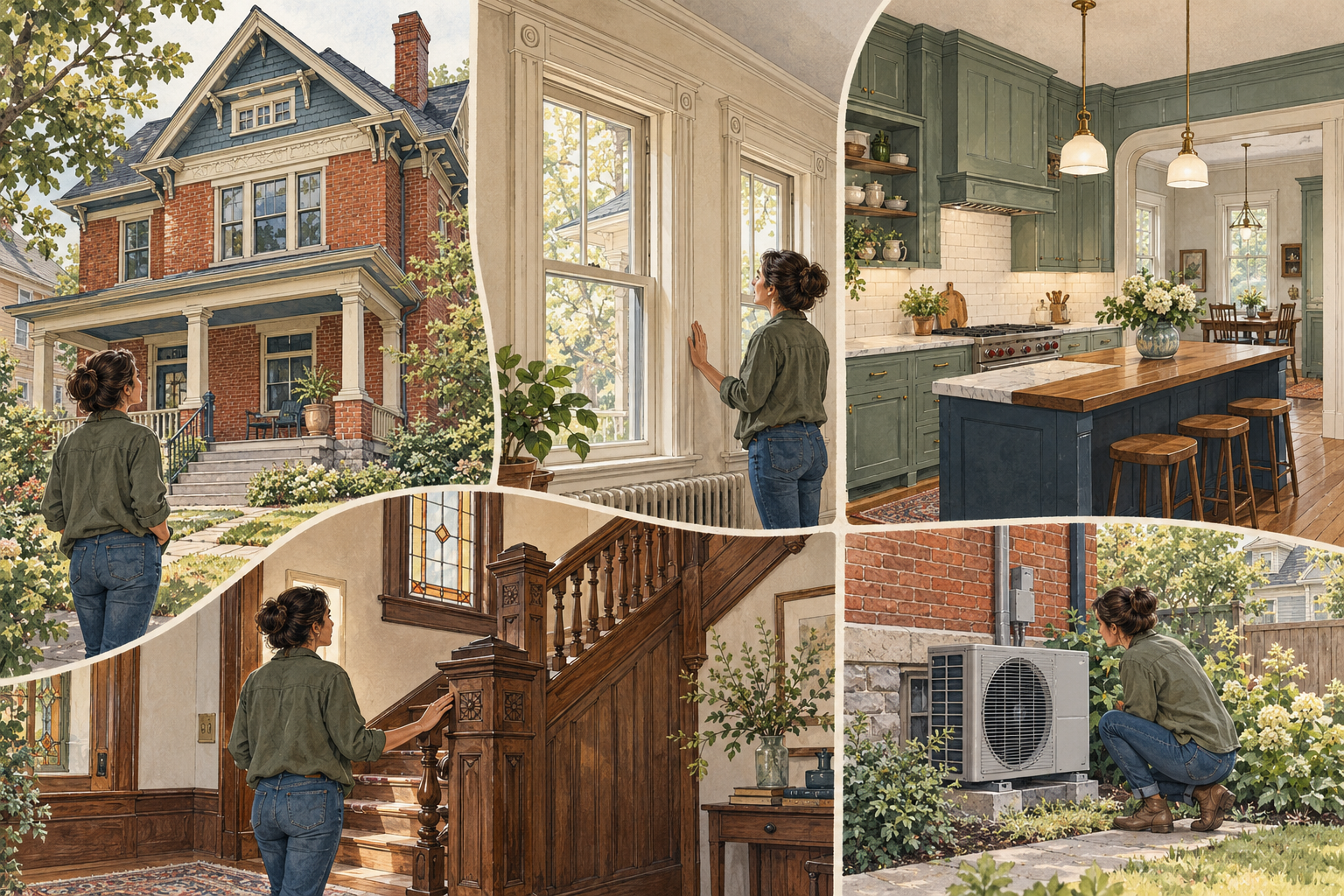
The first decision is not which product to buy. It is how much historic fabric, appearance, and change the project should preserve. The goal determines what a contractor must document, which materials are acceptable, how much access is tolerated, and whether repair is preferred to replacement.
Four useful project goals
Preservation
Preservation emphasizes retaining and protecting existing historic material. Work may focus on maintenance, stabilization, cleaning, limited repair, and preventing further deterioration. It can be the right goal when original fabric is in sound or repairable condition and its location, craftsmanship, or material is important.
Preservation is not the same as refusing all change. A house still needs functioning water, heat, electrical service, fire protection, and safe access. The economic question is how to provide those needs while disturbing as little significant material as reasonably possible.
Rehabilitation
Rehabilitation adapts a building for continued or changed use while retaining its character. It is often the most practical goal for a homeowner who needs modern systems, improved comfort, or a new room but wants the important features to remain. A rehabilitation scope might keep a stair, façade, plaster ceiling, or window pattern while routing new services through less visible areas.
The cost is shaped by coordination. New work may need to fit around old framing, preserve trim, use compatible finishes, and include restoration after access. The result can be more expensive than a basic replacement in one area but less expensive than attempting a complete period restoration everywhere.
Restoration
Restoration aims to represent a particular historic period or appearance. It may involve researching earlier conditions, removing incompatible later work, reproducing missing details, or sourcing period-appropriate materials. This can require architectural documentation, custom fabrication, salvage searches, mockups, and specialist labor.
Restoration is especially sensitive to uncertainty. A house may have changed repeatedly, and evidence about the intended period may be incomplete. Decide which elements need accurate reconstruction and which can remain as later layers. A quote for “restoration” is not meaningful until the target period, level of accuracy, and acceptable substitutions are written down.
Selective modernization
Selective modernization prioritizes current function, durability, energy performance, or accessibility while retaining chosen character-defining features. The goal may be appropriate for an old house with little formal significance or for a designated property where the owner and professionals have identified areas that can change without harming the important parts.
It still benefits from historic-building thinking. Replacing every old component can create unnecessary waste, remove repairable material, and introduce compatibility or moisture problems. Conversely, keeping a feature that is unsafe, failing, or incompatible with the required use may not be responsible preservation.
Identify what actually matters
Make a room-by-room inventory before asking for comparable bids. Note original windows, doors, trim, stairs, floors, plaster, masonry, roof materials, structural members, fireplaces, built-ins, and unusual hardware. Record condition, visibility, craftsmanship, relationship to the building’s story, and whether the feature is easy to repair or replace.
Do not assume that every old item has the same significance. A later partition may be less important than an original stair, even if both are in the same room. A plain window may still matter because its dimensions and rhythm define the façade. A preservation specialist can help when significance or material compatibility is uncertain.
How the goal changes the cost
The same defect can have different price paths. A damaged window might be replaced with a standard unit, repaired by a specialist, fitted with weatherstripping and a storm window, or reproduced to match an existing profile. A missing trim piece might be omitted, filled with salvaged material, milled from a profile sample, or recreated by hand.
The cost difference usually comes from scope rather than age alone:
- investigation and documentation before work;
- careful removal and storage of reusable parts;
- testing or mockups before committing to a treatment;
- specialist labor and limited availability;
- custom or salvaged materials;
- protection of adjacent finishes;
- local heritage review or building-permit coordination;
- restoration after electrical, plumbing, or HVAC access.
Ask contractors to price the base repair, reasonable alternatives, and restoration separately. That makes it possible to decide whether a premium protects a feature you value or pays for an unnecessary level of historical accuracy.
Set the goal before requesting quotes
Write a short project brief that states the intended use, features to retain, acceptable visible changes, desired energy or comfort improvements, and the level of period accuracy required. Include photographs and notes about known repairs. Ask bidders to identify assumptions rather than silently selecting a treatment for you.
For example, “repair the original front windows, improve air leakage, and preserve the sightlines” is more useful than “restore the windows.” “Modernize the kitchen while retaining the plaster ceiling and stair trim” gives a contractor a different access and restoration problem from “return the kitchen to its 1900 appearance.”
A practical decision test
Choose preservation when existing material is important and repair can meet the need. Choose rehabilitation when the house must support a changed use or modern systems while retaining character. Choose restoration when an identified period and level of accuracy justify research and custom work. Choose selective modernization when current performance is the priority and the features worth retaining have been deliberately identified.
The goal can differ by room. A whole-house project may preserve the front elevation, rehabilitate the living spaces, restore a stair, and modernize concealed utilities. State those choices early. A clear goal does not guarantee a low price, but it makes the scope, alternatives, specialist involvement, and contingencies visible before work begins.
Compare the goals by what they change
The labels are useful only when they change the written scope. Use a simple comparison before asking for bids:
| Goal | Usually protects | Common cost pressure | Decision that must be explicit |
|---|---|---|---|
| Preservation | Existing materials, details, and visible character | Condition surveys, careful access, specialist repair, and monitoring | Which changes are necessary for safe use and which are optional |
| Rehabilitation | Character-defining features while adapting the house | Coordination between new systems and retained finishes | Which rooms, elevations, and features may change |
| Restoration | A documented period appearance or feature | Research, selective removal, custom fabrication, and matching | The target period and acceptable evidence for reproducing missing work |
| Selective modernization | Chosen historic features rather than every original component | New equipment, access, utility upgrades, and restoration around the work | Which performance or accessibility improvements take priority |
These are not four bids for the same job. A restoration specification may reject a readily available substitute that would be reasonable in a rehabilitation. A modernization brief may accept a visible new system if it solves a serious functional problem, while a preservation brief may require a less visible route or a different sequence. Ask bidders to state which assumptions they used so an apparently cheaper proposal is not simply pricing a less demanding goal.
Separate necessary work from owner preference
Some work is driven by condition, safety, or local requirements. Other work reflects the owner’s desired appearance, energy performance, accessibility, or level of historical accuracy. Keep these categories separate in the brief and estimate. Correcting an active leak may be necessary before any treatment goal can succeed; reproducing a missing interior molding may be optional even if it improves the finished appearance.
This separation helps when the budget changes. You can defer a custom reproduction without pretending that a leaking roof or unstable masonry has also been deferred. It also lets contractors price a base scope and alternates without making preservation sound like an unexplained premium. For a designated property, the local authority may still require a particular review or treatment regardless of whether the owner considers the feature optional, so confirm that boundary before removing it from the bid.
Write a decision-ready brief
Include a room or elevation schedule with the feature, current condition, proposed treatment, acceptable alternative, and unresolved question. Add photographs, measured dimensions where available, and a list of systems that may need access. State whether the finished repair should blend into the existing work, remain legible as a repair, or be differentiated as new work.
Then request comparable options. Each option should identify investigation, testing, protection, demolition, repair, replacement, custom work, approvals, restoration, and future maintenance. Ask what the contractor has assumed about concealed framing, old coatings, moisture, utility routes, and material availability. If an assumption cannot be verified before work, give it an allowance with a clear trigger rather than hiding it in a general markup.
The best project goal is the one that matches how the house will be used and what the owner is prepared to maintain. It may be different in different rooms. The important point is to make that choice before the quotes are built around an unstated interpretation of “restore.”
Build a goal-specific estimate
There is no reliable national USD or CAD range for an old-house treatment because the goal changes the scope. Ask for separate options for preservation, rehabilitation, restoration, and modernization, with documentation, investigation, specialist work, access, materials, permits, protection, and finish restoration shown as distinct lines.
Keep the proposal tied to the local market and state the assumptions behind every allowance. A useful comparison shows what each goal retains, changes, or defers; it does not convert a price from one country into the other.