
Renovation can expose materials that were harmless while intact and undisturbed. The right question is not whether every old house contains every hazard. It is which materials the proposed work will disturb, what testing or work practice applies, and how discovery changes the schedule and budget.
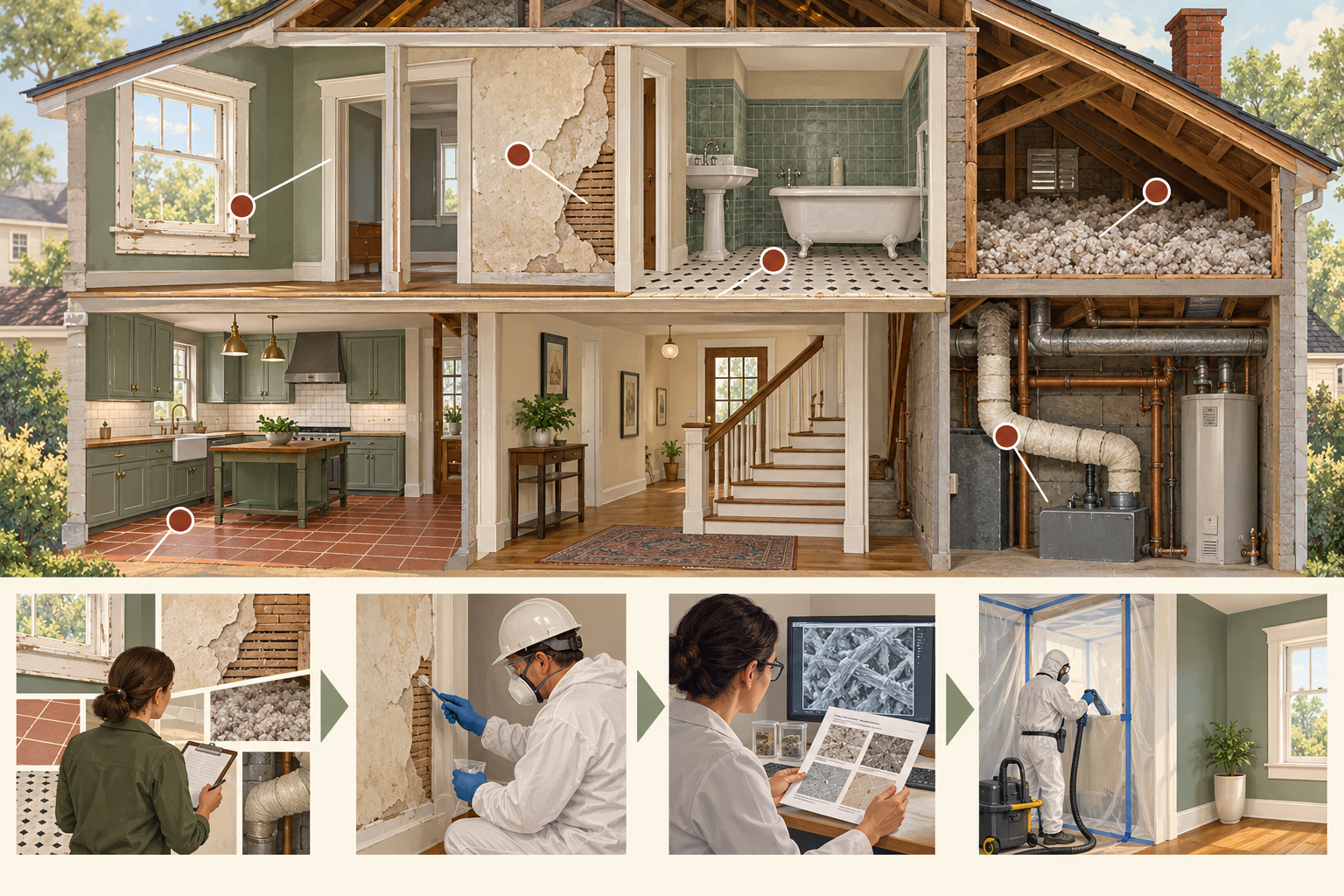
Lead paint and paid renovation work
The U.S. EPA’s Renovation, Repair and Painting rule generally covers paid work that disturbs painted surfaces in pre-1978 housing and child-occupied facilities, with stated exceptions. It includes common work such as electrical, plumbing, carpentry, painting preparation, and window replacement. Firms and renovators may need certification, pre-renovation information, and specified work practices.
Health Canada gives different screening guidance: a Canadian home built before 1960 probably contains lead-based paint, while exterior paint in a home built from 1960 to 1990 may contain it. These are screening indications, not test results or a universal legal cutoff. Do not transfer EPA requirements to Canada or Canadian age guidance to a U.S. compliance decision.
Asbestos and suspect materials
Health Canada lists older siding, cement or plaster, floor and ceiling tiles, roofing products, paint and sealants, heating systems, and insulation around pipes and tanks as possible locations. Suspected asbestos cannot be confirmed reliably by sight. If planned work will disturb suspect material, use a trained or accredited professional as required locally for testing and qualified removal. Intact material that will not be disturbed is often handled differently from material that will be drilled, sanded, cut, or demolished.
Vermiculite insulation deserves particular caution. Do not disturb or remove it as a homeowner project. Stop and obtain qualified advice if the renovation scope reaches it.
Turn discovery into a project plan
Before demolition, identify the work area, materials, testing method, containment or work-practice requirements, disposal path, and who is responsible for clearance or documentation. Add allowances for testing, protection, certified labor, temporary relocation, delay, disposal, and finish restoration. Do not let a low demolition price omit the hazard decision.
This article is a planning guide, not a removal manual. Health, environmental, and regulatory requirements vary by jurisdiction. Route testing, abatement, and detailed compliance questions to the relevant authority and qualified professionals.
Match the check to the planned disturbance
Make a room-by-room disturbance map. Mark areas that will be sanded, scraped, demolished, drilled, cut, heated, moved, or covered. Include windows, doors, plaster, flooring, siding, roofing, pipe and tank insulation, electrical routes, and HVAC work. A material that will remain intact and untouched may require a different decision from one that a contractor must break open to reach a new system.
Ask what evidence is needed before work begins, who is qualified to collect it, how results are documented, and what happens if a sample is positive or inconclusive. Do not treat a negative result from one surface as a blanket clearance for an entire building. Testing should relate to the material and area that the project will affect.
Put hazard work before finish work
If a hazard is confirmed or cannot be ruled out for the planned disturbance, revise the sequence before demolition. A qualified abatement or renovation professional may need to establish containment, work practices, disposal, clearance, or records. The result can affect the contractor, schedule, occupancy, insurance, and restoration scope.
Keep hazard abatement separate from the building repair that follows it. Removing or stabilizing a suspect material does not repair a leaking roof, damaged plaster, old plumbing, or a contaminated surface. The indoor environmental hazards guides cover testing, mitigation, and abatement decisions; this article helps a homeowner recognize when that scope must be added before an old-house project proceeds.
Ask for a transparent allowance
Separate screening, laboratory or professional assessment, containment, qualified labor, disposal, temporary relocation, delay, and finish restoration in the budget. State which costs are included and which depend on a result that is not yet known. An allowance that says only “possible asbestos” or “lead contingency” is difficult to compare and can either understate or inflate the real exposure.
Screen by material and disturbance
Build the disturbance map before requesting a demolition or finish quote. Mark the exact surfaces that will be sanded, drilled, cut, removed, heated, or covered, and identify the material and age information known for each. A broad building label is not a test result, and a test from one room does not automatically clear another material or work area.
Then match the proposed disturbance to the required decision: screening, sampling, qualified work practice, containment, removal, clearance, or documentation. The appropriate professional and authority depend on the jurisdiction and material. If the result is positive, negative, or inconclusive, the project plan should say who revises the sequence and how the change is priced.
Keep U.S. and Canadian boundaries visible
EPA’s paid-work requirements for pre-1978 U.S. housing and Health Canada’s screening examples are useful reference points, but they are not interchangeable legal rules. Confirm current local requirements for the property, contractor, material, and activity. Do not infer that a Canadian construction date creates a U.S. compliance cutoff or that an EPA rule describes Canadian practice.
Record only what was tested and treated
The handoff should identify the material and area, test method and result, qualified person or firm, work practices, disposal records, clearance or completion documents where applicable, what was removed, contained, or left intact, and the limits of the assessment. Do not imply that a whole house or every future renovation was cleared.
Revise the sequence when results change
A positive or inconclusive result can change access, containment, disposal, adjacent trades, temporary relocation, restoration, and occupancy timing. Ask the project lead to identify who approves the next step and to update the disturbance map if work is canceled or moved. A material left intact may have a different management decision from material disturbed later.
Decide before the first disturbance
Name the material, area, planned disturbance, qualified decision-maker, and stop point before demolition. If those are unknown, obtain assessment or testing first. Circulate results and their limits to the coordinator and every trade that may disturb the material so the finding changes the access, containment, disposal, and restoration sequence.
Make allowances and exclusions explicit
Separate sampling, laboratory work, containment, qualified labor, disposal, clearance, delay, temporary relocation, source repair, and finish restoration. State whether the price assumes a negative result, a defined material quantity, or a particular work practice, and name the event that activates each allowance.
Build a local estimate
No reliable national USD or CAD range applies to this specialized historic-home work. Request a dated local proposal that separates investigation, access, protection, materials, specialist labor, permits or review, restoration, and future maintenance. State the condition, area, and assumptions covered by each option.
Compare complete scopes in the market where the work will occur. Keep confirmed work, allowances, and owner-selected upgrades separate, and do not convert a price mechanically between U.S. and Canadian markets.