
Dirty masonry, damp masonry, efflorescence, staining, and deteriorated joints are different problems. A coating or water repellent can change how a wall absorbs and releases moisture, but it cannot be assumed to correct a leaking roof, failed drainage, rising damp, plumbing leak, or movement. Diagnose the source before choosing a surface treatment.
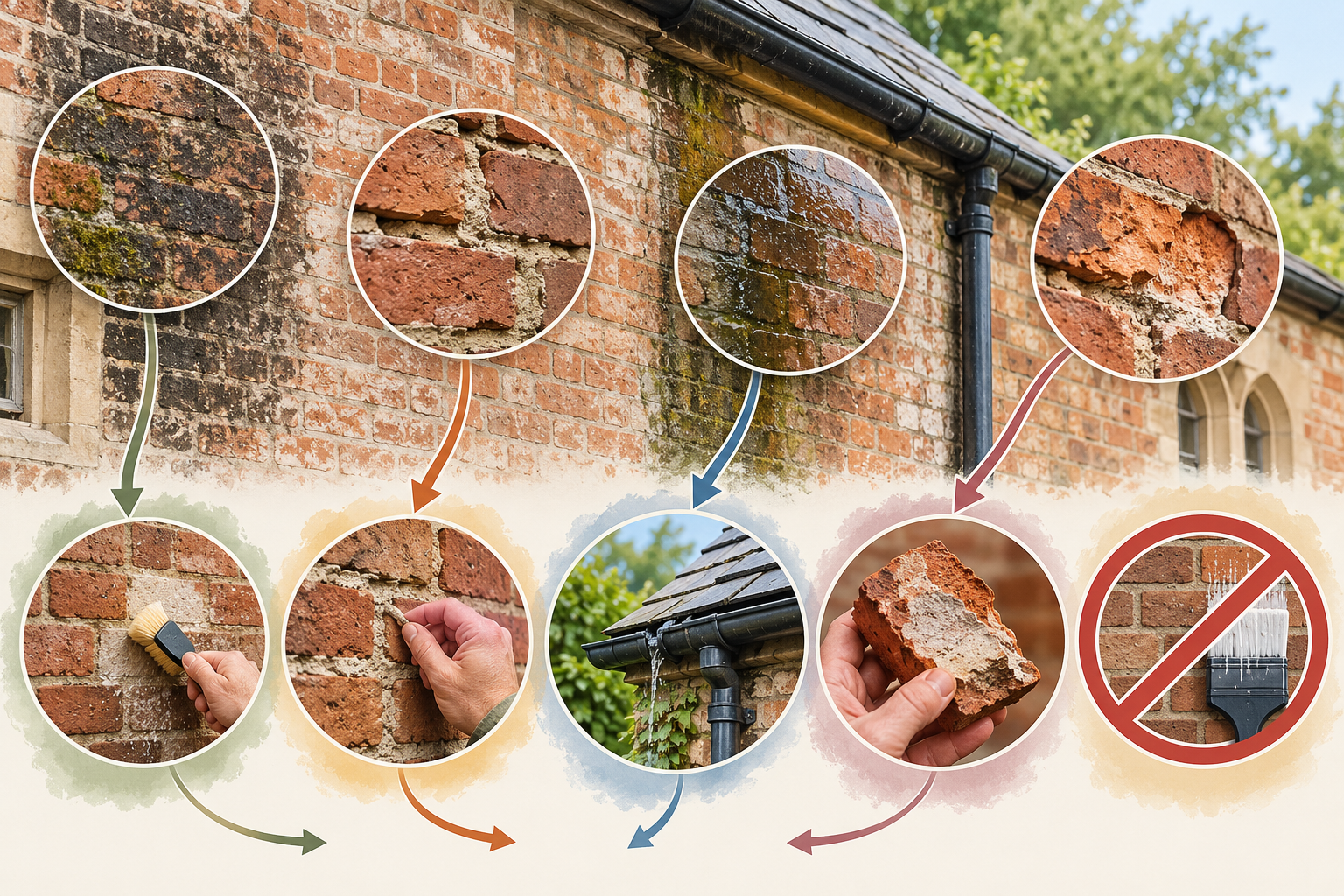
Separate appearance from performance
Darkening, staining, efflorescence, algae, paint failure, damp interiors, spalling, and open joints can look similar from a distance while requiring different responses. Begin by recording where the problem occurs, when it appears, the exposure of the wall, nearby roof and drainage details, and whether the units or mortar are actually deteriorating. A dirty surface is not automatically a waterproofing failure, and a dry-looking coating is not proof that water has been controlled.
Check the sources of bulk water and moisture movement before choosing a treatment. Roof edges, flashings, gutters, downspouts, grading, plumbing, rising damp, condensation, and movement can all change the result. Repointing or source correction may be more appropriate than cleaning or coating. If the wall is moving, unstable, or near occupied electrical equipment, obtain the relevant professional assessment before cosmetic work.
Compare treatment categories carefully
Gentle cleaning may remove surface dirt or biological growth while retaining material, but the method still needs to suit the brick, stone, mortar, finish, and condition. Abrasive cleaning can remove the surface of a unit or alter historic texture; it should not be treated as a default shortcut. Chemical cleaning raises questions about substrate, runoff, residue, worker protection, and surrounding materials.
Water repellents may be considered for a specific exposure and substrate, but they cannot correct a roof, drainage, crack, or rising-moisture problem. Waterproof coatings and paint change the appearance and the way the wall interacts with water and vapor; they can make later inspection or repair more difficult. The choice should follow a documented problem and a compatible specification, not a promise made from a product label.
Use a test area as a decision tool
Before committing to a visible elevation, specify a small test area or mockup. Record the starting condition, method, dwell or exposure assumptions where applicable, appearance, residue, water behavior, and effects on mortar and adjacent features. Allow enough time to assess the result; an immediately clean patch does not establish long-term compatibility.
The test should answer a question: does the proposed method remove the identified material without unacceptable loss, or does it change the wall in a way that makes the project unsuitable? If the result is uncertain, stop and obtain specialist input rather than expanding the treatment.
Price the complete intervention
Ask for separate lines for investigation, source correction, protection, access, cleaning, selective repair, repointing, coating or repellent, runoff and disposal, mockups, permits or review, and monitoring. Include window, trim, roof, gutter, or foundation interfaces. A lower cleaning price can be misleading if it excludes scaffolding, public-way protection, interior protection, or later masonry repair.
Choose the treatment by the problem it can solve
Before accepting a cleaning or coating proposal, write the problem in one sentence. “Remove surface dirt from the front elevation” is different from “reduce water entry at a failed flashing,” “repair open joints,” or “address interior dampness.” If the proposed treatment cannot reasonably address the stated problem, it should not be priced as the primary solution.
Use a decision table when comparing options:
| Observed problem | Question to answer first | Possible scope boundary |
|---|---|---|
| Dirt or biological growth | Will a gentle method remove it without damaging the surface? | Test cleaning and protect adjacent material |
| Open or eroded joints | Is mortar loss the cause or a symptom of water or movement? | Diagnose and repair masonry before cosmetic work |
| Damp interior | Where is bulk water, ground moisture, plumbing leakage, or condensation entering? | Investigate the source rather than sealing the visible wall |
| Spalling or surface loss | Is the unit failing, or has a prior treatment changed moisture movement? | Obtain materials or masonry assessment |
| Paint or coating failure | What is the coating, and what will disturbance expose? | Test, contain, and plan qualified handling where needed |
The table does not diagnose the building. It keeps the quote connected to an identified question and shows when a specialist or a different physical-system category is needed.
Ask what happens after the treatment
A proposal should describe how the wall will be inspected, maintained, and repaired later. Some treatments can make joints, cracks, or moisture paths harder to see. A coating may also change the appearance of later patches or complicate a future repointing project. Ask whether the product is intended to be breathable or film-forming, what compatibility evidence exists for the actual substrate, and how failure will be recognized. Do not infer suitability from a product’s general marketing description.
Include runoff, residue, plant and landscape protection, windows, trim, roof edges, public access, and cleanup in the scope. If a test area changes color or texture, decide whether that difference is acceptable before the full wall is treated. If it reveals a larger defect, stop and revise the plan rather than expanding the work to hide the test result.
Compare a no-treatment option
Leaving a sound, dirty, or weathered surface alone can be a responsible option when cleaning or coating would create more material risk than benefit. That does not mean ignoring active water, unstable masonry, or a health issue. It means distinguishing necessary correction from a cosmetic intervention and budgeting monitoring or maintenance when immediate treatment is not justified.
Protect the surrounding building
Cleaning is a site operation, not only a masonry line item. Ask how windows, doors, trim, roofs, landscaping, utilities, interiors, and neighboring property will be protected. Include runoff, collection, drying, access, public-way controls, and restoration. A test area should show not only the clean result but also the effect on adjacent materials and the surface’s appearance as it dries.
If a coating or sealer is proposed, state the expected service life, inspection access, maintenance, and what happens when it wears or fails. Do not assume a treatment that reduces visible staining has corrected the water source. Keep source correction, masonry repair, cleaning, coating, and interior restoration as distinct decisions.
Record and check the selected treatment
Before full work, keep photographs of the test area and record the selected method, the pressure or agitation limits, materials and elevations included, and areas excluded. A successful small test is not blanket permission to treat the rest of a wall that may differ by material or exposure.
After the treated area dries, compare its appearance, residue, joint visibility, water behavior, and effects on adjacent material with the agreed acceptance standard. Record the treated boundary, remaining source problems, method and product details, and the inspection or maintenance trigger. A clean or sealed surface does not establish that the masonry is stable or that water entry has stopped; do not present the treatment as a building-wide clearance.
Build a local estimate
No reliable national USD or CAD range applies to this specialized historic-home work. Request a dated local proposal that separates investigation, access, protection, materials, specialist labor, permits or review, restoration, and future maintenance. State the condition, area, and assumptions covered by each option.
Compare complete scopes in the market where the work will occur. Keep confirmed work, allowances, and owner-selected upgrades separate, and do not convert a price mechanically between U.S. and Canadian markets.