
Sill and rim work sits at the connection between the foundation and framing, so opening and support needs can matter more than the visible damaged section. Current evidence does not establish a comparable national installed price; compare the member length, temporary support, adjacent framing, cause correction, access, and restoration.
Published price context
HomeGuide’s U.S. sill-plate guide, dated September 20, 2025, reports US$120–US$200 per linear foot or US$12,000–US$35,000 total on average, including labor and materials. It identifies project length, damage extent, labor, permits, inspections, and lifting as cost drivers; it does not automatically include adjacent rim joists, floor framing, or cause treatment.
Why this repair can spread
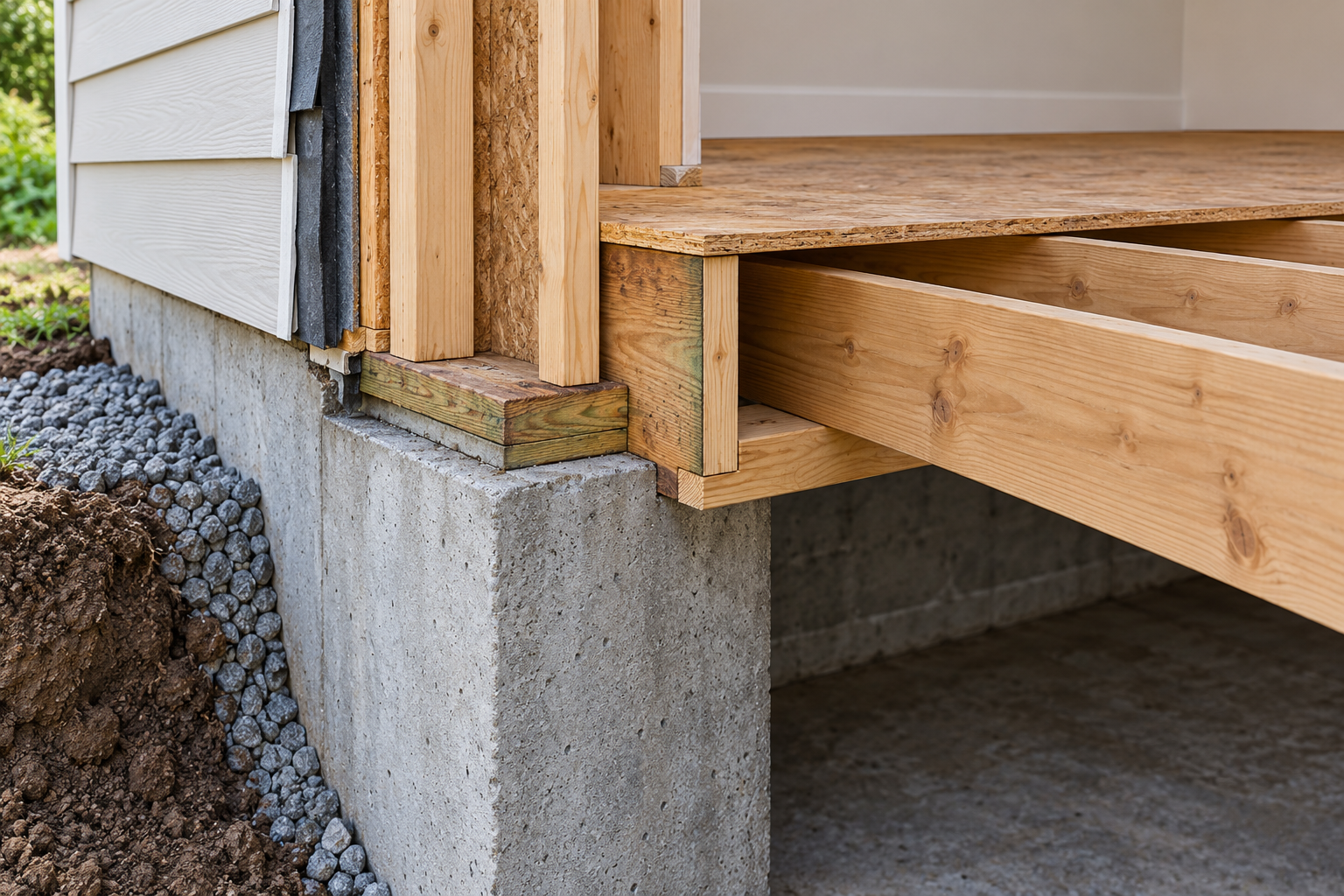
The sill plate sits at the foundation-to-wall or floor connection, while the rim or band joist closes the floor-system perimeter and transfers loads between joists and walls. Rot, insects, crushing, connection failure, moisture, or movement can affect joists, wall framing, anchors, siding, and finishes around them.
A local repair may be possible when damage is exposed and the surrounding load path is sound. Extensive replacement may require temporary support or lifting, exterior siding or interior finish access, connection work, and restoration. The visible wood is not necessarily the full extent.
Cost drivers
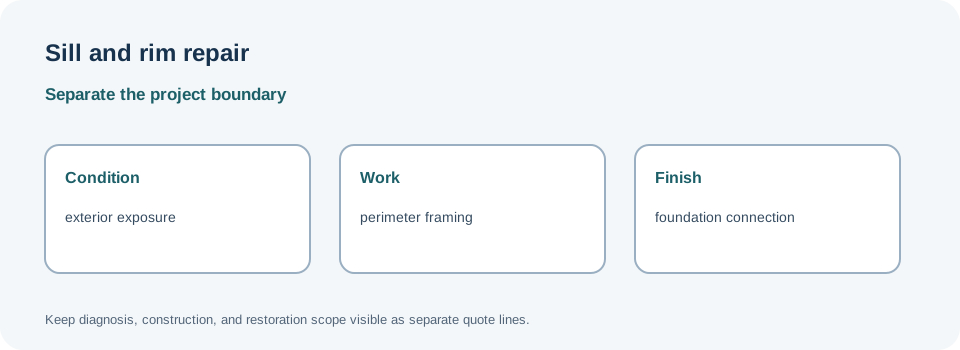 Affected length, access side, foundation height, crawl-space clearance, siding or interior finishes, temporary support, lifting, anchor and connection work, adjacent joists, rot or pest extent, moisture, excavation, utilities, engineering, permits, disposal, and restoration matter. A quote that prices “replace sill” without describing the support sequence is incomplete.
Moisture correction belongs to below-grade or envelope scopes, and pest treatment belongs to wood-destroying-organism work. They should be coordinated but separately identified.
Scenarios
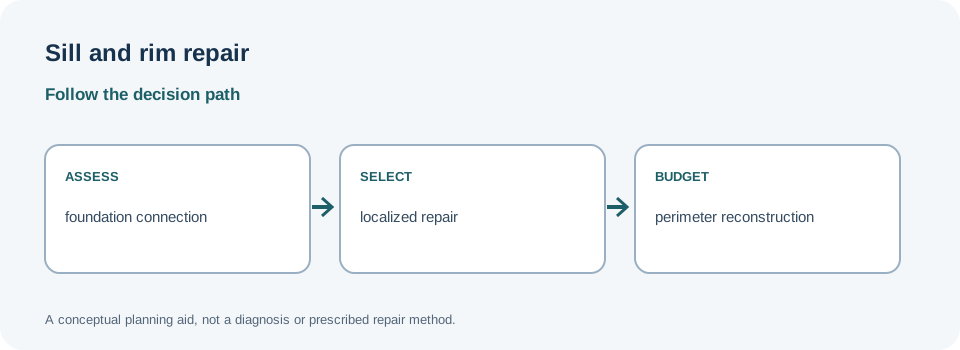 Sectional repair: One exposed area is deteriorated and the load path can be temporarily supported. Carry an allowance for adjacent wood once opened.
Perimeter repair: Longer runs require exterior access, lifting, anchor work, or several joist ends. Compare access and restoration line by line.
Broad reconstruction: Sill, rim, joists, wall framing, and foundation connection are all affected. The project may approach major structural-repair pricing and needs a defined sequence.
Read the quote
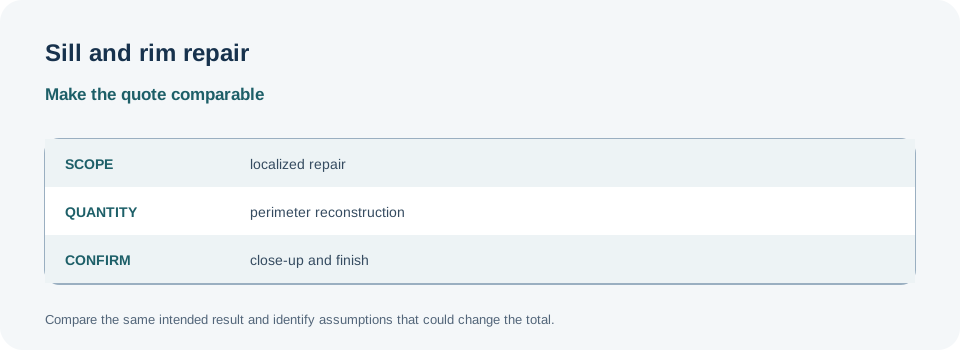 Ask which length and members are included, how temporary support works at a high level, whether lifting is included, what connections and anchors are covered, how rot or pests are handled, what moisture or siding work is excluded, and how hidden damage is priced. A treatment-only or caulking price is not equivalent to structural replacement.
The best budget distinguishes the structural connection, its cause, and the finish or pest work required around it.
Make hidden perimeter work controllable
Ask how much sill and rim was exposed, how the bidder will identify additional damaged length, and whether the contract uses a unit price or an approval threshold. Include the connection to the foundation, joist ends, wall framing, siding or interior access, and temporary support. A broad “replace rotten wood” allowance does not tell you how the total can change.
For a short horizon, a bounded sectional repair may be rational when the surrounding connection is sound and the cause is controlled. For a long horizon, include moisture and pest correction, inspection access, and the cost of repairing finishes after a second opening. Do not let a treatment or caulking price stand in for a structural sill repair.
Control the boundary before demolition
Ask the contractor to mark the base replacement length and identify how new damage will be measured. Include temporary support, connection and anchor work, joist ends, wall framing, siding or interior access, insulation, disposal, and restoration. A narrow sill line can become a perimeter project once concealed conditions are exposed, so the change-order rule matters as much as the base price.
Compare repair with replacement based on the condition left behind and the chance of repeat access. A short horizon may favor a documented sectional repair when the source is corrected. A long horizon may favor broader work if opening the same perimeter later would require lifting, siding removal, or finish reconstruction again.
Read the perimeter repair as a sequence
The sequence may include exposing the connection, temporarily supporting the wall or floor, removing damaged sill or rim material, restoring bearing and anchors, replacing adjacent joist ends or wall framing, and closing the exterior or interior finish. A bidder who starts with “replace wood” but does not describe support and connection work has not priced the full structural decision.
Ask whether siding, masonry veneer, insulation, utilities, and interior finishes are included. If rot or pests extend beyond the opening, use a defined unit price and documentation rule. For a long ownership horizon, the value lies in controlling the moisture or pest cause and retaining inspection access; a clean new section without that correction can create repeat work.
Make perimeter quantities measurable
Ask the contractor to mark the sill and rim length exposed, the joist ends and wall framing included, and the unit price for additional damaged material. Include temporary support, lifting, foundation connections, anchors, siding or interior access, insulation, disposal, and restoration. The change-order rule matters because concealed perimeter damage is common in this type of work.
Compare sectional repair with broader replacement by the condition left behind and the access required later. For long-term ownership, correct the moisture or pest cause and preserve inspection access. For short-term ownership, do not accept a treatment or caulking line as equivalent to structural connection repair.
Distinguish the perimeter member from the cause of failure
A damaged sill plate or rim joist may result from water entry, poor drainage, termites, condensation, settlement, or an isolated connection problem. The repair scope should show which member is being replaced, how the wall or joists are temporarily supported, how new material is connected, and what prevents recurrence. Moisture or pest treatment may be essential but is not the same line item as structural reconstruction.
Ask whether the crew can access the full affected length and how adjacent joist ends, studs, sheathing, insulation, and anchor connections will be inspected. If the wall has lost bearing, a cosmetic perimeter repair is not an equivalent alternative. A bounded opening with a unit price for additional damaged length is more comparable than “replace as necessary.” For long-term ownership, retain records of the source correction and the repaired connection so future buyers or contractors can understand what was actually restored.
Price the connection, not only the damaged wood
The sill and rim sit at a boundary where foundation, wall framing, floor framing, anchors, moisture, pests, and finishes meet. The structural question is whether the wall and floor still have reliable bearing and connection after the repair. Ask whether the proposal includes temporary support or lifting, new anchors or connections, joist ends, studs, sheathing, insulation, siding, masonry veneer, and interior access. A short replacement length can still require extensive enabling work.
The source of deterioration should be visible without being confused with the structural scope. Water entry, poor drainage, condensation, or pest activity may need correction before the perimeter is closed. A treatment or caulking line can be necessary and still not restore bearing. Conversely, replacing wood without controlling the source can create repeat work. Separate the lines and identify the handoff between trades.
Use exposure as a decision stage
For concealed damage, define the opening, the members inspected, the unit price for added length or members, the photo record, and the approval threshold. Ask what happens if the sill is crushed, anchors are missing, joist ends are damaged, or the wall has shifted. This makes a change order measurable instead of allowing a broad “replace as needed” instruction to determine the final budget.
For long-term ownership, value source correction, inspection access, and a documented connection. For short-term ownership, a sectional repair may be sensible when the remaining perimeter is sound and the cause is controlled. Compare the condition left behind and the cost of reopening the same boundary, not just the amount of new lumber.
Make the perimeter sequence visible
Repair may require exposing the connection, temporarily supporting the wall or floor, removing damaged sill or rim material, restoring bearing and anchors, repairing joist ends or wall framing, and closing the exterior or interior finish. Ask which of those stages is in the base price. Siding, masonry veneer, insulation, utilities, and finished rooms can make a short replacement length expensive because the access work is not proportional to the amount of wood.
The quote should also identify the source correction. Water entry, grading, condensation, and pest activity may have different owners and may be handled before or after structural reconstruction. If the source remains outside the contract, record the condition the new material assumes. A new sill or rim section without a controlled moisture or pest boundary can look complete while carrying repeat-work risk.
For long-term ownership, include records of the connection, source correction, and accessible inspection points. For short-term ownership, a sectional repair may be sufficient when the remaining perimeter and bearing are documented. Use a measurable allowance for concealed length and members so the final budget grows from evidence rather than an undefined contingency.