
Engineered floor-truss repair is product- and damage-specific, and the available technical sources do not establish installed market prices. A useful quote identifies the truss design and damage, who prepares or approves the repair, how access and temporary support are handled, and whether ceiling or utility restoration is included.
Published price context
A general floor-framing price cannot be transferred to an engineered truss. HomeGuide’s U.S. subfloor guide, dated September 3, 2024, lists US$350–US$1,000 per replacement floor joist, but does not price truss repair, design review, or a truss replacement. Ask for the affected truss, required designer or manufacturer input, temporary support, access, and restoration to be costed explicitly.
Engineered trusses are not just wide joists
 Open-web floor trusses use chords, webs, connections, and a design geometry that may be specific to the original system. A cut, crushed member, damaged connector, moisture or corrosion condition, or altered opening can require design or manufacturer information. A generic sistering detail may not be appropriate.
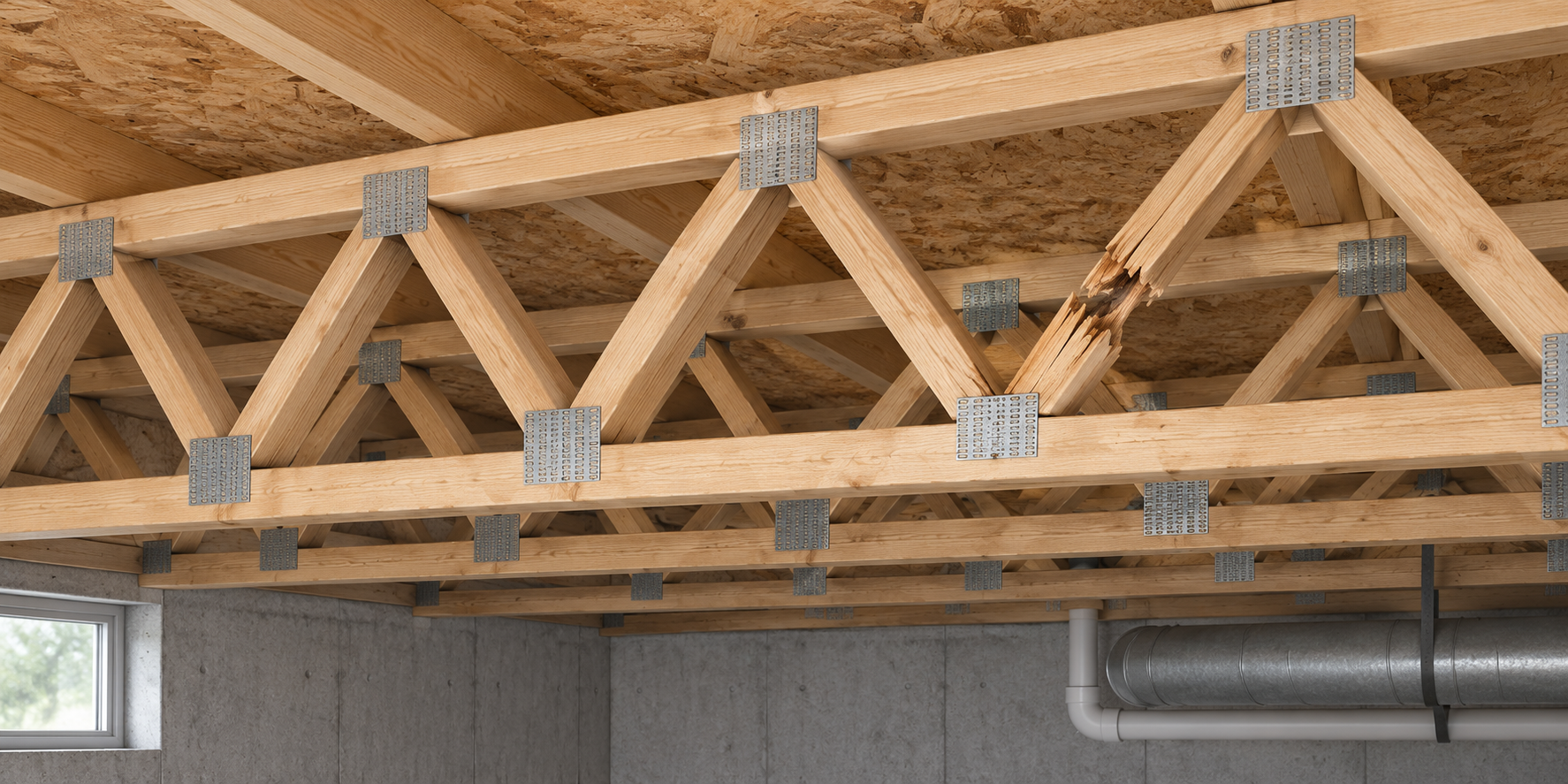
HUD structural guidance supports treating engineered members, loads, connections, and inspection findings as a system. The practical first step is to document the truss identification and damage, not to select a repair plate from a general price list.
What drives cost
The design record, damage location, number of trusses, access from above or below, finished ceilings, plumbing and HVAC routes, temporary support, engineering or manufacturer review, replacement availability, material handling, permits, disposal, and finish restoration matter. Older homes may lack drawings, making investigation and design slower.
Moisture, pests, and remodeling alterations can create separate correction work. Keep those causes and ordinary ceiling repair visible in the budget.
Repair versus replacement scenarios
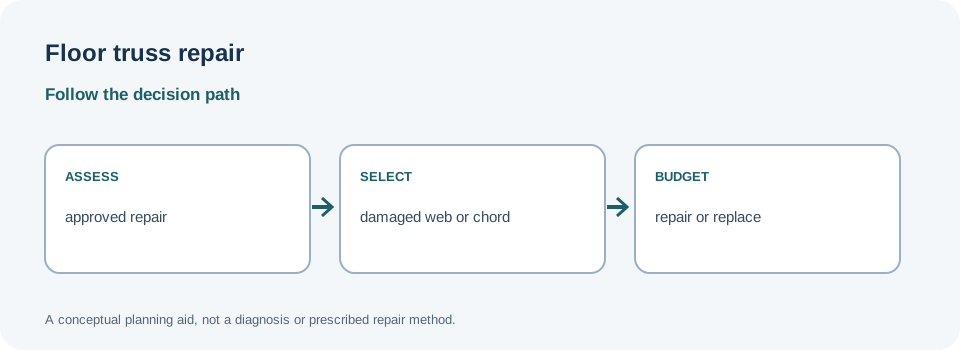 Limited engineered repair: One known defect, accessible framing, and documentation that supports a defined repair. Price the design review and finish access, not only materials.
Multiple truss or connector issues: Several members or plates are involved. Compare the repair system, temporary support, and access across the full affected area.
Replacement-level condition: Truss design is unknown, damage is broad, or replacement requires major demolition and utility relocation. A broad structural alternative may be more economical than repeated localized work.
Quote questions
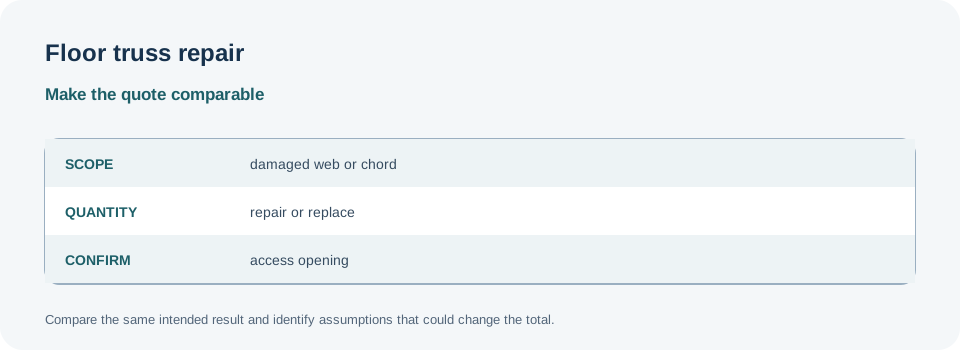 Ask who evaluates the truss, whether manufacturer or engineer documentation is required, which trusses and members are included, how temporary support is handled, what access and restoration cost, and what happens if design information is unavailable. Do not accept a universal repair detail or DIY instruction for an engineered member.
Treat missing documentation as a cost driver
When original truss information is unavailable, the budget may need field documentation, selective exposure, design review, and a repair drawing before construction. That is not wasted cost: it reduces the risk of applying a conventional-joist solution to an engineered system. Ask which portion of the design and review work is included.
Compare repair with replacement or supplemental support based on access, utilities, ceiling disruption, and the number of affected trusses. For a long ownership horizon, preserve the repair record and any manufacturer or engineer documentation. A low material allowance without a compatibility path is not a complete economic option.
When a truss is behind a finished ceiling, ask whether selective opening, temporary support, and restoration are in the base price or an allowance. That distinction often explains why two otherwise similar bids differ. Also ask whether the contractor is repairing a single design or assuming that every truss in the house is interchangeable. The intended scope should identify what was inspected, what remains inaccessible, and what triggers additional work.
Keep the estimate conditional but useful
Request a base price for the known truss and a separate allowance for opening, additional members, and finish repair. State what evidence changes the scope. This lets a homeowner compare bids without pretending that an inaccessible connector or concealed chord has already been diagnosed. The final choice should balance design certainty, disruption, and the cost of future access.
If the truss issue resulted from a prior utility or remodel alteration, coordinate the utility decision with the structural repair. Moving the utility may cost more now but preserve the engineered member and future serviceability; leaving it in place may be less disruptive only if the design confirms that the arrangement is acceptable.
Before signing a floor-truss quote
Record the affected truss locations, design documentation, access from above or below, temporary support, utilities, ceiling or floor restoration, and the approval rule for additional members. If the original design is missing, the estimate should say how field information and engineering review will be obtained.
Compare repair, replacement, and supplemental support by residual condition and disruption. A lower material allowance is not a lower project cost if it omits selective opening, design review, or finish restoration. Keep any plumbing, HVAC, or moisture correction visible as separate work.
Budget the boundary between design and construction
Ask whether field documentation, original drawings, manufacturer review, engineering, temporary support, access, utility changes, and ceiling or floor restoration are included. In an engineered system, design uncertainty is a cost driver, not a reason to borrow a conventional-joist repair detail.
Use a base scope for known trusses and a controlled allowance for selective opening or additional members. Compare repair and replacement by design certainty, disruption, and future inspection access.
A practical quote comparison
Put field documentation, original design or tag information, engineering or manufacturer review, temporary support, selective opening, repair materials, utility access, disposal, and finish restoration into the same comparison. Ask which assumption changes the price. A truss repair quote should not depend on a homeowner choosing a generic reinforcement detail.
If several trusses are affected, compare repair with supplemental support or replacement by residual condition and disruption. Preserve the final repair documentation. It can reduce uncertainty for future owners and contractors even though it does not guarantee a universal service life.
Preserve the engineered system’s identity
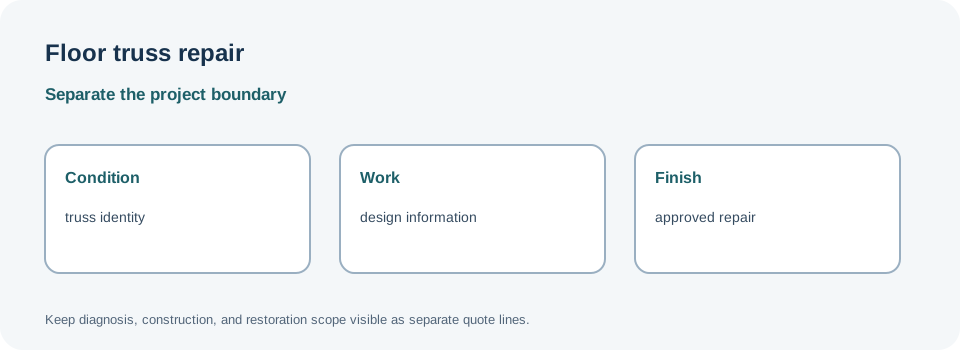
A floor truss repair should identify the truss type, affected panel or chord, spacing, span, bearing, and any field alteration or damage observed. A generic lumber patch may not be an equivalent repair. The designer, manufacturer, or qualified structural professional may need to define the repair, especially when the defect affects several trusses, a bearing zone, or a concentrated load.
Ask whether the proposal includes access through the floor or ceiling, temporary support, design or review, connector materials, fire or finish restoration, and inspection before closure. If documentation is missing, the estimate may need an allowance for investigation rather than pretending the repair is routine. Compare a discrete reinforcement with a larger opening or replacement plan by the finished result and the remaining access. Engineered-member uncertainty is a cost driver in its own right.
Treat documentation as part of the repair budget
The truss identity, span, bearing, spacing, chord and web arrangement, connector condition, and any field alteration help determine whether a repair can be designed at all. Older homes may have no original drawings, while a replacement component may not match the existing geometry or loading. Ask whether the proposal includes field documentation, selective exposure, design review, manufacturer consultation, and a repair record. Those services are not filler around the construction; they reduce compatibility uncertainty.
Access can also determine whether repair or replacement is economical. A truss above a finished ceiling may require a controlled opening and restoration; one in an open basement may be easier to inspect but still have utility or bearing constraints. Compare the same affected members, support sequence, and finish endpoint across bids. If the contractor cannot identify what is known about the engineered system, a low per-truss allowance is not a fixed repair outcome.
For a short ownership horizon, a documented limited repair may preserve a serviceable system when the design basis is clear. For a long horizon, include future inspection access, retained records, and the cost of reopening the assembly. Do not trade design certainty for a generic hardware package.
Compare repair, replacement, and redesign at the same endpoint
A truss may be repaired in place, replaced, supported by a new member, or redesigned around a new opening or load. Those options change access, temporary support, utilities, ceiling or floor removal, and the condition left behind. Ask whether the proposal restores the original system or creates a different structural arrangement. A lower material cost is not comparable if it depends on a different finished-space or support outcome.
The proposal should identify the trusses and members included, the areas not inspected, the design or manufacturer responsibility, connector and bearing work, and the rule for concealed conditions. If several trusses are affected, compare a coordinated opening with repeated small repairs. If the trusses support a finished ceiling or floor, include protection and restoration rather than assuming the assembly can be reached without disruption.
For long-term ownership, preserve drawings, approvals, and inspection access. For short-term ownership, a bounded design-compatible repair may be reasonable when the residual condition is documented. Engineered-member repair is a compatibility decision first and a materials-price decision second.