
An uneven floor is a symptom, not a price unit: the failed layer may be a joist, beam, post, foundation, or supporting soil. Since comparable national installed prices are not established, use the investigation to define the repair and compare bids with the same structural result, access, support, and restoration.
Published price context
HomeGuide’s U.S. subfloor guide, dated September 3, 2024, reports US$350–US$1,000 per replacement floor joist. This is one member-specific publisher estimate, not the price of correcting every cause of an uneven floor; a beam, post, foundation, soil, or finish scope can be different.
One symptom has several economic paths
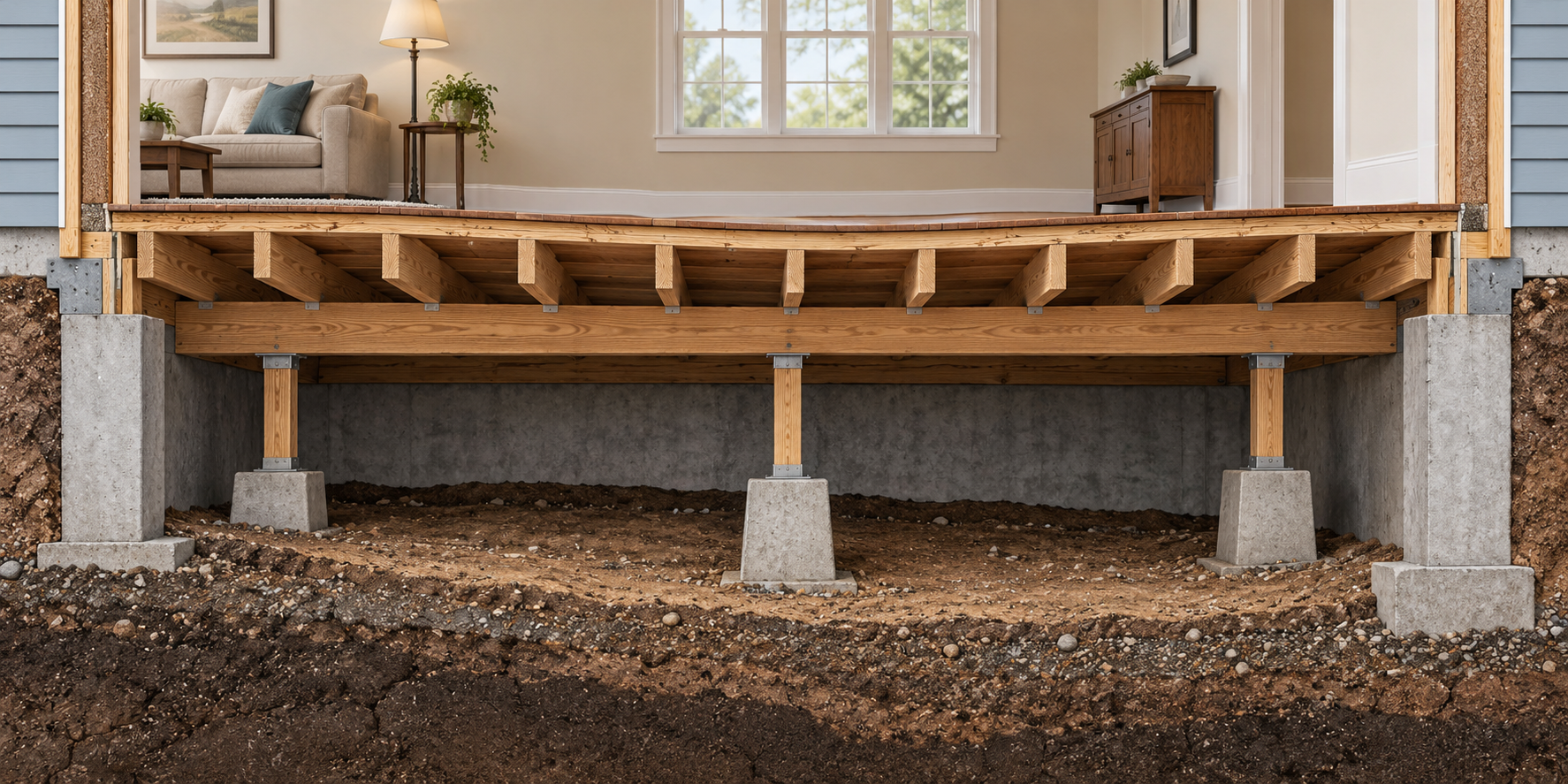
An uneven floor can reflect a damaged or undersized joist, a sagging beam, a failed post or pier, foundation settlement, soil movement, water or pest damage, or an intentional transition that is not a structural failure. HUD inspection guidance treats floor members, beams, columns, foundations, deflection, warping, and deterioration as related but distinct inspection concerns.
The first useful cost is diagnosis. A proposal that immediately recommends sistering every joist may be wrong if the beam or foundation is the source. Conversely, a floor finish repair is not structural correction if the support continues to move.
Cost map by failed layer
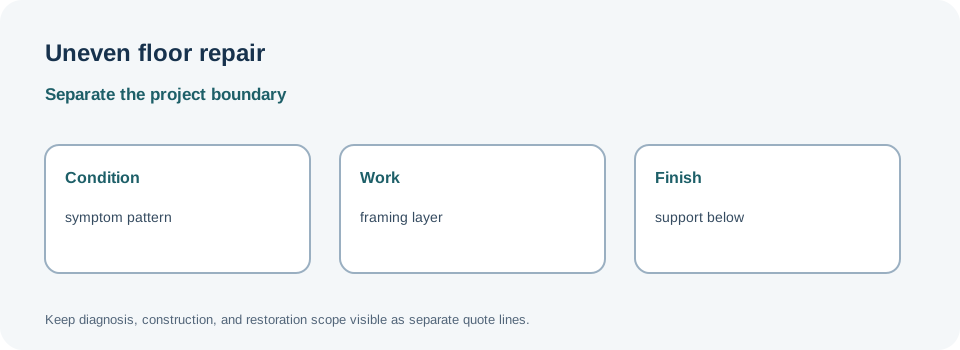 Joist repair or sistering is often a focused framing scope when access and surrounding members are sound. Beam or post work adds temporary support, bearing, footings, and handling. Foundation or soil work can involve excavation, underpinning, lifting, drainage, and major restoration. Finish restoration—subfloor, flooring, walls, cabinets, or trim—may be separate.
The more layers involved, the less useful a per-square-foot floor number becomes. Request each layer as an identified line.
Cost drivers
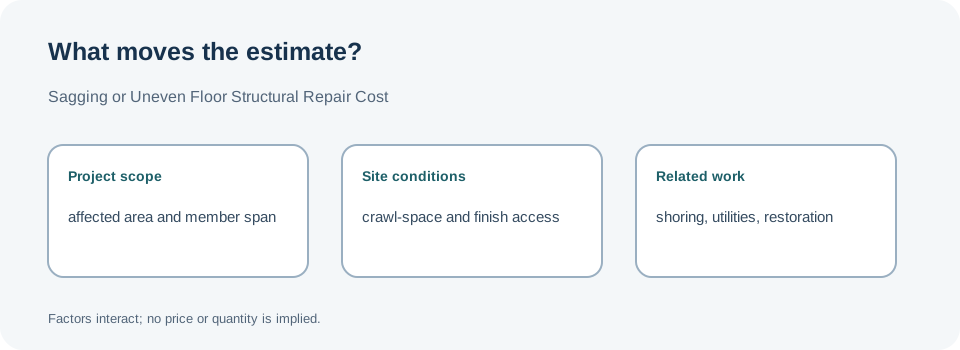 Affected area, number of members, span, access, crawl-space clearance, finished rooms, utilities, insulation, moisture or pest damage, temporary shoring, lifting objective, engineering, permits, disposal, and restoration matter. A small visible dip at the center of a house can implicate a long beam line; a broad uneven floor can still be a localized support problem.
Scenarios
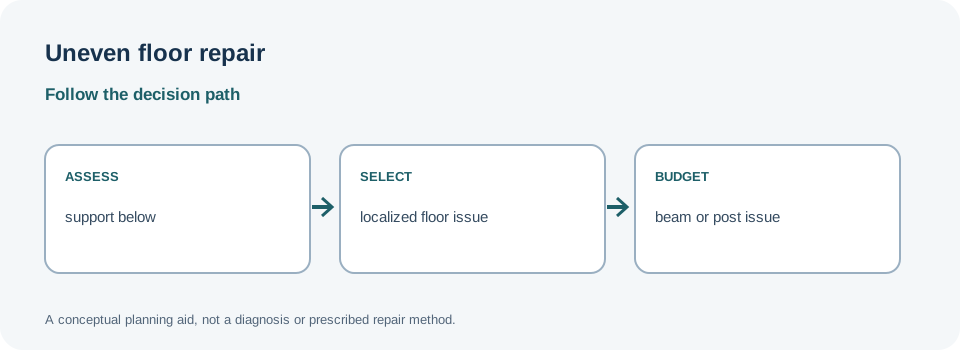 Focused framing repair: One or a few accessible joists are damaged and the support below is sound. Price preparation, structural repair, and subfloor restoration separately.
Support-line repair: A beam, post, pier, or footing contributes to the sag. Compare the cost and disruption of added support, replacement, and any finish adjustment.
Movement or leveling project: Several rooms show a pattern, foundation symptoms coexist, or soil is involved. Budget for assessment and stabilization before discussing cosmetic leveling.
How to compare quotes
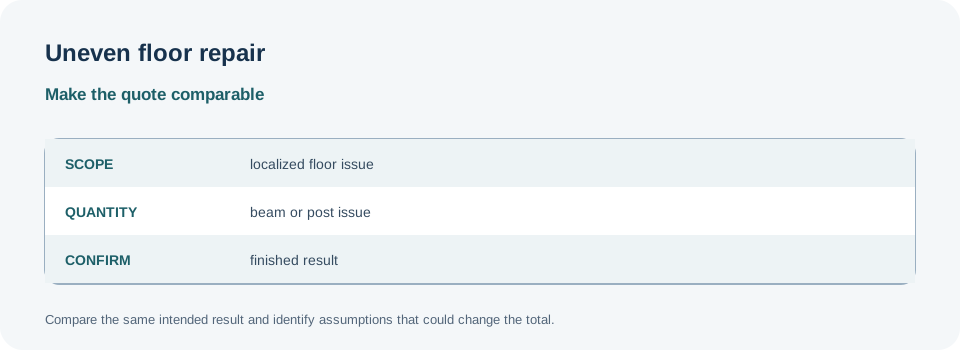 Ask each bidder to identify the failed layer, measurements or observations, temporary support, member quantity, access, utility protection, engineering, permits, root-cause exclusions, finish scope, hidden-condition allowance, and intended result. “Level floor” is not enough: determine whether the promise is a structural repair, a finish correction, or a measured elevation change.
Do not use a low finish price to compare with a structural repair. The correct budget resolves the support problem and states what remains outside the work.
Use measurements and openings intelligently
Ask how the floor level was documented, which areas were inspected, and what access remains unavailable. A sensible allowance may cover selective opening and repair of the failed layer; it should not become permission for unlimited demolition. Require photos, quantities, and a decision point before concealed work is added.
For a short ownership horizon, a focused repair with clear residual conditions may be preferable to a whole-floor rebuild. For a long horizon, include repeat access, the risk of finish damage after future movement, and the value of correcting the beam, post, foundation, soil, moisture, or pest cause once. A level-looking finish is not a substitute for stable support.
Match the repair to the symptom pattern
Record whether the unevenness is localized or distributed, whether it follows a beam or wall line, and whether foundation, roof, door, window, moisture, or pest symptoms occur with it. This information helps a professional decide whether to open a floor, inspect below, evaluate the support line, or investigate the foundation. It also prevents a finish contractor’s price from being mistaken for a structural diagnosis.
Ask each bidder to list the members and supports included, what is retained, how hidden work is measured, and what the finished floor is expected to do. For long-term ownership, include the cost of preserving access and correcting the cause. For short-term ownership, a bounded repair can be sensible if the residual slope and future risk are documented.
Normalize the finished result
Ask whether the proposal promises stability, reduced deflection, measured leveling, or only finish correction. Record the failed layer, affected members, supports, access, temporary shoring, utilities, engineering, permits, demolition, and finish restoration. This prevents a flooring quote and a support-system quote from being compared as if they solved the same problem.
For a long ownership horizon, compare future inspection access and the cost of reopening the same area. For a short horizon, a bounded repair can be sensible when the cause and residual slope are documented. A smooth finished surface is not evidence that structural movement has been corrected.
A practical quote comparison
Ask whether the proposal repairs joists, a beam, posts, a foundation, soil, or only the finish. List the affected area, access, temporary support, utilities, engineering, permits, demolition, restoration, and hidden-condition process. The final result should say whether the floor is stable, less deflected, or actually re-leveled.
For long-term ownership, include repeat access and the cost of correcting the cause. For short-term ownership, a focused repair can be reasonable when its residual slope and uncertainty are documented. A finish-leveling quote does not replace structural assessment.
Map the symptom pattern before buying a remedy
A floor that feels uneven can reflect joist deflection, a sagging beam, a failed post or footing, settlement, moisture damage, an altered opening, or a finish problem. The location and pattern matter: a broad center sag points to a different investigation from a localized soft spot or a slope that follows one support line. A proposal should show what was measured and which layer it assumes is responsible.
Ask how the repair will affect doors, partitions, tile, cabinets, plumbing, and brittle finishes. Raising a floor quickly may correct an elevation but transfer stress elsewhere; sistering or beam work may improve capacity without returning every finish to level. Price investigation, temporary support, structural work, and finish restoration separately. A useful comparison states the expected finished result and the tolerances the owner is accepting.
Trace the symptom through the load path
Use the floor pattern to organize questions, not to make a remote diagnosis. A center sag, a slope along one beam, a soft localized area, and a floor that changes near an addition can lead to different inspections. Ask whether the contractor looked at joist ends, beams, posts, foundations, sill or rim connections, moisture, pests, and altered framing. The goal is to identify the failed layer and the work needed to reach it.
The proposal should distinguish structural stability, reduced deflection, measured leveling, and finish correction. These outcomes can require different access and can leave different conditions behind. A self-leveling floor treatment or finish replacement may be appropriate for a surface issue but should not be used to price a structural movement problem. Conversely, a structural repair may not return every finish to its former elevation without additional restoration.
Use a controlled opening and restoration allowance
Ask which rooms, ceilings, floors, crawl-space areas, or basement areas were inspected and which remain concealed. If an opening is needed, define the base area, the evidence to collect, the unit price for additional members or support work, and the decision point before the finish is closed. Utilities and brittle finishes can dominate a small structural repair, so include them in the comparison rather than treating them as surprises.
For long-term ownership, include future inspection access and correction of the beam, post, foundation, soil, moisture, or pest cause. For short-term ownership, a bounded repair can be sensible when its residual slope and remaining uncertainty are documented. A good quote explains both what will be stable and what will merely look better.
Separate comfort, appearance, and structural outcomes
Homeowners may want a floor that feels firmer, looks level, accepts a finish, or has a corrected support condition. Those goals can overlap but may require different work. A finish correction can improve appearance without changing the load path. Joist or beam work can reduce deflection without restoring every elevation. Foundation or soil work can address the cause while leaving some finish repair for later. Ask the proposal to state which result is priced.
Record the locations of doors, partitions, cabinets, tile, plumbing, and other brittle or fixed elements that could be affected by movement or lifting. Ask whether the bid includes protection and restoration, and whether an opening or temporary-support stage is needed. If the contractor discovers that the symptom belongs to another layer, a defined investigation allowance is safer than approving an unrelated repair because the number looked low.
For long-term ownership, compare repeat access and future inspection with a coordinated correction. For short-term ownership, a focused repair may be reasonable when the remaining slope and cause are documented. The decision should follow the intended use of the room and the stability of the structure, not a generic promise that the floor will become perfectly level.