
The beam itself may be only one part of a support-beam project. Because current evidence does not establish comparable national installed prices, request a designed scope that states the beam, bearings, posts or footings, temporary support, handling route, utilities, and restoration.
Published price context
A HomeGuide U.S. cost page, dated October 3, 2023, reports US$6,500–US$10,000 to replace a basement support beam and US$20,000 or more for a long beam plus removal of multiple basement load-bearing walls. This is a dated publisher estimate, not current local pricing; use it only as historical context and obtain a quote that states beam length, bearings, shoring, access, and restoration.
A main beam is a load-path project
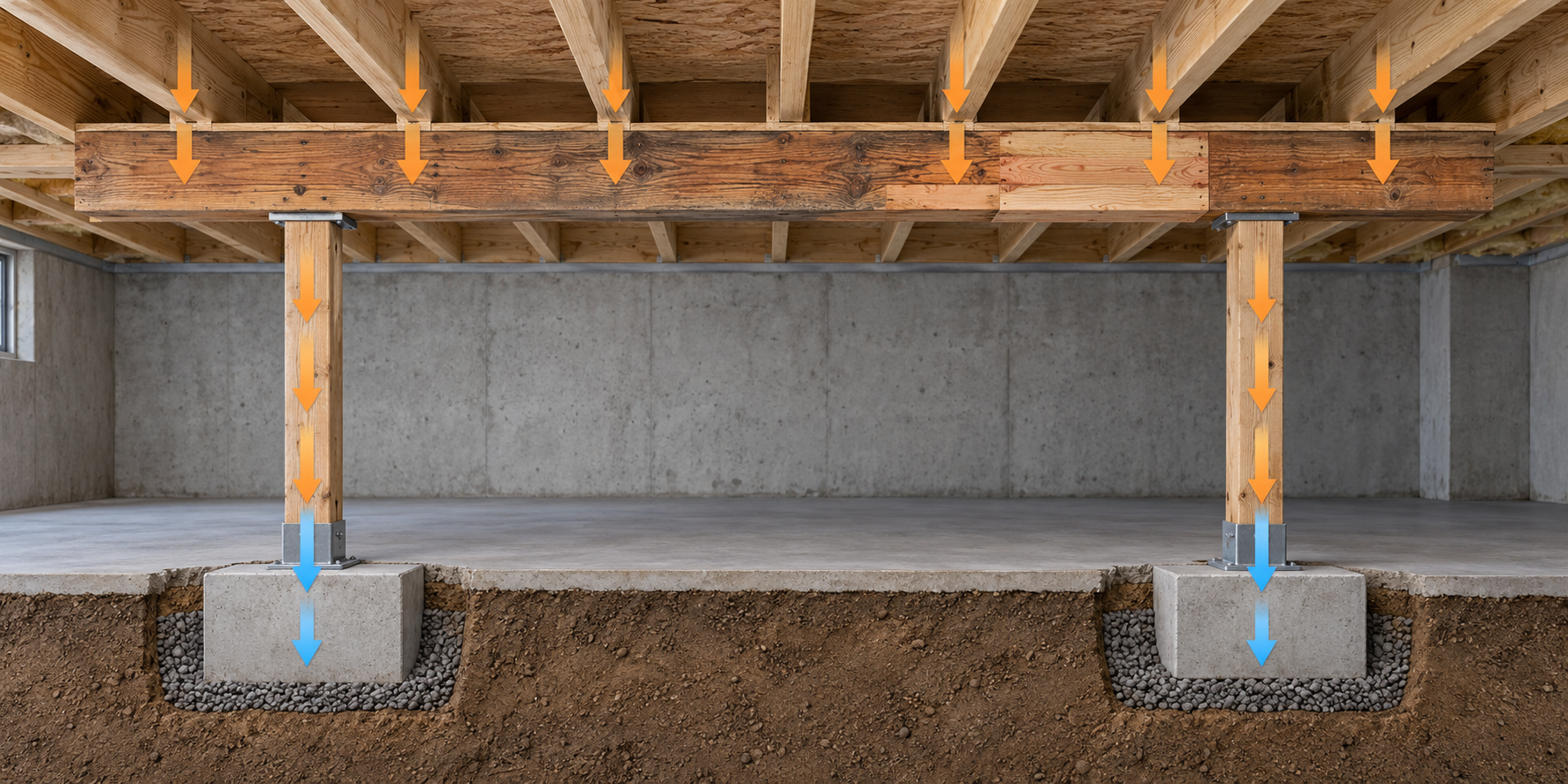
A primary beam or girder collects loads from joists, walls, or other framing and transfers them to posts, columns, piers, or foundations. A crack, sag, rot, corrosion, undersized member, or failed connection can therefore affect more than the visible beam. The repair may be local, a full replacement, or a new supplemental support system.
Replacement and added support are not the same decision. This article covers substantial repair or replacement of an existing main beam; a planned supplemental beam under a sagging floor has a separate cost and tradeoff path.
Cost layers
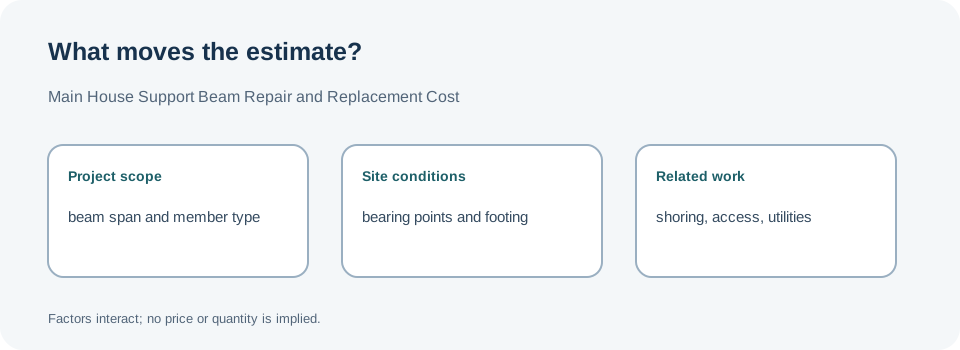
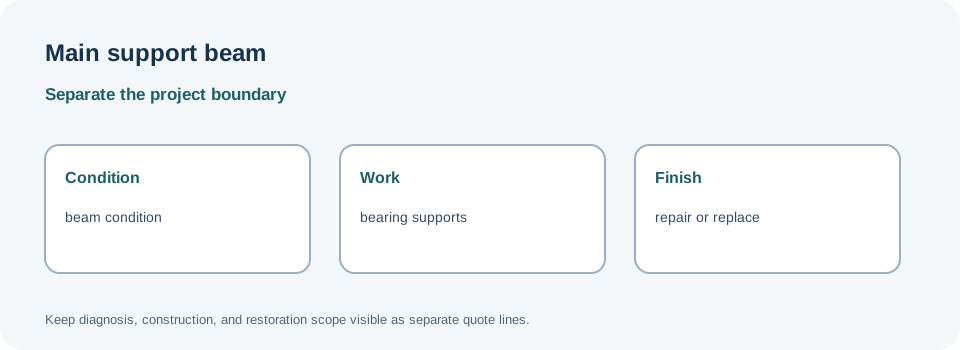 Expect the proposal to address temporary shoring, access, demolition, beam handling, new wood or engineered/steel member, posts and bearing points, footing condition, connections, utility relocation, engineering, permits, fire or finish integration where applicable, disposal, and restoration. A finished basement or low crawl space can make shoring and handling the largest line.
Rot, termites, moisture, settlement, overloading, or altered framing may require cause correction and additional members. Those scopes should be identified rather than hidden in a vague contingency.
Repair versus replacement
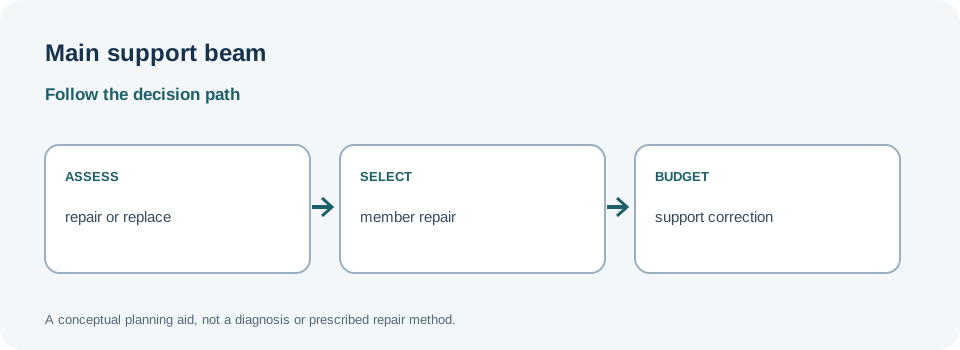 Repair can make sense when damage is localized, the surrounding beam and bearings are sound, access is manageable, and the repaired load path is well defined. Replacement is more persuasive when damage is distributed, the member is repeatedly overloaded or deteriorated, bearings are failing, or the same access would otherwise be repeated.
An added support beam may reduce span or load on existing framing but can consume headroom and require new posts or footings. Compare it separately with replacement, including use-of-space and future access.
Scenarios and drivers
Focused repair: A visible localized defect with open access and sound supports. Budget for investigation and finish protection, not only material.
Typical replacement: Temporary support, removal, new beam, post or connection work, and restoration. Utility conflicts and bearing conditions should be explicit.
Complex: Low clearance, finished rooms, multiple posts, new footings, concealed deterioration, or foundation movement. Engineering, staging, and restoration may exceed the beam cost.
Compare quotes
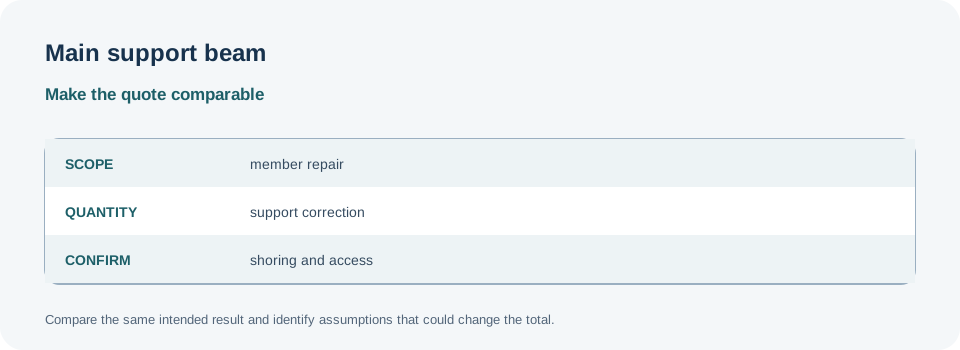 Normalize beam length and material, temporary support, bearing points, post and footing work, engineering, permits, utilities, access, demolition, restoration, concealed-condition unit prices, and warranty. Do not select a beam material or size from a generic table; structural design determines what is viable.
If a quote cannot describe how load is supported during and after the work, it is not a complete beam-replacement budget.
Test the whole support line
Ask whether the beam’s ends, posts, columns, piers, footings, and connected joists were evaluated. A replacement can transfer load successfully only if the receiving points can carry it. If one proposal includes new footings or posts and another reuses existing bearings, the totals are not comparable until that difference is explained.
For a short horizon, a documented localized repair may avoid major demolition when surrounding members are sound. For a long horizon, compare repeat access, future basement use, maintenance visibility, and the chance that concealed rot or settlement will require the same work again. Keep pest, moisture, and foundation correction visible as related scopes.
Separate member economics from access economics
The beam may be a modest material line beside shoring, demolition, handling, post and footing work, utility relocation, engineering, permits, and restoration. Ask whether the existing ends and receiving supports are included. A new beam that needs new bearings can change the job more than a difference between wood, LVL, glulam, or steel.
For a short horizon, a repair can preserve finishes when the defect is bounded and the surrounding load path is serviceable. For a long horizon, replacement or a designed supplemental support may reduce repeat access. Compare the residual condition, headroom, future service route, and warranty—not only the first mobilization.
Confirm the receiving supports
A beam replacement budget is incomplete until its ends, posts, columns, piers, footings, and connected joists are addressed. Ask whether those components are being reused, repaired, or replaced and whether temporary support is included. A material price can be low because bearing work has been excluded.
Compare repair, replacement, and supplemental support on the same result. For long-term ownership, include future access and repeat-shoring risk. For short-term ownership, a localized repair may be worthwhile when surrounding members are sound. Keep rot, pests, moisture, foundation, and finish restoration as visible related scopes.
A practical quote comparison
Ask for the beam length and material, the ends and bearings, posts and footings, temporary support, access, utilities, engineering, permits, demolition, restoration, and hidden-condition allowance. A bid that prices only the member is not equivalent to one that prices the load path.
Compare the cost of repair, replacement, and supplemental support over the ownership horizon. Include headroom, future services, maintenance access, and the likelihood of another opening. Keep rot, pest, moisture, and foundation work visible so a structural total does not hide an unresolved cause.
Shoring and receiving supports deserve their own review
Replacing or repairing a main beam changes concentrated loads while the work is in progress and after it is complete. Temporary shoring, jacking, post locations, footings, beam pockets, connections, and the condition of the framing above can cost as much as the member itself. A proposal that prices a beam by length without describing its supports is incomplete.
Ask for the assumed span, loads, bearing points, access path, lifting or shoring sequence, and any new or enlarged footing work. Check whether posts land on a suitable support below or simply transfer the problem to a floor or slab. A lower-cost repair may make sense if the beam is sound outside a bounded defect; replacement may be better when access is already open or repeated repairs would require the same disruption. Compare the entire load path, not just steel, wood, or labor.
The beam cannot be priced apart from its reactions
The receiving supports are part of the beam decision. A new or repaired beam transfers concentrated loads to posts, columns, piers, footings, walls, or slabs, and each connection can change the scope. Ask whether the proposal reuses or replaces the supports, how their condition was verified, and whether new point loads need their own bearing work. This is why a beam sold by length is not a complete installed price.
Temporary shoring and handling deserve the same clarity. The crew may need to protect the structure while the old member is removed, bring a heavy or long member through a limited opening, move utilities, and restore finishes afterward. Ask which stage is included, who designs or supervises it, and what happens when an end, pocket, post, or footing is more deteriorated than expected. Do not fill those gaps with a generic beam size or hardware assumption.
Compare the finished support line
For a localized repair, the key question is whether sound beam and bearing remain around the defect. For replacement, compare the complete removal, support, new member, connections, and restoration sequence. For a supplemental beam, include headroom, use of space, new posts, and footings. The options may produce different floor behavior even when the headline costs overlap.
For long-term ownership, value future service access, inspection visibility, and the cost of reopening the same finished area. For short-term ownership, a documented localized repair can preserve capital when the load path is sound. In either case, the proposal should state what it restores and what rot, pest, moisture, foundation, or finish work remains outside it.
Decide whether the beam is the cause or the receiver
A main beam can fail because of deterioration, overload, poor connection, movement at a post or footing, an altered load, or a condition above it. The beam can also be the part receiving a problem from the floor or roof. Ask what was inspected at the ends, posts, columns, piers, footings, joists, and supported walls. A replacement that simply transfers the same load to an inadequate bearing point is not a complete structural solution.
The work sequence can include protection and temporary support, demolition, delivery and handling, beam installation, connection and bearing work, utility relocation, and restoration. Ask which phase each price includes and what discovery changes the scope. A finished basement or low crawl space can make access and shoring more expensive than the member. Keep optional ceiling, lighting, or remodeling work separate from required structural restoration.
For long-term ownership, compare the residual support condition, inspection access, future service routes, and repeat-shoring risk. For short-term ownership, a localized repair may be appropriate when the surrounding load path is serviceable and the cause is controlled. The meaningful price is the beam and its reactions, not the retail cost of a piece of steel or wood.