
A foundation affected by pyrrhotite can lead to a major assessment and reconstruction project, but a crack or a price guide cannot establish that a particular home has this problem. The budget depends on what qualified professionals find, whether part or all of the foundation is included, and how lifting, utilities, excavation, and restoration are handled. Québec’s former pyrrhotite assistance program ended on September 30, 2026, so do not subtract its old aid from a current project budget.
A crack is not a material diagnosis
Pyrrhotite is an iron-sulfide mineral that can occur in concrete aggregate. Research by the U.S. National Institute of Standards and Technology describes reactions that can expand within concrete and contribute to cracking and deterioration. Similar-looking cracks can have other causes, however, and appearance alone cannot identify the aggregate or show how much structural capacity remains.
NIST reports that standardized methods to assess the occurrence and amount of pyrrhotite in concrete are still being developed. Its research discusses laboratory analysis and foundation specimens; it is not a homeowner testing procedure, a Québec testing rule, or a threshold for deciding that replacement is needed. Do not use a crack width, a surface treatment, or an informal sample as a substitute for a qualified assessment.
If pyrrhotite is suspected or has been identified in records about the property, ask an appropriately qualified local professional what material and structural assessment is needed for this building. The report should distinguish what was observed, what the evidence can establish, what remains uncertain, and whether more investigation or structural design is needed. A material finding and a repair recommendation answer different questions; neither should be inferred from a general online description.
Separate assessment from the construction estimate
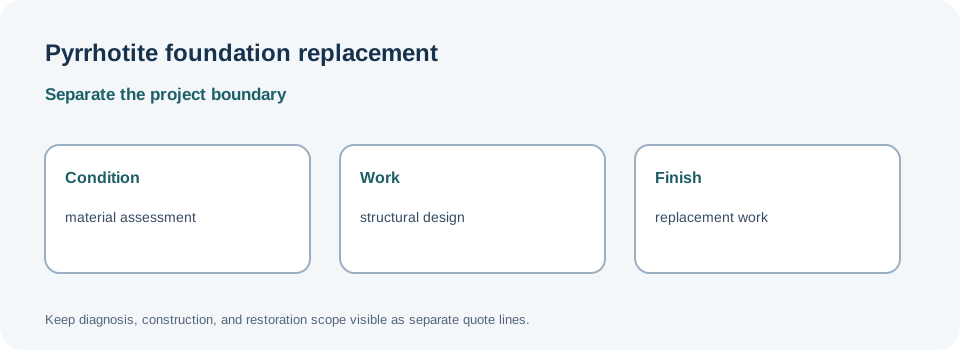 There is no defensible general price for a pyrrhotite-specific test, expert report, or installed replacement. Ask providers for written quotes and keep these possible costs separate:
| Budget stage | What it may cover | What to ask the provider to define |
|---|---|---|
| Material and condition assessment | Professional review of available records and the concrete or structure | Who performs the work, what locations and questions are included, and what the report can conclude |
| Structural design and approvals | Design documents, engineering, permit or inspection coordination where applicable | Whether design and permit work are included or separately contracted |
| Structural construction | The defined partial or full foundation work | Which walls, footings, connections, quantities, and end condition are included |
| Enabling work and restoration | Temporary support, lifting, excavation, utilities, demolition, backfill, finishes, and site restoration | Which trade owns each item and what is excluded or conditional |
The first stage should clarify the scope used for the later estimate. A professional-service fee is not part of a contractor’s installed foundation price unless the proposal explicitly includes it. Ask whether any material assessment, structural assessment, design, or permit coordination is priced separately and when it must be paid.
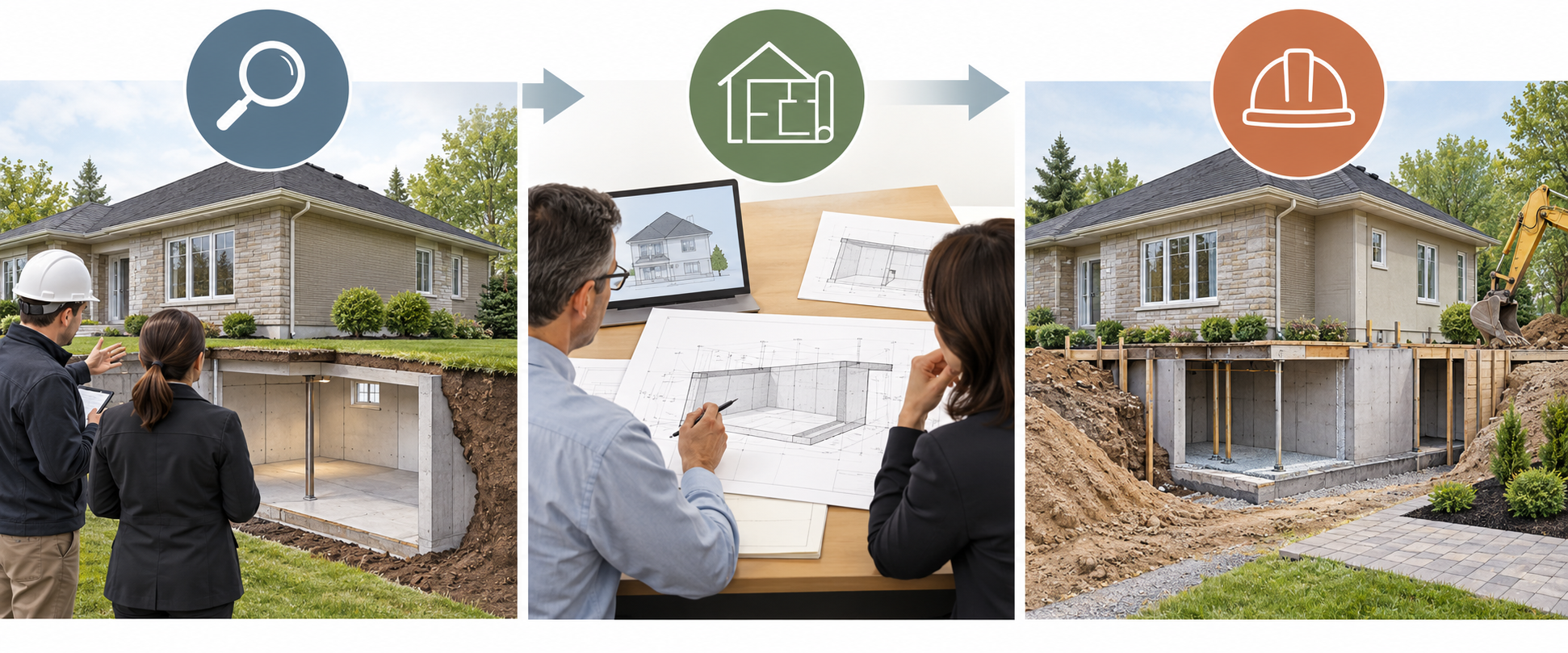
What a replacement proposal needs to show
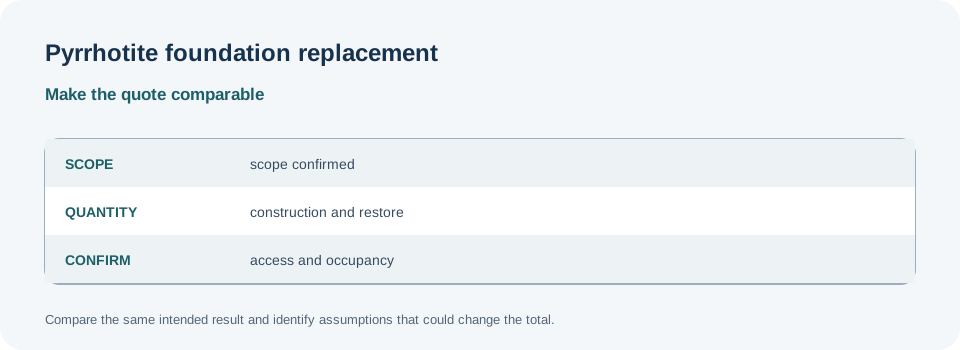
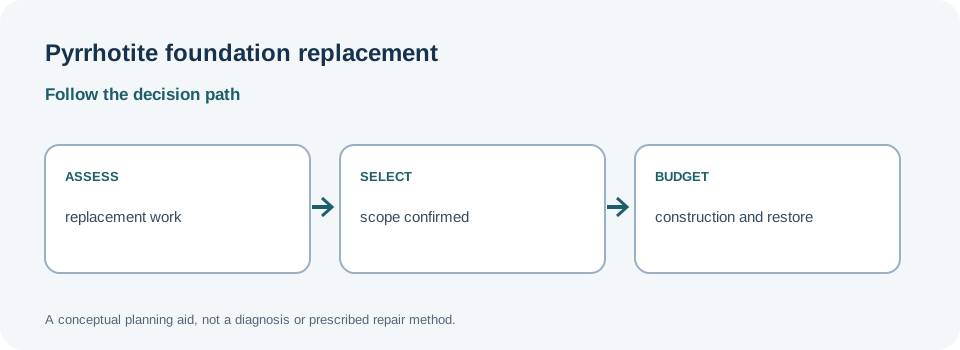 Partial and full replacement are different project classes. A qualified design may identify a limited wall or section, or a broader foundation system; the visible damage does not decide which scope is appropriate. For either scope, compare proposals against the same documented condition and intended result.
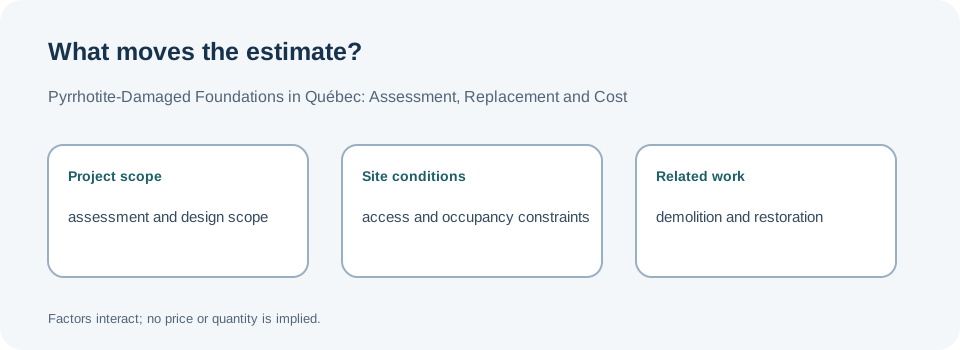 Ask the contractor to identify the foundation area and quantities, the temporary support or lifting assumptions, excavation and disposal, utility disconnection and reconnection, new foundation work and its connections to retained structure, and the restoration endpoint. Also separate basement finishes, exterior work, landscaping, drainage, and other related projects where they are not included in the structural scope. A price that stops at new concrete or masonry is not the same as a price for a reconnected and restored home.
Ask how the proposal handles access restrictions, weather protection, temporary accommodation, concealed deterioration, and changes after opening the site. A useful estimate states what is measured, what is an allowance, who approves a change, and whether the contractor expects the home to remain occupied. These items can affect both the amount and the timing of payments even when the structural method is unchanged.
A Québec price example is adjacent context, not a pyrrhotite estimate
One Québec foundation contractor’s August 2026 guide lists CAD $20,000–$45,000 for partial foundation replacement, CAD $40,000–$90,000 for full replacement without lifting, and CAD $100,000–$150,000 for full replacement with house lifting, before taxes. The guide does not identify a pyrrhotite project sample, quote count, or method for calculating those ranges. Treat them only as that contractor’s broad replacement examples, not a market average or a prediction for a pyrrhotite-affected home.
The same source says access, excavation depth, soil, bedrock, and related work affect cost. Those factors are useful prompts for comparing the scope, but they do not make the amounts transferable to a specific property. The guide does not establish whether engineering, utilities, accommodation, basement restoration, or all site work are included in each range.
For a more general discussion of project boundaries, see foundation replacement under an existing house and foundation repair cost. Keep U.S. examples and prices from other provinces separate from Québec estimates; do not convert them into a local price.
Plan for access and occupancy
The construction budget is only one part of a major replacement. Ask whether the work can proceed while the home is occupied, what rooms or utilities will be unavailable, and whether the owner must arrange temporary lodging or storage. A contractor’s answer should be tied to the actual scope and schedule, not a general promise that a home can stay open during foundation work.
Confirm who coordinates utility interruptions and reconnection, who protects the house and contents during demolition, and where restoration stops. A proposal may end at the new foundation, while another may include backfill, exterior finishes, basement surfaces, and landscaping. List those endpoints separately so you can compare proposals without mistaking a narrow structural price for the cost of returning the home to use.
Set a process for concealed conditions before work begins. Ask what evidence will trigger a change, who documents it, what unit prices or allowances apply, and whether written owner approval is required before the contractor proceeds. The work may reveal a different boundary than the original report described; a defined change process makes that uncertainty easier to budget without presuming which repair will be required.
Do not count closed assistance as available money
The Government of Québec’s current pyrrhotite program page says the Société d’habitation du Québec program ended on September 30, 2026. The page, updated October 8, 2026, identifies former streams for repair work and expert reports but names no successor. Older descriptions or aid ceilings are historical program terms, not a current offer, an expert-report price, or a construction estimate.
If a new provincial, municipal, insurance, or other recovery option is announced, confirm its current status and written eligibility for the property and work before treating it as a source of funds. Keep the gross project amount intact in the budget until an administrator or insurer confirms an award and explains the payment sequence. A possible reimbursement does not necessarily pay the contractor’s deposit or costs due during construction.
Compare the owner-paid budget, not just the foundation line
Use separate budget lines for assessment, design, construction, utilities, restoration, temporary living arrangements, and any confirmed assistance. For each proposal, record the price date, taxes, exclusions, allowances, payment milestones, and conditions that could change the total. Ask whether the contractor’s price assumes the same replacement boundary as the professional’s scope.
Before approving work, ask:
- Which findings support the proposed partial or full scope, and what remains uncertain?
- Does the estimate include temporary support, excavation, utility work, disposal, reconnection, and restoration?
- Which professional, permit, and inspection costs are outside the contractor’s price?
- What must be paid before a grant, loan, or insurer payment could arrive?
- What written approval is required before the work starts, and what happens if the scope changes?
If a condition raises an immediate safety concern, contact qualified local professionals and the relevant authority promptly. Do not delay an urgent assessment or protective action while waiting for a funding decision. For insurance questions, see foundation repair and insurance; for other conditional repair support, see foundation and structural repair assistance.
Sources
- Programme pour les résidences endommagées par la pyrrhotite, Gouvernement du Québec; last updated October 8, 2026.
- Assessing Pyrrhotite in Concrete, National Institute of Standards and Technology; updated March 25, 2026.
- Foundation Replacement Cost in Quebec: The 2026 Price Guide, Solution ProFissure; August 4, 2026. The listed amounts are a single contractor’s estimates without a disclosed project sample or pricing method.