
There is no general insurance answer to “foundation repair.” A policy responds to covered causes of damage under its own wording, limits, and conditions; it does not cover every project just because the foundation needs work. Build the gross repair budget first, then count only work and payments the insurer has confirmed in writing.
Start with the cause and the repair scope
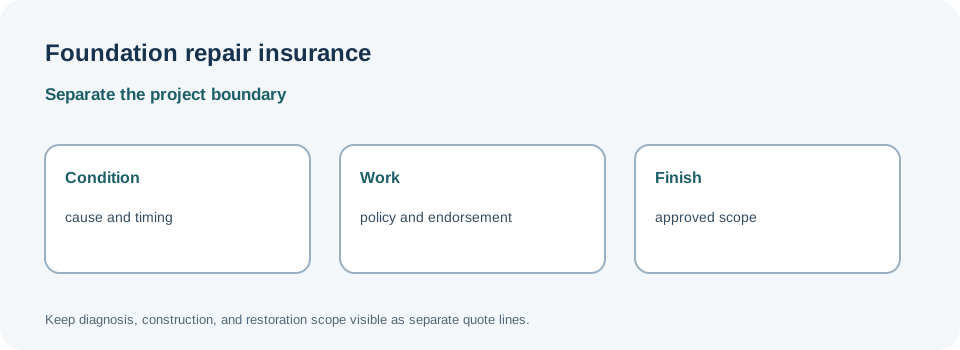
A contractor’s proposal describes work and price. An insurance policy describes covered causes and conditions. Those are related but different documents. A foundation repair can involve movement, gradual deterioration, sudden damage, water intrusion, an earthquake, or another event. The cause that applies to your home must be established for the insurer to assess the policy; the visible crack or repair method does not determine coverage by itself.
Before treating insurance as a budget offset, keep the contractor’s total as the gross project amount. Ask for a scope that identifies the affected area, proposed work, access, temporary support, utilities, demolition, restoration, and exclusions. Then compare the insurer’s written position against those same line items. A covered portion of the structure does not automatically make every related cost covered.
Read the policy and the applicable endorsements
 Look at the policy form, declarations, exclusions, endorsements, and any separate policy that could apply to the stated cause. Focus on:
- the cause of loss and any earth movement, settling, water, or gradual-damage exclusion;
- optional foundation, slab, earthquake, or code-related coverage;
- the deductible that applies to this cause and how it is calculated;
- the limit for the affected property and any separate limit for added coverage;
- whether code-related work, temporary accommodation, or finish restoration is addressed;
- what documents or inspections the insurer requires before work begins.
The word “endorsement” usually means an addition or change to the base policy. It can add coverage, but the title alone does not show which damage, costs, limit, or deductible applies. Use the actual form and written explanation for your policy rather than another homeowner’s claim or a generic list.
Regulator examples show why the location matters
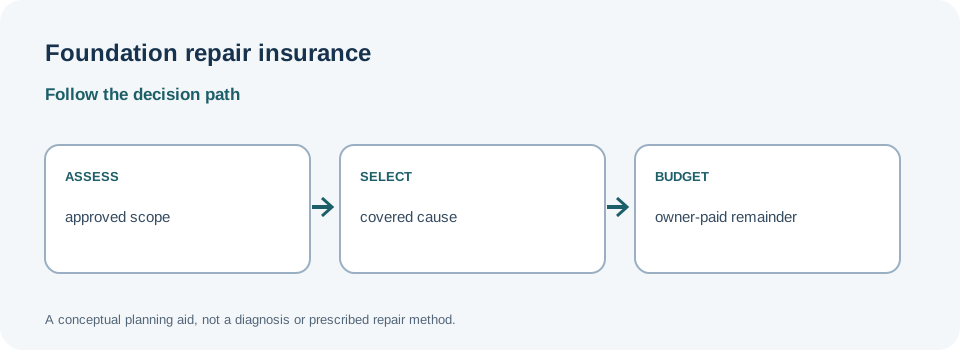 In California, the Department of Insurance’s residential guide lists earthquake, earth movement, wear and tear, and some water-related causes among perils generally not covered by a standard homeowners policy. Its earthquake guide explains that earthquake damage is handled through separate earthquake coverage, with its own limits and deductible. These are California examples, not a rule for every state or policy.
The Texas Department of Insurance likewise says most policies do not cover earthquake or earth movement. It lists damage to foundations or slabs and extra construction or repair costs for building-code compliance among common optional endorsements. That means the endorsement may be available; it does not mean every Texas policy includes it or that a particular claim will be paid.
For Canadian readers, the Insurance Bureau of Canada says earthquake coverage is optional and is not included in a standard home policy. That fact establishes only an earthquake distinction. It does not establish how a Canadian policy treats ordinary settlement, soil movement, pyrrhotite, water-related damage, or any specific foundation claim. Ask the insurer about the cause and wording that apply where the home is located.
Use the examples as prompts for the policy questions, not as a decision tree for a claim:
| Reported cause or cost | What to verify in the policy and written insurer response |
|---|---|
| Earth movement or settlement | Whether the cause is excluded, whether an endorsement changes that exclusion, and what evidence the insurer uses to classify the movement |
| Sudden water release or long-term seepage | How the policy distinguishes a sudden event from a continuous leak, and whether stopping the leak and repairing the structure are treated separately |
| Earthquake | Whether a separate earthquake form applies, and its deductible and limit for the affected structure |
| Code-required work | Whether ordinance-or-law coverage exists, what limit applies, and whether it applies to the accepted repair |
The same words can describe different policy facts. For example, “water in the basement” may refer to a sudden pipe break, long-term seepage, surface flooding, or groundwater. Describe what happened accurately and ask the insurer which policy language it is applying; a table or label cannot settle the cause for you.
Similar-looking water damage can be treated differently
Regulator guides distinguish sudden and accidental water damage from continuous seepage or leakage. California and Texas both describe sudden and accidental water as generally covered under the policies they summarize, while listing seepage, continuous leaks, or maintenance-related damage among common exclusions. These descriptions are broad consumer examples; a concealed pipe break, long-running leak, or wet foundation still has to be evaluated under the policy and facts of the loss.
If water is part of the reported cause, ask what evidence establishes when it began and whether the policy treats the resulting structural damage separately from the cost to stop the leak. Also ask whether excavation, plumbing, drying, foundation repair, and interior restoration are handled as one scope or separate covered lines. Do not assume that coverage for one water-related repair means the foundation work is also accepted.
Turn the insurer’s answer into a budget
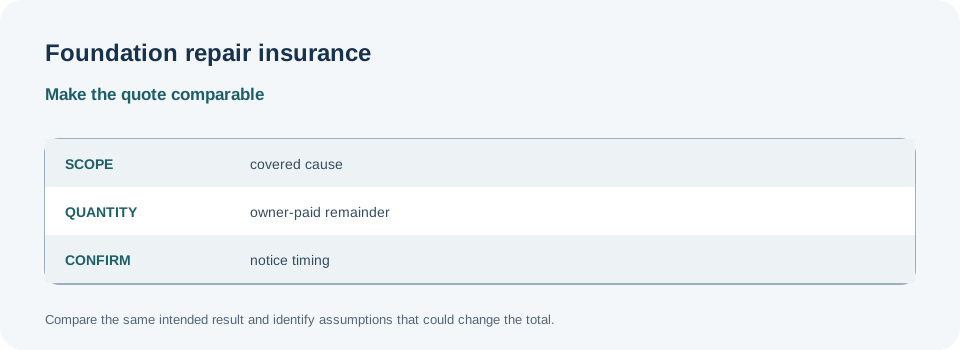

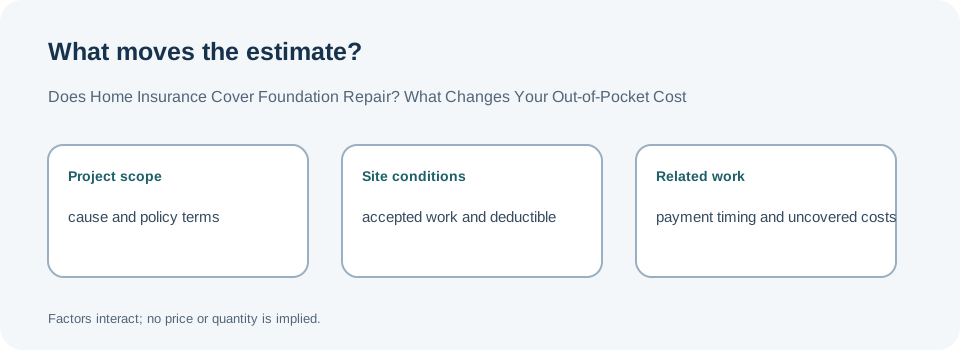 Use four separate numbers or statuses rather than one hoped-for net figure:
| Budget item | What belongs here |
|---|---|
| Gross project price | The full contractor scope, including related work and stated exclusions |
| Confirmed covered scope | Only the work the insurer has accepted under the policy, subject to its written conditions |
| Owner-paid policy share | The applicable deductible, policy limits, depreciation or other policy adjustments, and uncovered work |
| Unconfirmed payment | Any pending review, appeal, estimate, or possible reimbursement that is not yet approved |
Do not subtract a coverage limit from the quote and assume the rest will be paid. The insurer may accept only part of the proposed scope, apply a deductible, require another inspection, or find that some restoration or code work is outside the coverage. A policy maximum is a ceiling; it is not an expected payment.
Also check whether the repair contractor’s price includes items the insurer has not evaluated, such as engineering, permits, excavation, temporary support, utility work, finish restoration, or temporary accommodation. If those items are necessary, ask who will review them and whether the insurer needs an estimate or records before the work starts.
The policy’s payment basis can change the amount available for the same approved work. The Texas regulator explains the difference between replacement-cost and actual-cash-value coverage, where depreciation may be deducted under the latter. Ask whether the policy applies that distinction to the repair, whether any amount depends on completing work, and whether the deductible is taken from the same scope the contractor priced. Use the wording of your own policy; regulator examples do not predict an individual payment.
Keep safety and claim timing on separate tracks
If you have a reported event or possible loss, contact the insurer promptly and ask what documentation, inspection, and notice requirements apply. Keep copies of dated photographs, professional findings, proposals, change orders, invoices, and written insurer responses. Ask whether any emergency work or opening of the structure needs prior inspection, but do not rely on an insurance discussion as a structural assessment.
If a qualified professional or public authority identifies an urgent safety issue, do not postpone necessary protective action while waiting for a coverage decision. Ask the insurer how urgent steps should be documented and whether they need to inspect before work proceeds. Coverage and immediate safety are separate decisions.
Questions that resolve the budget gap
Ask the insurer or its representative to answer in writing:
- What cause of damage is being considered, and what policy wording applies?
- Which contractor line items have been accepted, rejected, or left pending?
- Which deductible and limit apply to this cause, and are any endorsements involved?
- Are engineering, access, temporary support, code upgrades, utilities, and restoration included?
- What inspection, documentation, or approval is needed before a contractor starts?
- When would any approved amount be paid, and what costs must the homeowner pay first?
Keep the contractor’s gross price intact until those answers are documented. If assistance or a grant may also apply, track it separately from insurance; see foundation and structural repair assistance. For a Québec material-specific example, see pyrrhotite-damaged foundations. The broader foundation repair cost guide explains how to compare project scopes.
Sources
- Residential Insurance: Homeowners and Renters, California Department of Insurance; Form 401 revised January 2026.
- Earthquake Insurance, California Department of Insurance; revised April 25, 2024.
- Home insurance guide, Texas Department of Insurance.
- Earthquake Protection, Insurance Bureau of Canada.