
Repair assistance can make a difficult project possible, but a program ceiling is not a repair price or a promised award. Before counting outside funds, check whether the program is open, whether it accepts the exact foundation or framing work, who receives the money, and when the owner must pay. Keep the full contractor budget visible until written approval explains the covered scope and payment sequence.
Define the project before searching for help
Start with a written repair scope and gross project estimate. It should identify the affected structural area, intended result, quantities or locations, access, temporary support, professional design, permits, utilities, restoration, exclusions, and any allowance for concealed conditions. The program administrator may need a professional report or contractor proposal, but an assistance application does not decide whether the proposed repair is structurally appropriate.
If the scope is not ready, treat the first inquiry as an eligibility screen, not a funding commitment. Ask the administrator what document is needed to review the structural work and whether the program can consider it before the application is complete. Keep the cost of assessment or design separate from the construction estimate unless the program confirms it can pay those costs.
Screen five conditions first
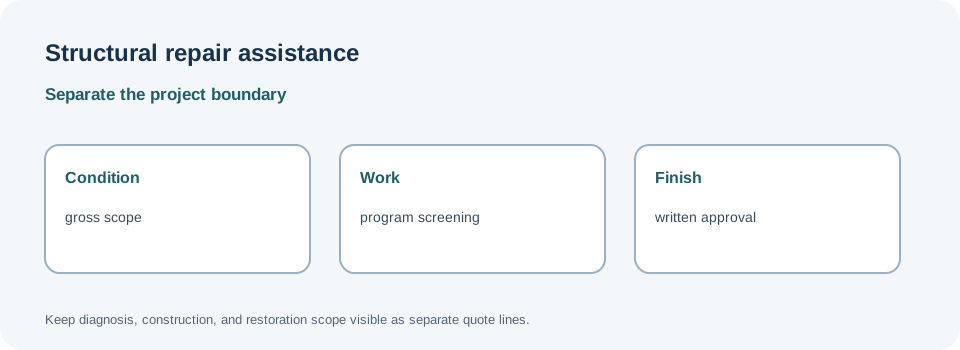 Most assistance paths are limited by a combination of:
- Location: country, province or state, city limits, rural eligibility, or a participating community.
- Applicant: owner occupancy, length of ownership, income, age, disability, or ability to qualify for credit.
- Property: existing home, property type, condition, household use, or program limits on prior assistance.
- Work: whether the program names structural work, and whether it accepts this specific repair rather than only general health-and-safety work.
- Timing and funds: whether intake is open, funding remains, work may start before approval, and how the money is paid.
A broad phrase such as “home repair” does not prove that a large foundation replacement qualifies. Ask the program to confirm the exact work description in writing. Also ask whether the applicant, a lender, a city, a province, or another administrator receives the funds; that changes the documents, contractor arrangements, and cash needed.
Compare a few official examples
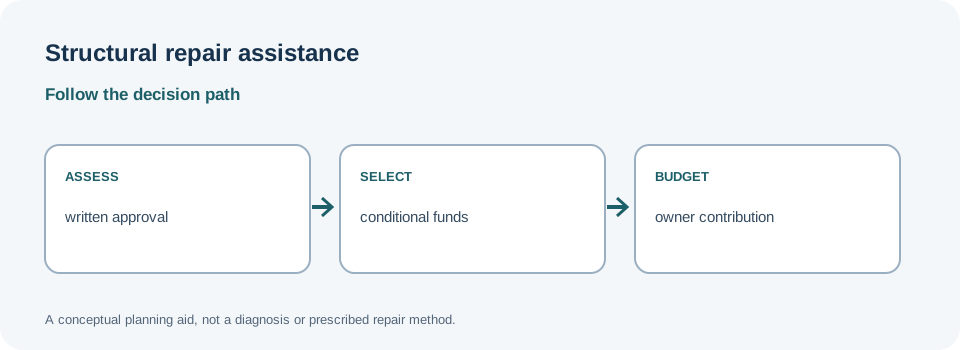 These examples show why checking scope and repayment matters. They are not a complete program directory, and none determines an individual household’s eligibility.
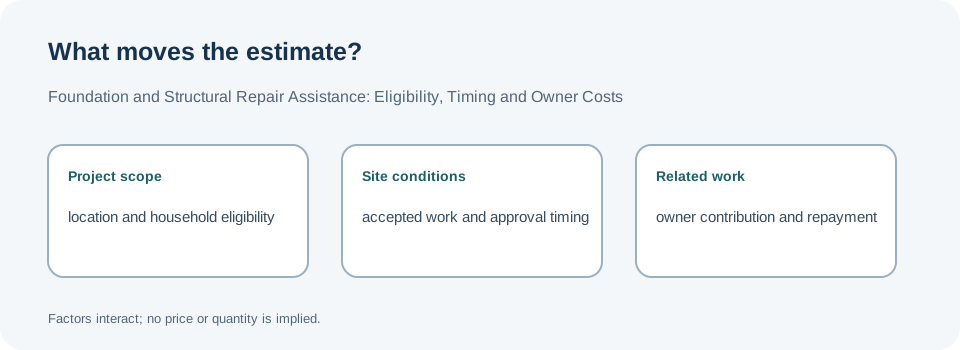
| Program example | Published scope and assistance | What still needs confirmation |
|---|---|---|
| USDA Section 504, eligible rural areas in the United States | The program lists home repair loans up to US$40,000 and grants up to US$10,000 for eligible homeowners aged 62 or older to address health and safety hazards. Loan terms listed are 20 years at a fixed 1%. | Applicants must own and occupy the home, meet county income limits, be unable to obtain affordable credit elsewhere, and meet rural-area rules. Its general repair language does not name every foundation project. As checked October 12, 2026, the current page lists an open application window, but approval depends on local funds. |
| Newfoundland and Labrador Home Repair Program | The Fall 2026 page lists minor structural repairs when an unresolved defect may threaten occupant safety or force the household to leave. Eligible homeowners may receive a forgivable loan up to $10,000, or $13,000 in Labrador, subject to a five-year occupancy condition and a $30,000 lifetime maximum. | Combined annual household income must be below $42,500, or $65,000 in Labrador; applicants must own and occupy the home for five years and cannot be NLHC clients. Confirm whether a specific replacement scope is accepted and any repayment if the owner moves early. |
| New Brunswick Homeowner Repair Program | Housing NB lists structural work among major repair areas for eligible low-income owner-occupants and describes a loan with a forgivable portion up to $18,000. Any repayable portion is at the provincial borrowing rate for up to 15 years. | Income limits vary by household size and location. The page does not state the forgivable share or approve a particular foundation scope; ask Housing NB for the current local threshold and project decision. |
Program pages change. Recheck the administrator’s current requirements before applying or signing a construction schedule. A current program can still have closed intake: Raleigh, North Carolina’s page updated September 30, 2026 says its Substantial Rehabilitation Program is not accepting new applications, even though it lists structural systems among possible repair needs.
Separate grants, loans, matches, and mortgage financing
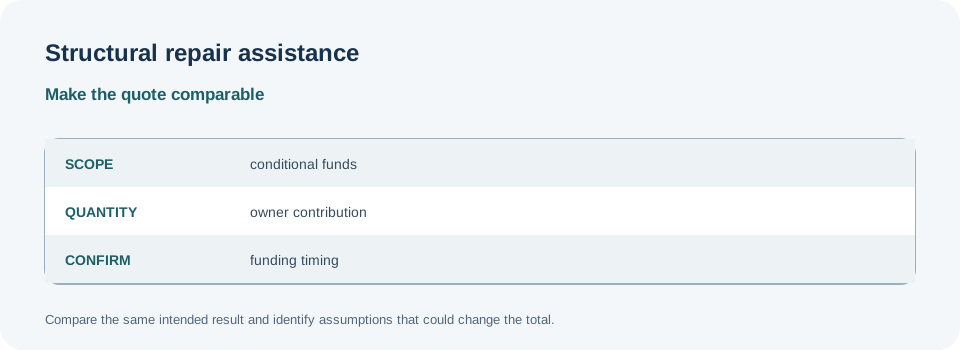 The word “assistance” can describe different financial obligations:
- Grant or contribution: may not need repayment, but eligibility, eligible work, award, and payment timing still apply.
- Forgivable loan: may be forgiven only after the owner meets conditions such as remaining in the home for a stated period. Some program terms trigger repayment if the owner moves or transfers the property before that period ends.
- Repayable loan: lowers the immediate cash gap but adds a debt payment. Confirm the amount, rate, term, security, and any fees.
- Matching funds: require the owner to contribute a defined share. The City of Creston, Iowa’s program document says the homeowner must contribute the full owner share before City matching funds are applied. That means a match may require cash before the public funds arrive; confirm current funds and project approval with the City.
- Purchase or refinance financing: some renovation mortgage products can include approved improvement costs in a larger loan. This is not a grant, and lender underwriting, appraisal, allowed work, and advances control. If a foundation project is part of a purchase or refinance, ask the lender to confirm the exact structural line items, required documents, disbursement timing, and who pays overruns. A product summary alone does not establish that a particular foundation repair will be accepted.
Do not compare a loan’s maximum with a grant ceiling as if they reduce the contractor’s price by the same amount. A loan must be repaid; a forgivable loan has conditions; a match has an owner share; and an approved mortgage may depend on transaction timing and lender controls.
Get the funding sequence in writing
An application date is not the same as approval, and approval is not always the date the homeowner receives money. Before accepting a contractor schedule, ask the program to identify any required assessment, application, scope review, written approval, permit, contract, inspection, invoice, or completion document. Confirm which steps must happen before a deposit or construction begins. Some programs require the administrator to approve the project first; work that starts too early can fall outside the approved scope.
Ask the contractor how long the proposal remains valid and whether the bid can accommodate an assistance decision. If a program pays after inspection or reimbursement, compare that date with the contractor’s deposit and progress-payment milestones. If a program pays the contractor or municipality directly, confirm how the owner share is collected and what happens if approved costs exceed the award. Make a short cash-flow schedule for the period between signing, work, inspection, and payment rather than relying on the maximum assistance amount alone.
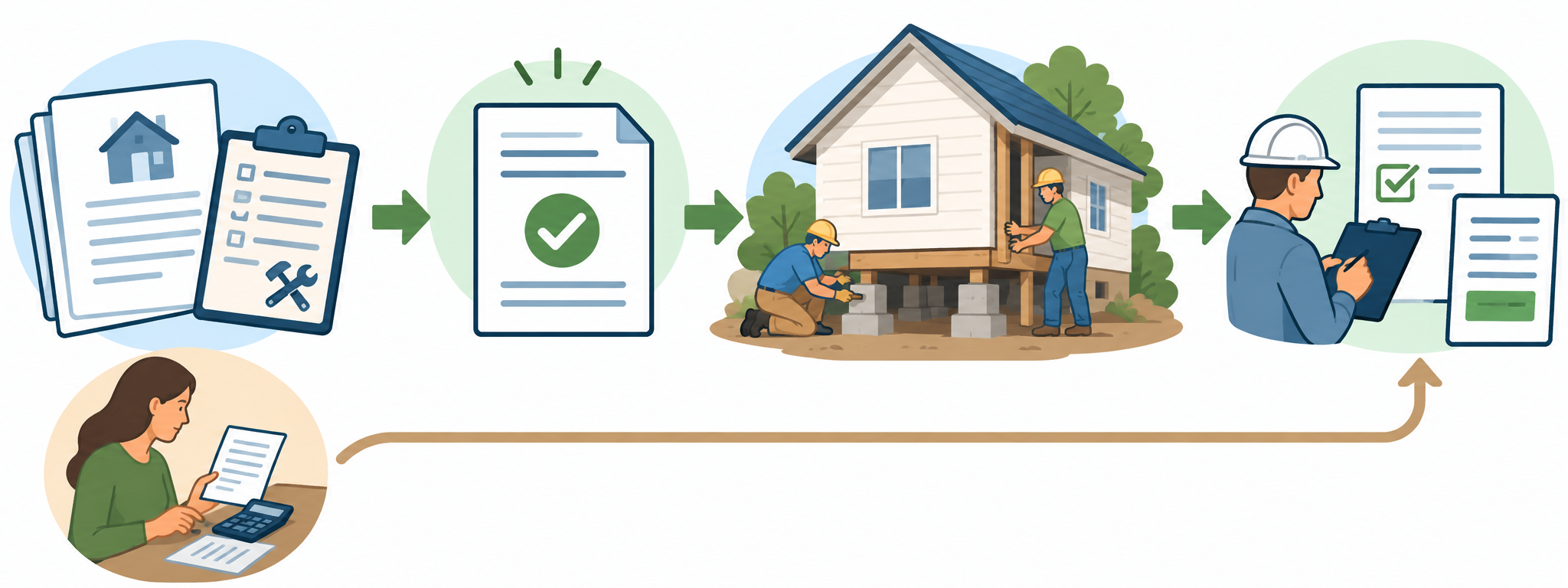
If the program’s written decision covers less work than the structural proposal, keep the difference visible and decide how it will be funded before authorizing the excluded work. A payment sequence can also matter when a project must be split into assessment, construction, and restoration contracts. Ask who may approve a scope change and whether an increase needs a new program decision. This is especially important when concealed conditions are not known until the site is opened.
Build the amount you can actually rely on
Keep a budget with four distinct lines:
- Gross project cost: all work the professional and contractor say is needed, including related work and exclusions.
- Potential assistance: the program’s published ceiling or estimated amount, marked unconfirmed.
- Confirmed assistance: written approval for this owner, property, scope, and amount, including repayment conditions.
- Owner cash and debt: costs outside the program, required contribution, deductible or other funding, loan payments, and expenses due before funds arrive.
Do not subtract a maximum from the contractor’s bid before an award. A program may pay only a selected line item, pay the administrator or contractor directly, reimburse after work, require an owner share first, or decline a scope that does not meet its rules. Any project cost outside the approved work remains in the owner’s budget.
Ask these questions before scheduling:
- Is the application window open, and are funds currently available in my area?
- Does the program accept this exact structural repair and the required related work?
- Who applies, who receives the funds, and who signs the construction agreement?
- Must written approval arrive before any deposit, permit, demolition, or construction?
- How much must I contribute, and when must it be paid?
- Is the award a grant, forgivable loan, repayable loan, match, or mortgage proceeds?
- What repayment, occupancy, lien, or completion conditions apply?
- If concealed conditions change the scope, who must approve the change before work continues?
Keep written answers with the assessment and proposal. If the response is uncertain, keep the program amount out of the committed budget. Do not postpone a needed safety assessment or protective action to wait for an award; ask the administrator how urgent work affects eligibility as soon as practical.
For a Montréal property considering RénoPlex, see the local foundation grant guide. For the closed former Québec program specific to pyrrhotite, see pyrrhotite assessment and replacement costs. The foundation repair cost guide helps define the gross project before an assistance screen.
Sources
- Single Family Housing Repair Loans & Grants, USDA Rural Development.
- Home Repair Program, Newfoundland and Labrador Housing Corporation.
- Homeowner repair program, Housing NB.
- Homeowner Rehab and Repair Programs, City of Raleigh; updated September 30, 2026.
- Creston Home Improvement Program, City of Creston.
- HomeStyle Renovation Mortgages, Fannie Mae.
- CMHC Improvement, Canada Mortgage and Housing Corporation.