
Repairing fiber cement can mean replacing a board, correcting a loose detail, restoring a finish, or opening the wall to investigate moisture. The material line is only one part of the cost.
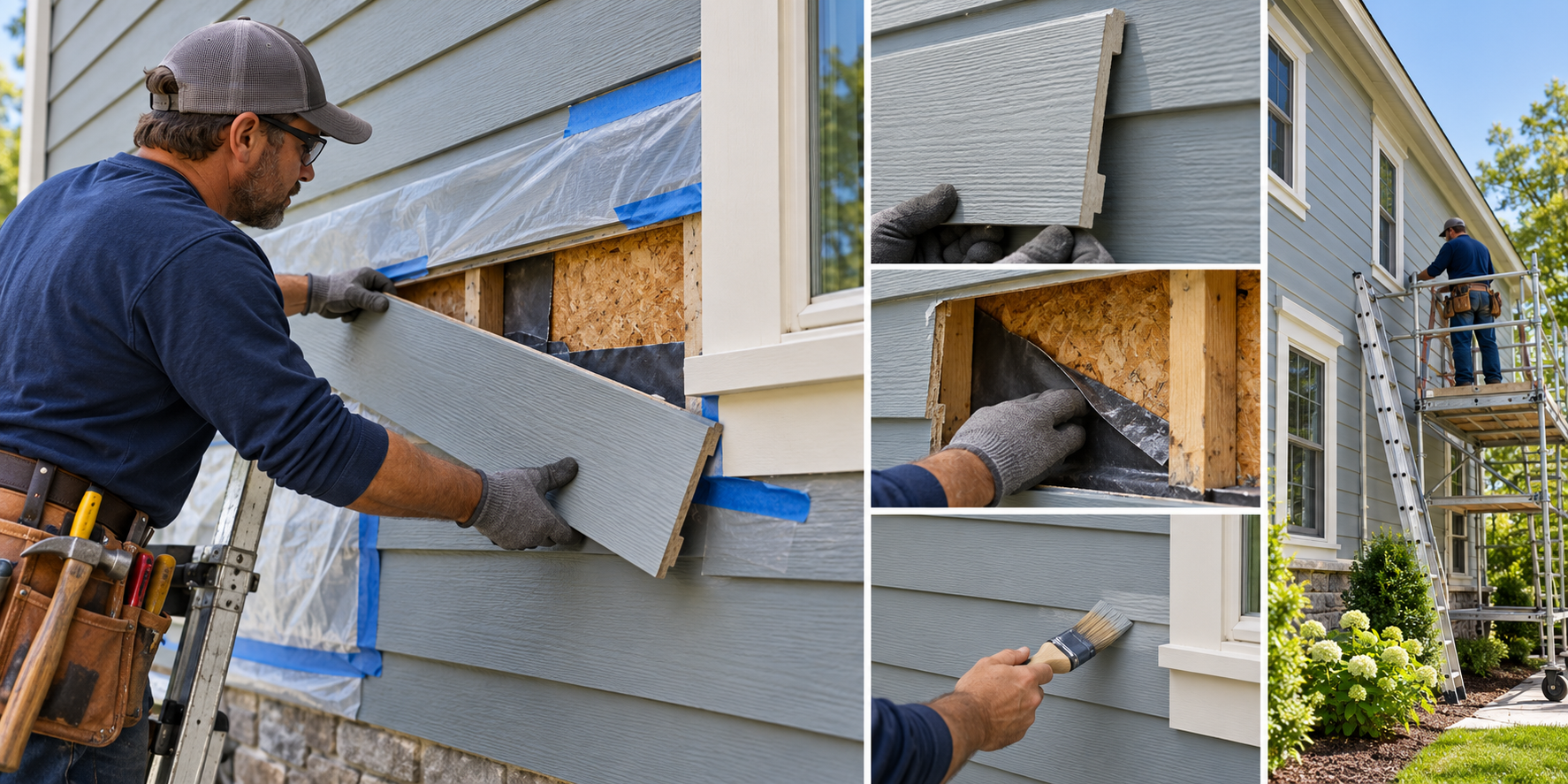
The contractor may need to identify the exact profile, remove adjacent pieces without damage, correct fasteners or flashing, replace the board, and match texture or paint. Height, brittle pieces, trim, openings, and staging add labor. A service minimum can make a small repair expensive per board.
Manufacturer documents govern the repair boundary. Product families differ in clearances, fasteners, joint details, and warranties. Do not assume a generic patch, fastener, or caulk method is suitable for every board.
Cracks, chips, soft areas, or staining can be surface symptoms of moisture or substrate problems. If the wall is opened, ask whether sheathing, framing, insulation, or water-resistive layers are included or excluded.
The evidence does not establish a universal repair price or Canadian benchmark. Use a local quote with minimum charge, access, material sourcing, finishing, disposal, and contingency. Repair suits localized damage on a sound elevation; widespread deterioration or repeated matching problems may support replacement.
Match the repair to the failure
A cracked board, failed joint, damaged corner, loose fastener, and finish defect are different repairs. Ask the contractor to identify which condition is present and whether the board can be removed without damaging adjacent courses. The estimate should state the number and location of boards, trim pieces, and joints, plus whether cutting, disposal, replacement material, fastening, sealing, and finish work are included. A patch that only covers the visible crack may not be suitable if the board is unsupported or water has reached the wall behind it.
Exact replacement can be difficult when a product line, texture, dimension, or coating is no longer available. Compare the smallest local repair with a larger section or elevation if the mismatch would be conspicuous. Ask for a sample or product identification before authorizing demolition. If the original cause was impact, wind, or an opening detail, consider whether the repair includes the attachment or flashing correction as well as the board.
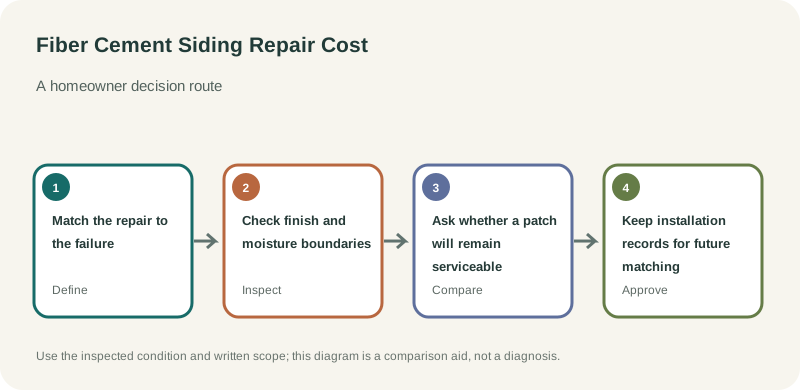
Check finish and moisture boundaries
Field cuts and replacement surfaces may need specific treatment under the product instructions. Clarify whether new pieces will be primed, sealed, or painted, and how the contractor will blend the finish with weathered material. A coating can improve appearance but will not repair a persistently wet wall or an incorrectly detailed joint. Staining, soft trim, or recurring damage around an opening warrants investigation of water entry before the new cladding is installed.
Ask what evidence would trigger a broader repair: damaged sheathing, failed flashing, repeated board movement, or widespread coating failure. Keep those possibilities priced separately so the initial quote remains understandable and a change order can be reviewed.
Ask whether a patch will remain serviceable
A repair should restore the board’s attachment and maintain required clearances, joints, and finish treatment. Ask the contractor to point out the damage boundary and describe how adjacent pieces are removed or released without cracking them. If the installation detail cannot be accessed locally, the repair may need a larger opening; the estimate should explain why. A surface filler or paint touch-up should not be presented as equivalent to replacing a cracked or detached board.
For a small patch, include a minimum labor charge, trip, product sourcing, and finish blending in the comparison. For broader damage, request a per-board rate and a fixed price for one complete elevation. Keep repair and repainting as separate options if the rest of the wall’s finish is sound. This shows whether the added finish work is aesthetic or required to restore the product’s protection.
Keep installation records for future matching
Record the manufacturer, profile, exposure, finish, and installation date. If the product line is discontinued, ask the supplier about compatible replacements before work starts. Store unused pieces under the conditions specified by the manufacturer. These details reduce the chance that a future repair requires a larger section only because no one knows which product is installed.
Compare the simplest and expanded repair
A direct board replacement on an accessible wall is the simplest case. Cost can rise if adjacent boards must be removed to reach the damaged piece, a discontinued profile needs sourcing, the wall backing is wet, or finish blending requires painting a larger area. Request a fixed price for the visible repair and a defined method for pricing those contingencies. Do not assume a panel-only quote includes the work needed to restore the wall behind it.