
Exterior trim includes corner boards, window and door trim, rake and edge boards, decorative details, and other weather-exposed pieces. Cost depends on profile, access, hidden extent, replacement material, finish, and the water source.
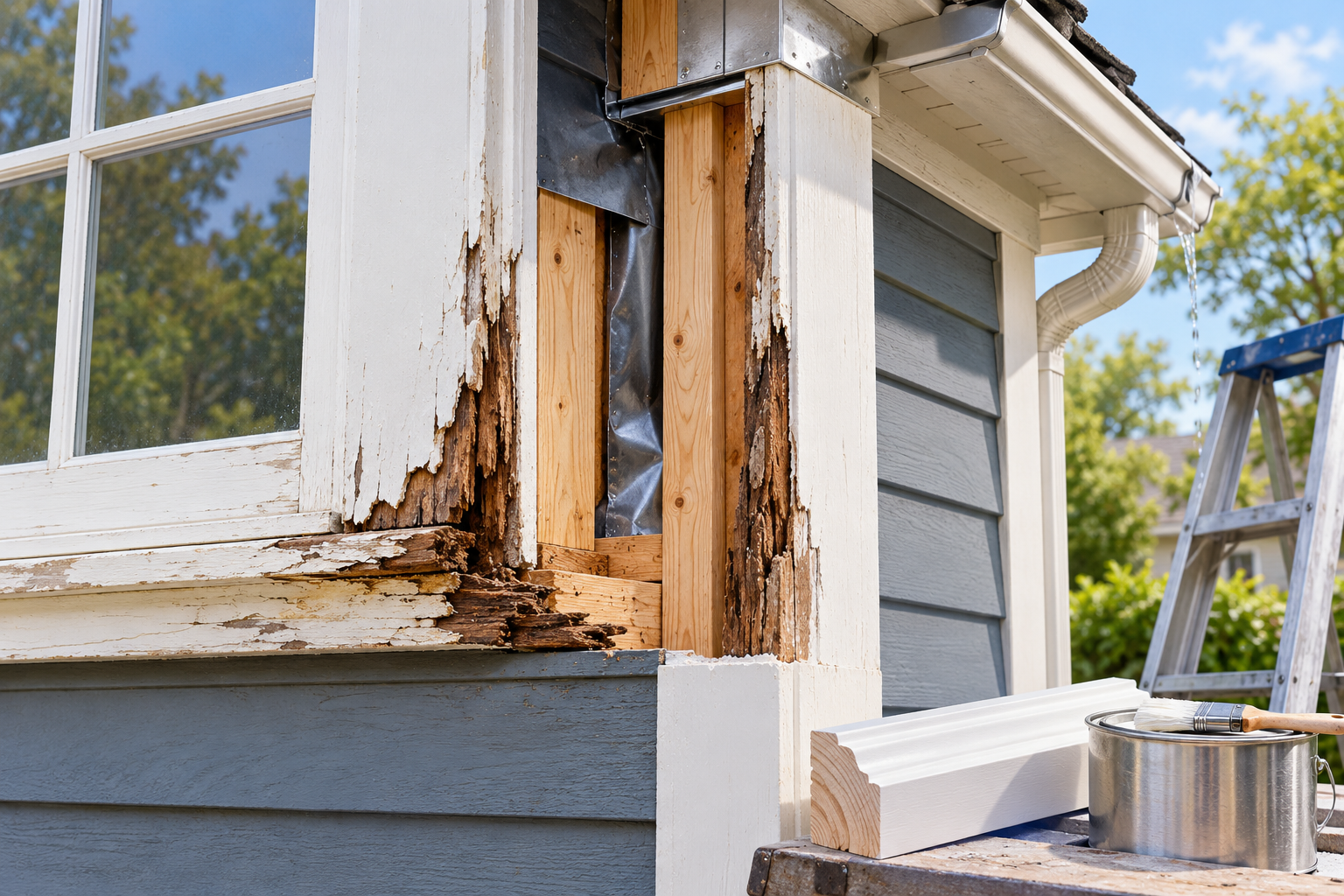
A contractor may patch a sound section, replace a board or profile, rebuild a corner, remove adjacent siding, repair flashing, prime and paint, or replace a longer run for consistent appearance. Custom profiles and older material can make matching expensive.
Ask whether the quote includes adjacent cladding, substrate and sheathing, flashing, sealant, paint, access, disposal, and cleanup. A soft trim board can conceal damage, but concealed rot is a project-specific contingency.
Trim sits at openings and transitions where water can enter. Sealant, flashing, roof edges, siding, and drainage behind cladding may all matter. Pest treatment belongs with the appropriate specialist.
Paid work disturbing paint in qualifying pre-1978 U.S. housing may fall under EPA’s RRP program, including some work where newer siding covers older lead-painted siding. This is not Canadian law. Confirm qualified testing and local requirements before disturbing suspect coatings; do not provide hazardous scraping instructions.
Homewyse’s May 2026 U.S.-oriented models give $6.29–$11.10 per linear foot for basic exterior-trim installation and $2.55–$5.21 per linear foot for trim painting. They describe separate installation and finish tasks, not removal of rotted material, concealed repairs, or a complete trim-repair quote. Use a mapped local estimate for the damaged profile and compare finish scope with exterior house painting cost.
Measure the repair to a sound boundary
Ask the contractor to probe or otherwise assess the affected trim and mark the proposed cut or replacement limits. A short patch can be appropriate when the surrounding board and backing are sound; a longer run may be more economical when decay is scattered or the profile is difficult to splice. Define whether the work includes adjacent siding removal, flashing, sheathing, backer, priming, finish coats, and repainting beyond the repaired board.
Matching cost depends on material and profile. Ask whether the replacement will be wood, a manufactured trim product, or another compatible material, and how its dimensions and appearance compare with the existing piece. A sample or profile sketch can prevent disagreement over custom milling or a visible mismatch. Clarify who restores paint or sealant disturbed during removal.
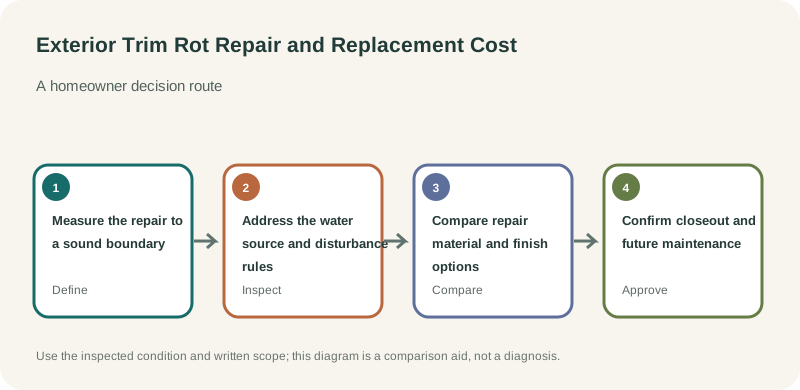
Address the water source and disturbance rules
Trim at windows, doors, corners, and roof edges is part of a water-shedding detail. Ask what allowed the wood to stay wet and whether the proposed scope corrects that condition. If the source is a roof or window flashing defect, price that repair explicitly rather than relying on new trim and caulk alone. A recurring symptom may justify a targeted envelope assessment.
When older paint may be disturbed, confirm the applicable testing, containment, and contractor requirements for the jurisdiction and building. The U.S. EPA RRP rule described in this article is not Canadian law. Include any required assessment or controls as a defined, separately priced scope before cutting or sanding suspect coatings.
Compare repair material and finish options
The replacement material can change initial price, appearance, and future maintenance. Ask whether the quote uses like-for-like wood, a cellular or composite trim product, or another system, and confirm that it is suitable for the exposure and adjacent cladding. Changes in thickness can alter window returns, drip edges, and siding termination. Require the installer to explain how the profile will remain compatible with surrounding details rather than assuming materials can be substituted without adjustment.
A factory-primed board, field-primed wood, and prefinished product carry different finish labor and repair requirements. Specify which faces and cut ends are treated, the paint or coating, and whether the final coat is included. If the affected trim is part of a larger paint project, coordinate the scope so separate mobilizations do not duplicate masking and access costs.
Confirm closeout and future maintenance
Ask the contractor to show the repaired detail after installation and retain photographs before paint or cladding conceals the transition. Keep the profile dimensions and product data. If the trim rotted near a gutter or roof edge, also retain the related drainage repair records. This helps a later contractor determine whether the source correction worked before replacing the same trim again.
Price access by trim location
A short board at a first-floor corner may be reached with ordinary ladder setup, while trim above a porch roof or at a high gable can require scaffold or lift access. Ask for each location to be measured separately and for access costs to be stated. If several repairs share the same setup, compare a combined visit with separate mobilizations. Do not infer that the lowest per-board price includes difficult roof-edge access.