
Envelope work and electrification interact because the building load affects comfort, equipment sizing, operating cost, and sometimes electrical capacity. That does not make “insulation first” a universal rule. The right sequence depends on the condition of the house, the urgency of replacement, the kind of enclosure work, climate, access, and whether the proposed equipment can be selected around a credible future load.
Why the order matters
Installing equipment before understanding the building can lead to a poor match: equipment may be larger than necessary, rooms may remain uncomfortable, or a later retrofit may require controls or distribution changes. Waiting too long can be equally costly when a furnace fails, a water heater leaks, or a contractor must work under emergency conditions.
Start with an assessment that distinguishes observed conditions from modeled assumptions. A report may identify air leakage, insulation gaps, windows, ventilation, and mechanical loads. It should explain which improvements affect sizing and which are mainly comfort, durability, or health decisions.
When envelope work has priority
Prioritize enclosure work first when it is accessible, materially changes the expected load, addresses serious comfort or moisture issues, or can be bundled with a remodel. This is particularly valuable when the existing heating system is sound and the household has time to plan. The benefit is not merely a smaller future system; it can be a more predictable one.
Do not assume every insulation proposal has the same economic effect. A targeted air-sealing project, attic insulation, window work, and a deep wall retrofit have different costs, disruption, and interactions with ventilation. Keep the enclosure scope and its expected result explicit.
When equipment comes first
Replace equipment first or in parallel when failure is imminent, comfort or safety is unacceptable, seasonal lead time is long, or waiting would require an emergency purchase. A well-designed heat pump can be selected with current and expected building conditions in mind. If future envelope work is likely, ask the designer to state the sizing assumption and how the system behaves if the work is delayed.
An urgent project may still include low-disruption enabling work: capacity review, duct or distribution corrections, equipment location, or a pathway for later improvements. The point is to avoid turning urgency into permanent lock-in.
The cost comparison
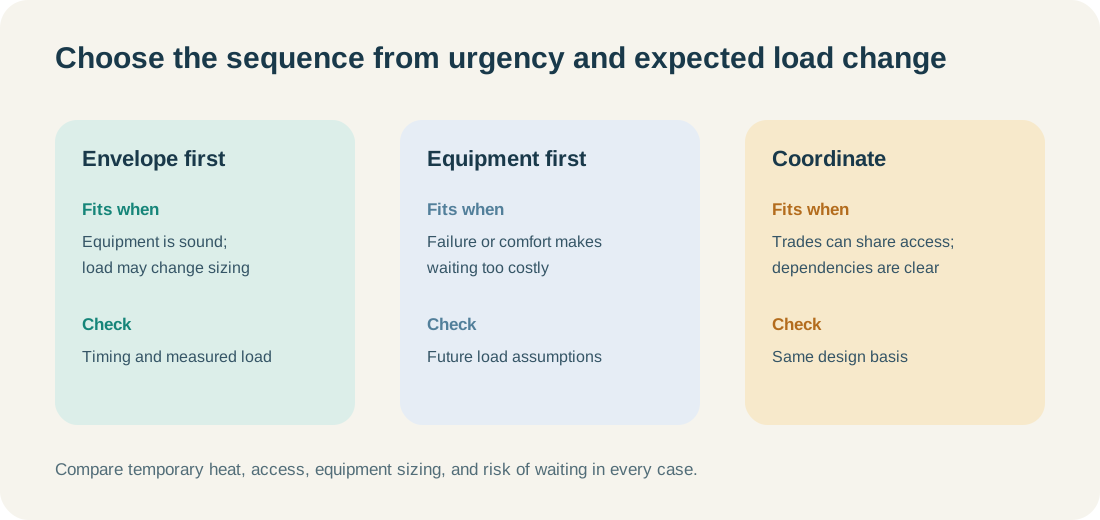
Compare at least three cases: envelope first then equipment; equipment first then envelope; and coordinated work. Include equipment cost, enclosure cost, access and restoration, temporary heat, utility bills during the delay, financing, emergency premiums, and the risk that later work changes the equipment design. Do not count modeled energy savings as guaranteed cash flow. Actual weather and household operation can differ from the model.
In a cold climate, include low-temperature performance, backup heat, winter demand, and lead time. NRCan warns that improper sizing or installation can undermine performance and that electrical upgrades or other renovations may take substantial time. That makes early planning valuable even when installation is phased.
Decision thresholds
Choose envelope-first when the work is urgent for the building, accessible now, and likely to change the equipment decision. Choose equipment-first when failure or safety controls the schedule and the equipment can be designed without pretending future work already exists. Choose coordinated work when several trades can share access and the dependencies are understood.
Ask the team to document the assumed post-retrofit load, the consequence of not completing the envelope work, and any equipment limitation. This turns a slogan into an economic decision.
Use a decision matrix
Give each option a row for immediate need, expected load, equipment scope, access, disruption, capital cost, operating effect, and future rework. A targeted attic or air-sealing job may be sensible before equipment; a major wall retrofit may not be sensible if the furnace has failed. Mark which assumptions are measured and which are modeled.
Ask what happens if the envelope project is delayed by one season. If the heat pump still meets the documented load and controls remain suitable, equipment-first may be reasonable. If the design only works after insulation, the quote should state that dependency and provide a temporary or alternate plan. Reducing load may avoid a service upgrade, but that outcome must be verified rather than assumed.
How to compare quotes
Ask each proposal to state the assumed building load, equipment size, enclosure scope, service capacity, and timing. One bid may price a heat pump for the existing load while another assumes insulation first. Normalize those assumptions before comparing totals. If an envelope measure is optional, keep it separate and show its effect rather than treating it as free prerequisite work.
Avoid false savings
Do not count a smaller future heat pump as an automatic return for an expensive enclosure project. Count comfort, durability, moisture correction, avoided energy use, equipment life, and access separately. Conversely, do not treat emergency equipment replacement as free because it happens first. The strongest sequence solves the urgent problem while preserving the value of later building work.
Calculate whether envelope work changes the equipment decision
The economic case for enclosure work is strongest when it changes a consequential choice: the capacity or type of heating equipment, required electrical backup, comfort in occupied rooms, or recurring energy use. Ask for the heating design assumptions before and after the proposed air-sealing or insulation work. If the change is large enough to move to a smaller equipment class or reduce backup operation, request that both equipment and electrical implications be priced. If equipment size remains the same, the enclosure work may still improve comfort or resilience, but those benefits should be stated separately from claimed equipment savings.
Do not use an audit’s modeled annual savings as a direct substitute for a heating-load calculation. Annual energy estimates and design-peak heat loss answer different questions. Air sealing may also require ventilation planning and attention to moisture or combustion safety; the apparent savings can be incomplete if the work changes airflow without assessing those conditions. The relevant specialist should state the boundary of their analysis.
Compare three packages with the same indoor comfort target: enclosure work first followed by newly sized equipment; equipment replacement now with a later enclosure project; and a coordinated design where work can be phased but equipment sizing accounts for the planned improvements. Include temporary heating, repeat mobilization, finish access, electrical enabling work, and the risk that future construction occurs after the equipment is installed.
A “wait for the envelope” strategy is less attractive when the heating system is failing, the enclosure project has no committed date, or the existing equipment can be replaced with a design that allows later refinement. An “equipment first” approach is less attractive when a near-term remodel or known insulation defect could materially change load and would otherwise lead to oversizing. The decision should identify which fact would reverse it: measured leakage, project timing, an equipment constraint, or a revised design load.
A qualified assessor and installer can coordinate these inputs, but the homeowner’s comparison should keep measured findings, modeled assumptions, and contractor allowances distinct.
Compare the cost of resizing with the cost of waiting
If enclosure improvements could reduce the required equipment size, ask both the envelope contractor and installer what changes in their scope after the work. A lower design load may affect equipment cost, distribution, backup, and electrical capacity, but the value depends on whether a smaller viable product or simpler service path is available. Do not assume a smaller heating load automatically reduces every line in the electrical quote.
If equipment must be installed before enclosure work, ask whether the design can account for a committed later improvement without exceeding manufacturer or professional requirements. The answer might be a staged control plan or later adjustment, but it must be supported by the installer and equipment. Do not choose a temporary undersized system based only on a hoped-for future renovation.
Add delay cost to the comparison: repair of the existing system, temporary heat, a second mobilization, or loss of a construction window. Then compare that with the cost of doing the enclosure work first. The better order is often apparent once the likely load change and the system’s failure risk are both documented.
Ask for a comparable design basis
Before accepting either sequence, request the load assumptions that each contractor used. One bid may assume today’s insulation and another may assume planned upgrades; their equipment sizes and prices then answer different questions. Ask the assessor and installer to agree on the before-work and after-work load basis, then show what is included in each quote.
If no credible post-upgrade load estimate exists, do not credit a specific equipment downsizing saving. Carry the enclosure project’s comfort and energy benefits separately and revisit equipment selection when measurements or design information are available. This avoids false precision while preserving the option to coordinate the work. If both projects proceed, coordinate the boundaries. The envelope contractor should know which equipment penetrations, outdoor-unit location, and ventilation provisions are planned. The mechanical installer should know which air-sealing or insulation work will be completed and when. The electrician should use the same equipment and backup assumptions in the capacity review.
This reduces the chance that one trade’s completed work must be reopened by another. Put dependencies in the schedule and change order process so a delayed enclosure project does not silently change equipment sizing.