
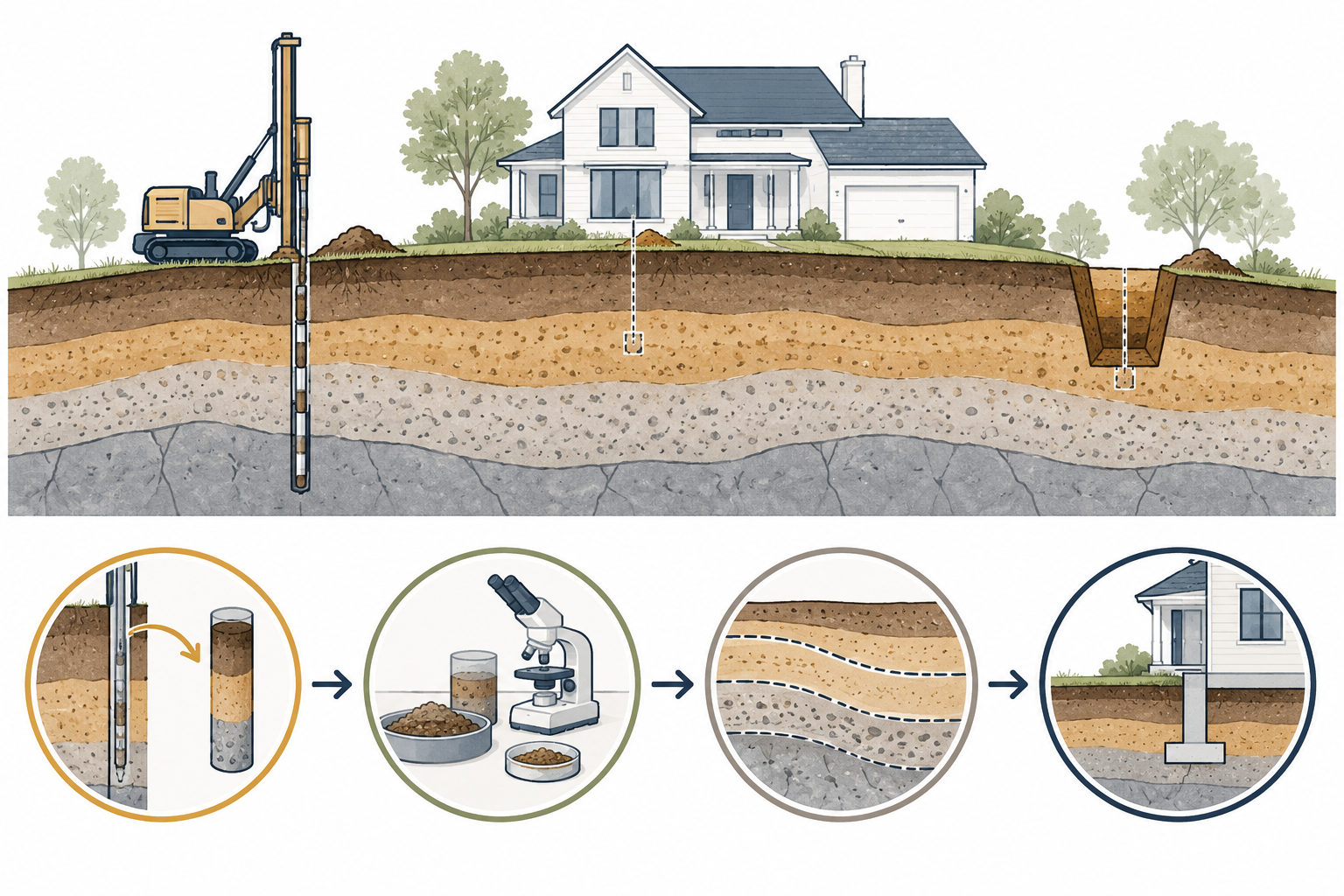
A geotechnical investigation evaluates subsurface conditions that affect a foundation, addition, retaining system, slope, drainage design, or other site decision. It may involve borings or test pits, samples, laboratory testing, engineering interpretation, and recommendations. A shallow soil test or a contractor’s observation is not automatically a geotechnical report.
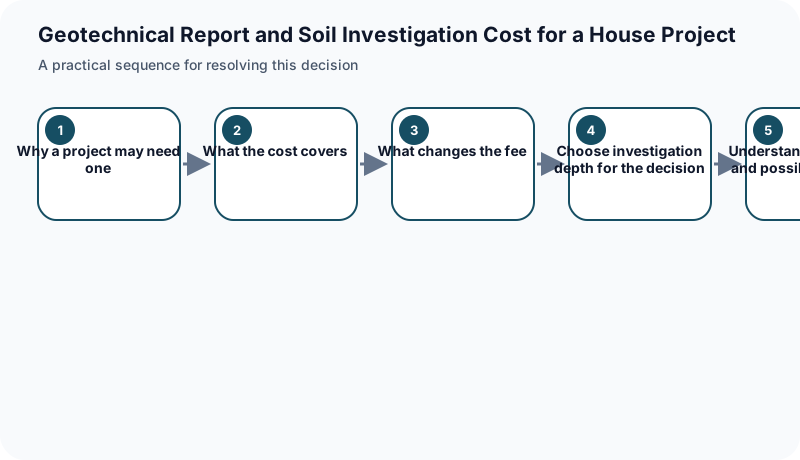
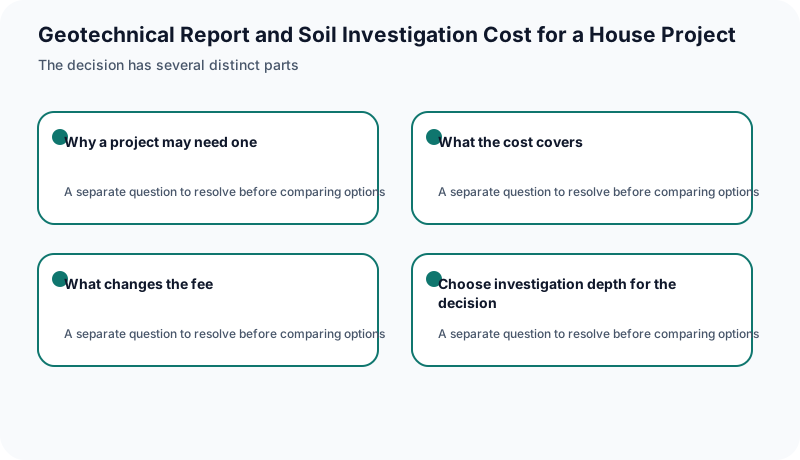
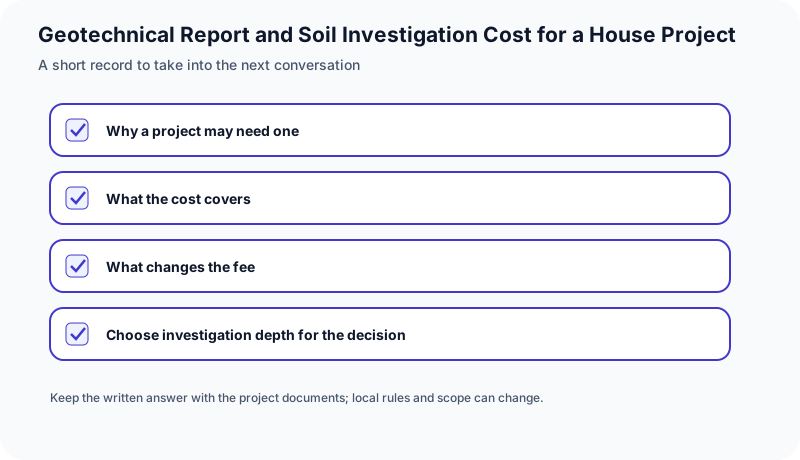
Why a project may need one
The service becomes more relevant when the site has fill, soft or expansive soil, settlement history, a steep slope, groundwater, a retaining wall, a large new foundation, unusual loading, or uncertainty that cannot be resolved from surface observations. An authority, structural engineer, civil engineer, insurer, or lender may also request it for a specific project.
The trigger is not universal. A new foundation on one lot may need a different investigation from a small interior remodel. Ask the person requesting the report what decision it must support and what minimum deliverable the authority or design professional will accept.
What the cost covers
Separate the scope into:
- Mobilization and access: Bringing equipment to the site and working around buildings, landscaping, utilities, and limited access.
- Field investigation: Borings, test pits, sampling, in-situ tests, groundwater observations, or other methods selected by the professional.
- Laboratory testing: Classification, strength, moisture, compaction, or other tests appropriate to the question.
- Engineering interpretation: Translating results into foundation, earthwork, drainage, slope, or construction recommendations.
- Reporting and follow-up: Written findings, meetings, design coordination, additional borings, or responses to review comments.
HomeGuide and similar specialist market sources can provide broad U.S. market context, but current prices vary sharply by site, equipment, depth, travel, testing, and report scope. Do not publish or accept a single “cost per boring” as the cost of an entire engineering investigation without confirming what is included. Canadian pricing should be quoted independently.
What changes the fee
Site access and mobilization often matter as much as the number of tests. A tight urban lot, remote property, steep slope, winter conditions, buried utilities, or a need to work around an occupied house can add time. The required depth, number of locations, laboratory program, groundwater question, structure, and level of design recommendation also change the scope.
An investigation can identify a need for more work. That is not necessarily a failed report; subsurface conditions may require additional testing before a responsible conclusion can be made.
Choose investigation depth for the decision
The test program should be tied to the building or site question. A proposed addition beside an existing foundation may need different information from a new home, slope assessment, or retaining system. The geotechnical professional should explain which locations and depths would be investigated, what laboratory work is proposed, and how the results will be used. A contractor may supply drilling or test-pit services, but the engineering interpretation and recommendations are distinct.
Ask whether the scope investigates only the planned building area or also a driveway, slope, retaining feature, infiltration area, or other site work. A report based on a few locations cannot establish that every part of the property has identical soil. The engineer should state the investigation limits and how they affect the recommendation.
Understand the stages and possible add-ons
The total assignment may include record review, site reconnaissance, utility coordination, field mobilization, drilling or excavation, sampling, laboratory testing, engineering analysis, report preparation, and follow-up with the design team. Some proposals list the field contractor as an allowance because the final scope can depend on access and underground conflicts. Confirm who schedules that work and who is responsible for site restoration.
The first report can lead to additional testing if it reveals conditions that were not anticipated. Ask what happens if a boring encounters refusal, groundwater, fill, or a material difference from nearby records. The professional should explain how an additional test would change the analysis and obtain approval before expanding the fee. The fact that a second phase is recommended does not mean the first phase was incomplete; it may reflect genuinely uncertain ground.
Coordinate the report with the design team
Give the geotechnical professional the current building footprint, approximate loads, foundation concept, proposed grading, drainage concept, and permit requirements. If those change materially, ask whether the report remains applicable. A foundation engineer needs the recommendations in a form that addresses the actual design and site; a report prepared for a different building area or load may need an update.
Ask when the report must be delivered. Ordering it after structural documents are nearly complete can cause redesign if the recommendations affect foundation type, excavation, retaining, or drainage. On the other hand, a premature report based on a speculative footprint may need to be repeated. Coordinate the investigation with the architect and structural or civil engineer before mobilizing.
Compare quotes with the same assumptions
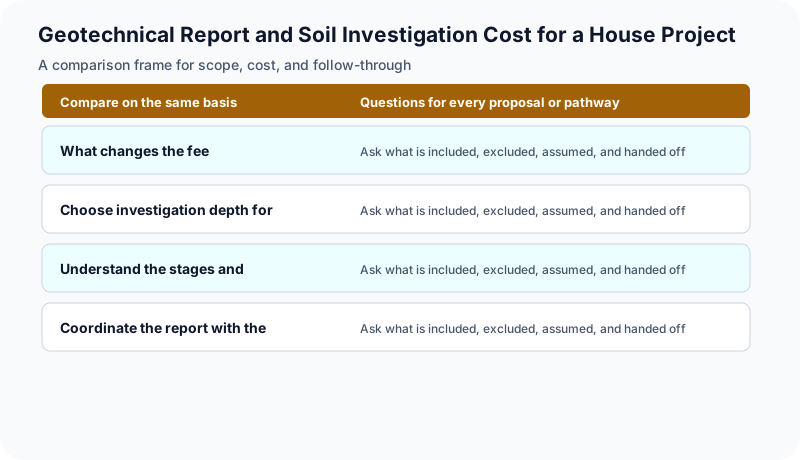
Give each firm the same site plan, access information, proposed construction, and geotechnical question. Ask them to state the number and location of investigations, laboratory tests, assumed depths, report content, and follow-up. Also ask what is excluded: utility locating, permits, traffic control, landscaping restoration, engineering for the building, construction observations, and additional testing.
If one quote is much lower, check whether it proposes fewer test locations, less interpretation, or no design recommendations. If one is much higher, ask which site risk or authority requirement justifies the extra work. The right scope is the one the responsible structural or civil designer can use, not necessarily the one with the most tests.
Use the result to inform a named design decision
The investigation should answer a defined question for a particular project. Ask the structural or civil designer what recommendation they need: bearing assumptions, excavation conditions, slope information, infiltration response, retaining recommendations, or another site-specific item. The geotechnical proposal should identify the intended user of the report and coordinate with that designer.
If the project footprint or loading is still changing, ask whether the investigation can be phased. An initial site assessment may identify the need for field testing, while a later design-specific review may be needed after the layout is established. Do not order a large test program simply because a project is described as an addition; ask what uncertainty the work resolves.
Plan access, locating, and restoration
Before mobilizing equipment, ask how access will be provided and what must be protected or moved. Confirm who arranges utility locating, traffic or access permissions, excavation permits if needed, landscaping restoration, and safe site control. Ask whether the provider expects an owner or contractor representative to be present.
The quote should state what happens if a planned location is inaccessible or conflicts with a buried feature. Ask whether an alternate test location is included or billed separately and who approves a change to the investigation plan. These logistical questions can affect cost and schedule as much as the laboratory testing.
Confirm that the design team can use the report
Before authorizing field work, send the proposed investigation scope to the structural or civil professional who will rely on it. Ask whether the location, depth, and report questions match the design decision. A report can accurately describe the tested locations yet be insufficient for a different building footprint or later retaining design.
Ask how recommendations are presented and whether the report includes construction observations or only pre-design guidance. If the contractor encounters materially different soil during excavation, ask who should be contacted and what additional review is required. Do not treat a general report as an inspection of every condition exposed during construction.
Keep field assumptions visible
Ask whether the quote includes pavement or landscaping restoration, disposal of drill cuttings, and protection of existing improvements. Confirm the owner has identified septic systems, irrigation, underground services, and access limits. If a location must move, ask whether the professional will approve the alternate position and how the fee changes.
After field work, compare the report’s location plan and recommendations with the current building design. If the footprint moves, send the revised plan to the geotechnical professional and ask whether the report remains suitable. Do not assume that a change elsewhere on the lot is immaterial.
Ask the report provider to tell the structural or civil designer how to interpret any recommendation that depends on site-specific assumptions. The owner should not convert a technical report into a foundation detail without the responsible designer’s review.
What to ask before ordering
- What project decision will the report support?
- Who specified the investigation, and will the structural or civil professional review it?
- What field methods, testing, and interpretation are included?
- Are utility locating, permits, traffic control, restoration, and travel separate?
- Does the report include design recommendations or only observed soil data?
- What conditions trigger additional work?
- Is the provider authorized to give the professional opinion required locally?
Do not substitute a geotechnical report for structural design, a land survey, or a drainage plan. The findings may inform those services, but each answers a different question. Do not use this article to make a site-specific foundation or slope decision; obtain advice from the qualified professional responsible for the project.