
Automation is a system, not a motor added to an otherwise complete fence. A complete quote may include the gate, posts and hinges, operator, power, controls, access devices, safety equipment, wiring, drainage, concrete, commissioning, and future maintenance.
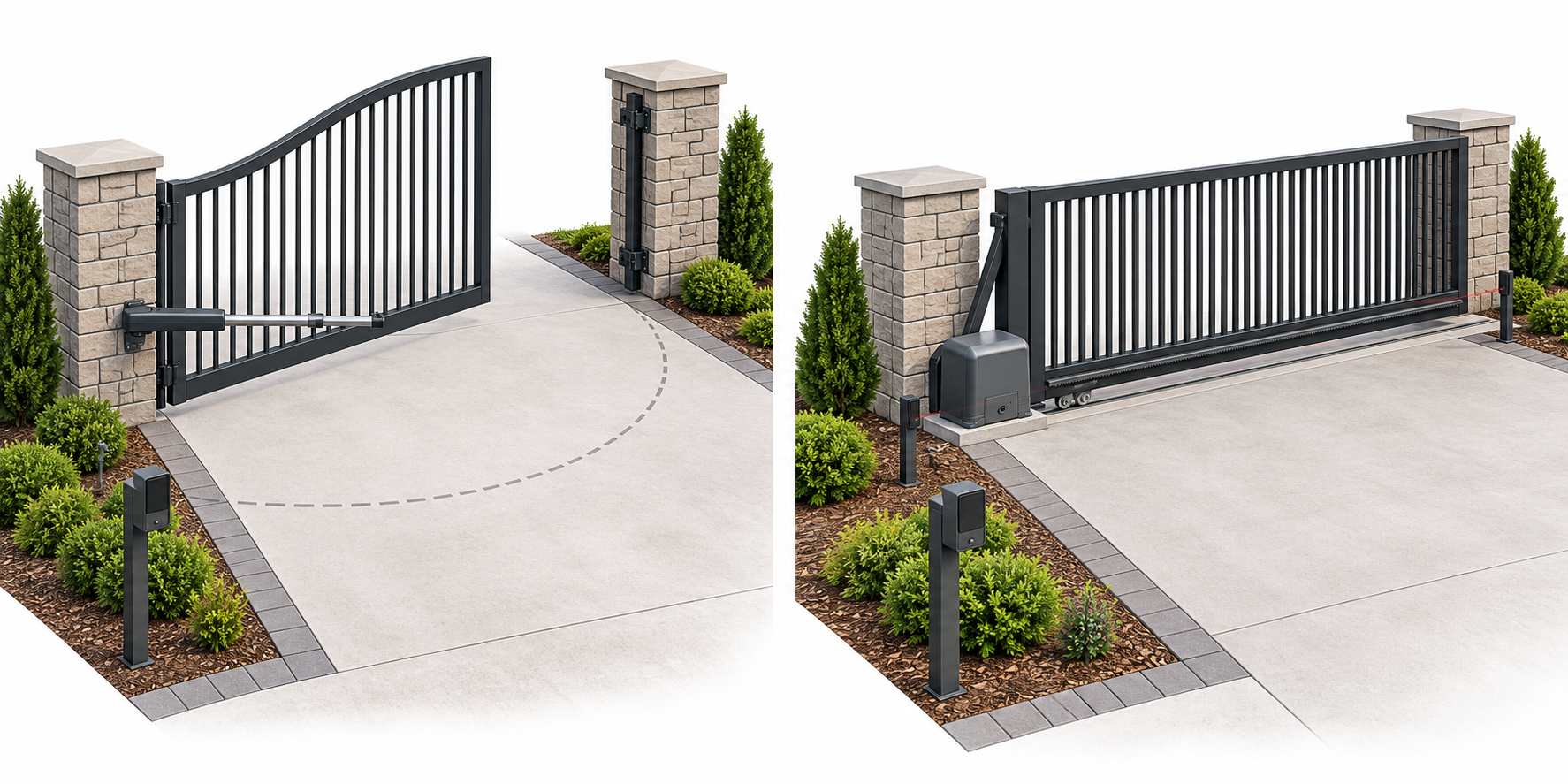
What changes the price
Swing and slide configurations have different site and clearance needs. Existing-gate retrofit depends on weight, condition, hinges, geometry, and whether the gate is suitable for the operator. Trenching, long power runs, solar or battery backup, intercoms, keypads, cameras, and difficult access are separate cost drivers.
Safety is part of the budget
UL Solutions explains that CAN/UL 325 addresses electric-shock, casualty, and entrapment hazards for opening systems and is used for product certification in the United States and Canada. Its overview emphasizes certified product selection, correct installation and maintenance, and safety devices such as photoelectric sensors or reversing-edge switches. The standard’s binational status does not make local code or authority requirements uniform. Ask the installer to identify the operator and protective devices, installation responsibility, required tests, maintenance instructions, and local approval assumptions. Do not disable, bypass, reposition, or omit a safety device to solve nuisance operation; have a qualified installer diagnose the cause and confirm applicable requirements.
New gate, retrofit, or operator replacement
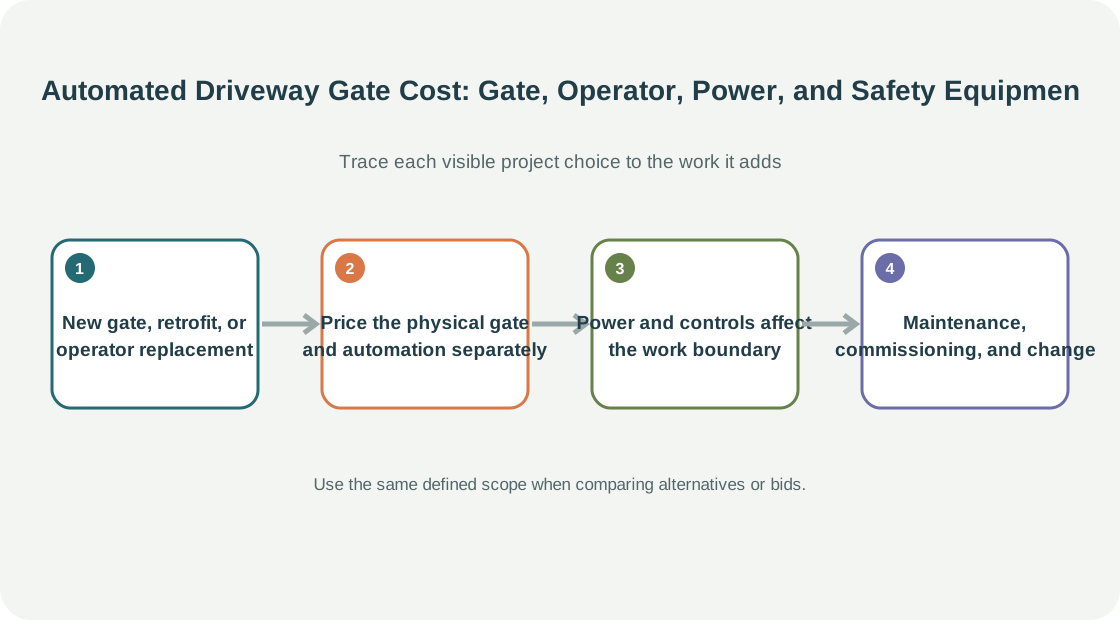
Start by deciding which parts of the system are being purchased. A new project may include the gate leaf, posts, hinges, foundation work, operator, controls, power route, safety devices, commissioning, and related fence changes. A retrofit may reuse the gate but should first verify its condition, weight, balance, movement, hinge or track condition, and attachment. Replacing an operator alone may not solve a gate that binds or a post that moves.
Swing and slide systems have different space and site needs. A swing gate requires its travel area to remain clear; a slide gate needs a suitable path and room to move alongside the opening. Slope, drainage, snow or debris, driveway width, and nearby walls or landscaping can affect which configuration is practical. Ask the installer to identify how the site and gate geometry were evaluated before the operator is selected.
| Purchase path | What may be reused | What must be confirmed before comparing price |
|---|---|---|
| New automated gate | Usually little of the opening system | Gate leaf, posts, hinges or track, foundation, operator, power, controls, safety devices, and commissioning are all in scope. |
| Operator added to an existing gate | The gate may remain if it is sound and compatible | Weight, balance, movement, hinges or track, attachment, geometry, and required safety equipment need a product-specific check. |
| Operator replacement | Gate and some site work may remain | Verify the existing gate and operator interface, controls, safety devices, power route, and any mechanical defect before assuming a simple swap. |
These paths answer different questions. Ask the installer to state which components are being retained and why, and to price any repair needed to make a retained gate operate correctly. A motor selected from an estimated weight alone does not confirm that the gate, posts, foundation, or opening are suitable.
Price the physical gate and automation separately
Request separate amounts for gate fabrication or purchase, posts and footings, operator, electrical supply and wiring, controls, protective devices, access features, installation, setup, and restoration. Identify whether trenching, conduit, a new circuit, backup power, removal of an old system, or concrete work is included. Product costs alone do not represent the installed project.
The U.S. fence market data in this category identify gates, material, length, site conditions, and removal as cost drivers, but do not establish an installed price for an automated system. Do not transfer a generic fence average to an operator project. Local estimates need the opening geometry, power route, controls, and safety equipment. Canadian prices should come from Canadian quotes rather than converted U.S. data.
Existing-gate compatibility requires more than matching a motor rating to a guessed gate weight. Ask how the exact operator is selected, which gate measurements and condition were considered, and whether the gate needs mechanical repair first. A product-specific claim or a seller’s general retrofit statement is not proof that the existing gate is suitable.
Power and controls affect the work boundary
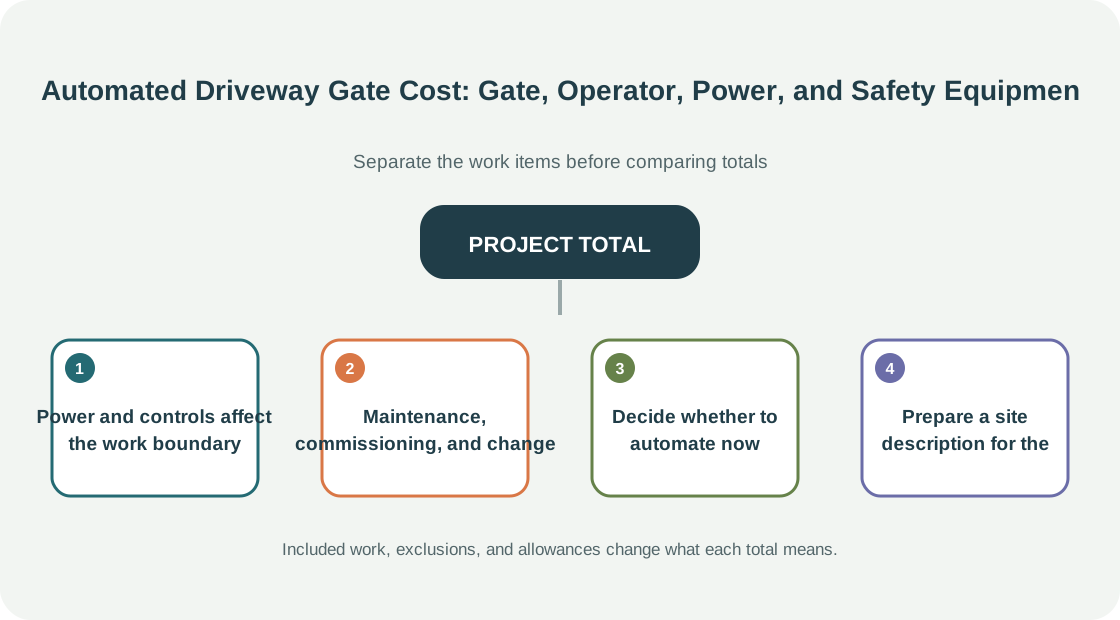
The power route may involve a long trench, surface conduit, a nearby circuit, or a separate electrical scope. Ask who evaluates the existing supply, performs electrical work, restores the route, and obtains any required approvals. Controls may range from a simple remote to a keypad, intercom, phone application, vehicle sensor, or property-wide access system. Identify which controls are included and whether recurring subscriptions, connectivity, or service plans apply.
For a useful comparison, have each proposal trace power from the source to the operator and list trenching or conduit, wire, connection, controls, testing, and surface restoration separately. Ask whether the installer expects existing power to be suitable or has included evaluation and any electrical work. If solar or battery operation is proposed, identify what the package includes, how the backup is maintained, and the operating instructions that apply; do not assume it provides the same capacity or behavior as another product. Record whether an intercom, keypad, camera, or phone control is essential to the project or an optional upgrade.
If communication or access management is the dominant project, some of that scope may belong with low-voltage or smart-home work. Keep those costs distinct from the mechanical gate and operator so the bid explains the physical opening system separately.
Maintenance, commissioning, and change orders
Ask what routine checks the manufacturer requires, where replacement parts are available, and who services the system locally. Weather, dirt, wear, power interruption, and vehicle impact can affect operation; automation does not eliminate maintenance or careful use. At handover, request product and operating information, control setup, documented safety-device checks, warranty contacts, and the maintenance schedule for the exact system. Confirm who performs any required local inspection. A working remote does not prove that safety equipment or installation is complete.
Ask how a power outage, damaged control, or obstruction should be handled under the manufacturer’s instructions. Do not rely on improvised release methods or disable protection. Before signing, identify the concealed conditions that could change price, such as an unsuitable existing gate, damaged posts, inadequate power, poor drainage, a blocked slide path, or additional safety work. Have the contractor record the trigger and obtain owner approval before extra work proceeds. Confirm local service and parts availability so the installed system can be maintained.
Decide whether to automate now
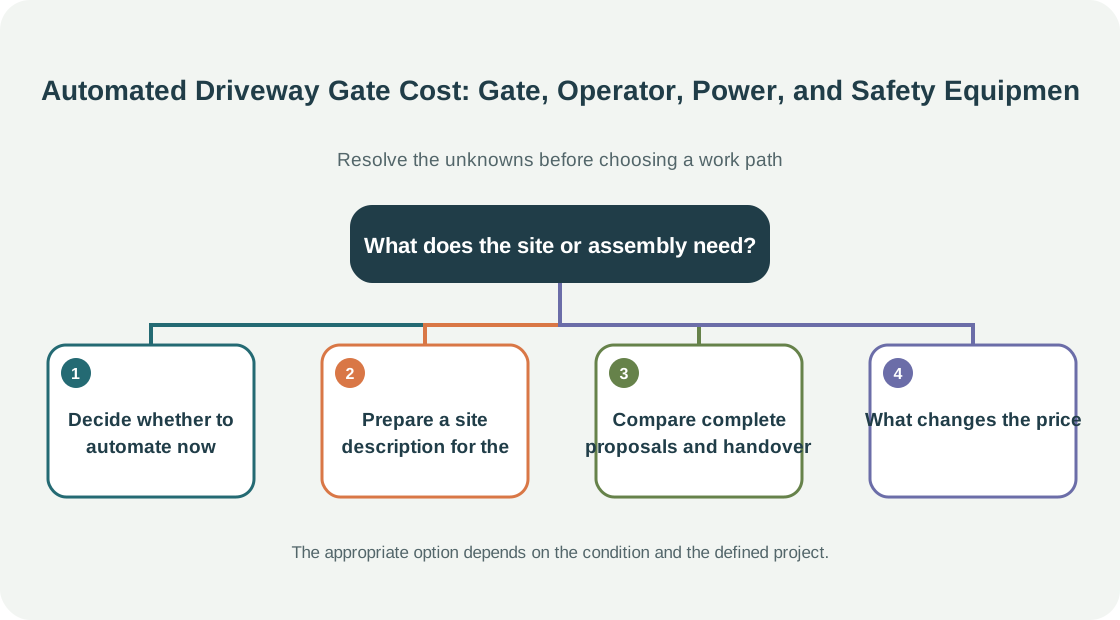
If the physical gate is already failing, compare repairing or replacing it before adding automation. An operator can add cost and complexity to a gate whose alignment or hinges need work. If the gate is sound and the site suits the system, automation may be a distinct convenience project. State whether access control, monitoring, or security integration is necessary or optional.
Consider the people and vehicles that use the opening, including a separate pedestrian route and how the gate behaves when it is not moving. A vehicle-access feature does not replace a suitable pedestrian entrance or resolve a property-security plan. Ask who will have credentials, whether networked features require a continuing service, and how a failed remote or power interruption affects normal access. These ownership choices can change controls and support costs even when the physical gate is unchanged.
Prepare a site description for the installer
Provide the opening width, gate type, approximate weight if known, condition of hinges or track, slope, clearance, nearby walls, power availability, control preferences, and how often the gate is used. Include the driveway approach and any pedestrian entrance. Photos can help explain the site but do not replace measurements or a professional assessment.
Ask the installer to identify which parts were measured, which are assumptions, and what site work remains open. If the gate is being retained, request an explicit compatibility finding for the selected operator. If the existing gate binds or moves, have that condition diagnosed before operator selection.
Compare complete proposals and handover
Ask each bidder to record the opening, gate dimensions and weight assumptions, swing or slide path, post and foundation condition, slope, clearance, power route, controls, and pedestrian access. The quote should identify the gate and operator models, hinges or track, concrete and removal, electrical boundary, safety devices, installation, testing, commissioning, required inspection, warranty, and service terms. Keep keypad, card, intercom, monitoring, and network integration costs visible as access-control work, including recurring charges where applicable.
Compare bids against the same geometry and operating duty. Confirm how power failure is handled, whether backup power or manual operation is included, and what exact product instructions govern it. Ask which qualified parties verify the installation and local requirements, and how the travel path and safety features will be checked at handover. Keep excluded civil or electrical work and uncertain existing conditions in separate lines. Current research supports driver-based budgeting, not one universal installed price; the operator alone is not the complete project.