
Wildfire mitigation for a condo, townhouse community, or apartment property is a managed-property project. A roof, exterior wall, deck, shared access route, landscape, and nearby buildings can be controlled by different people, but the assessment and work may need to fit together. The cost question is the budget for the defined property and its continuing upkeep, not a detached-house estimate multiplied by the number of units.
Program criteria and local grant examples do not create a reliable price per unit or national project range. A useful budget starts with a property boundary, a qualified assessment, and a written scope that separates professional services, physical work, access, coordination, documentation, and maintenance. Any household contribution is a later governance and funding decision; it cannot be inferred from the whole-property contract.
Define the property being priced
Start with a current site plan or a marked aerial view. Identify each building, attached structure, shared deck or stair, fence, landscape area, road, parking area, utility, and boundary that affects the work. Record which features the owner or managing entity controls, which belong to an individual unit, and which require a neighbor or public authority. A proposal for one building should not quietly include a second building or land outside the property.
The assessment should describe the site’s wildfire exposure and the building or property features that drive the proposed work. A complex property may need an exterior and grounds review, access planning, and coordination with a fire or building professional. The report should distinguish observed conditions from items that still need opening, measurement, or local verification. A checklist alone is not a construction scope.
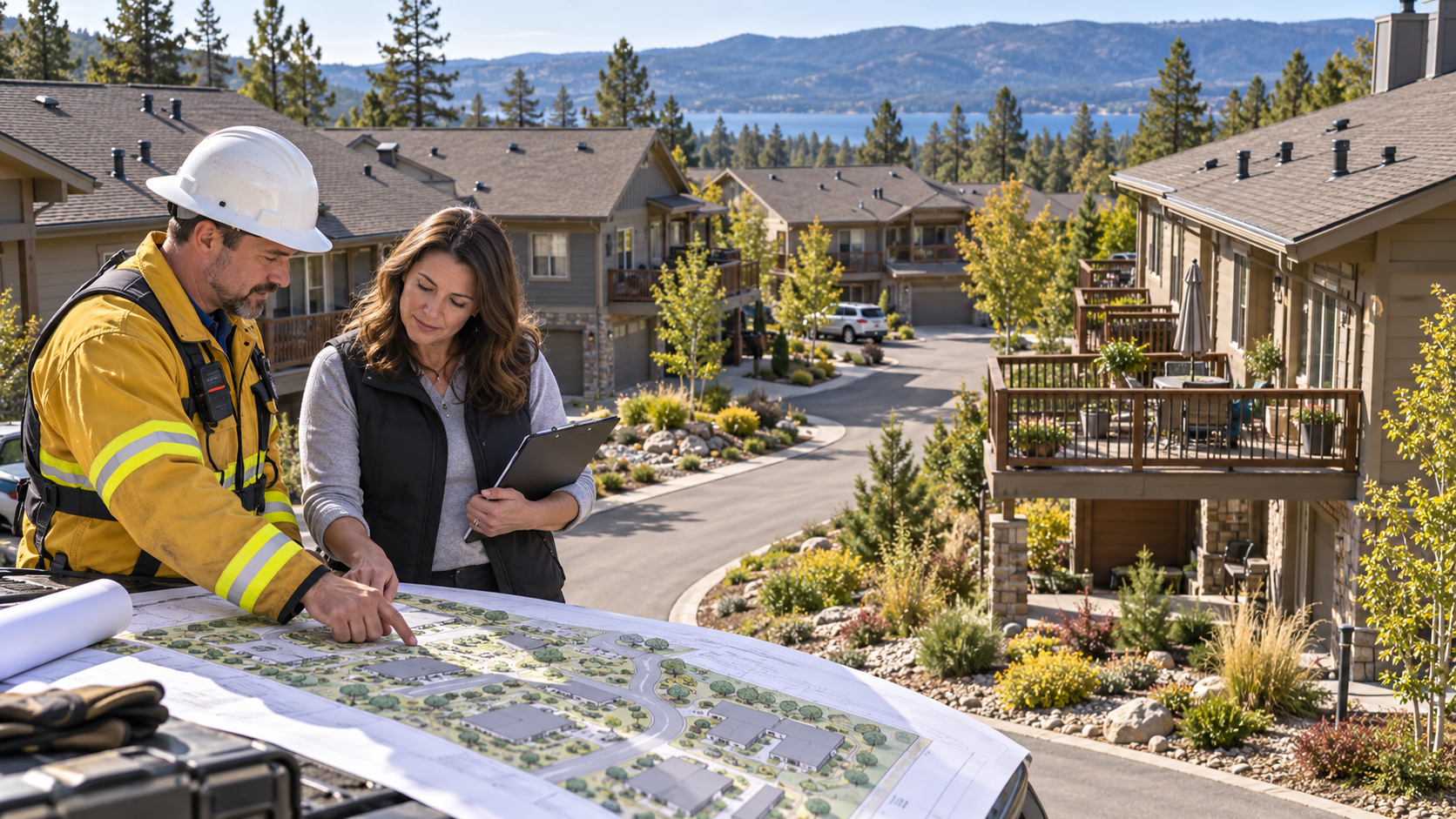
The commissioning unit matters. The IBHS Wildfire Prepared Multifamily program evaluates an eligible managed property and surrounding area; an individual condominium or townhouse unit does not qualify on its own. Its program requirements also depend on a managing entity with authority over the exterior features that must be addressed. This describes a voluntary U.S. program, not every jurisdiction’s law or a universal standard for shared buildings.
Build the whole-property budget
Ask for separate amounts and deliverables for each stage. This makes it possible to decide whether to proceed after assessment, combine work with a planned exterior project, or defer a package that lacks agreement or funding.
| Budget line | What the scope should identify |
|---|---|
| Assessment and records | Buildings and grounds visited, records reviewed, exposure assumptions, inaccessible areas, and the written findings or work schedule delivered. |
| Design and coordination | Drawings or specifications, professional disciplines, local review, contractor coordination, and decisions needed before work begins. |
| Building work | The roof, edges, vents, walls, openings, decks, stairs, attachments, or other assemblies actually included, by building and quantity. |
| Grounds and shared features | Vegetation, storage, fences, shared access, detached structures, and the property areas included or excluded. |
| Access and construction logistics | Scaffolds, lifts, staging, resident notices, temporary protection, work hours, disposal, and finish restoration. |
| Documentation and program services | Product records, photographs, application or evaluation fees, inspections, corrective work, and any follow-up review. Keep these distinct from installation. |
| Continuing upkeep | Seasonal debris removal, inspection, vegetation work, repairs, replacement, and responsibility for keeping the treatment in place. |
| Contingency and exclusions | Concealed damage, product substitutions, weather delay, quantity changes, and the work that the quote does not include. |
The budget should state whether it covers one building, several buildings, or the full managed site. It should also say whether a professional fee is fixed, hourly, or conditional on additional fieldwork. The source material for voluntary wildfire designations identifies application and evaluation steps but does not provide a typical assessment, installation, application, or renewal price. Ask the provider for current written fees rather than filling those lines with an allowance that looks like a published rate.
Understand why two shared properties price differently
Unit count is a poor shortcut for estimating a shared mitigation project. A property with many compact, accessible buildings may need less work than a smaller site with steep roof access, complex attachments, limited staging, or long exterior runs. The estimate can move with building type and height, roof geometry, opening count, material condition, number of structures, shared-property boundaries, slope, vegetation, and the distance between work areas.
Access can change labor and schedule. A contractor may need lifts or scaffolding, resident coordination, temporary protection, traffic control, or a way to keep entries usable during work. If multiple trades need the same access, ask whether sequencing saves a mobilization or creates extra setup and coordination. Do not assume that a project is cheaper per unit merely because the contractor is already on site.
Existing conditions also matter. The crew may find deteriorated materials, inaccessible cavities, unrecorded repairs, or a detail that cannot be changed without redesign. Ask which findings trigger a change order and who can approve it. The estimate should name the assumed product or assembly, area, quantity, and finish restoration instead of using a broad label such as “whole-property hardening.”
Compare maintenance, targeted work, and major renovation timing
Maintenance-led work can address recurring debris, vegetation, storage, and visible upkeep. Targeted retrofit work can address selected building or site features. A larger exterior renovation may create access for several measures at once, but coordinating them does not prove a particular saving. Request the ordinary renovation price and the incremental mitigation scope separately where that comparison is possible.
Phasing can spread spending, but each phase should state what remains exposed. A building package that addresses vents while leaving attached features, shared landscape, or another building outside the scope is not a complete site treatment. A phased plan should show which buildings and areas are covered, which are deferred, and what event or maintenance condition would change the next priority.
Recurring work belongs in the decision from the start. The board or manager should know who will inspect, clear, prune, replace, document, and pay for upkeep after installation. A one-time project price does not describe the cost of keeping a voluntary designation or property treatment current. Ask the professional to distinguish required maintenance from optional improvements and ordinary landscape or exterior-service work.
Treat a voluntary designation as a separate scope
IBHS’s Wildfire Prepared Multifamily program is voluntary and U.S.-specific; it is not a building code, local permit, insurer discount, or guarantee of a fire outcome. Its current technical standard describes building and surrounding-property measures, an application and third-party evaluation process, a time-limited designation, and continuing review and maintenance. The standard does not publish typical contractor costs or evaluation and renewal fees. Program criteria and availability can change, so obtain the current standard, any supplemental bulletin, state availability, and written fee schedule before including a designation in a project budget.
Ask the evaluator and contractors to separate the base mitigation scope from work needed only for a chosen designation. Include application, evaluation, verification, follow-up review, corrective work, and recurring upkeep as distinct lines. A designation may shape the work and documentation, but the building official and other authorities determine local code requirements. A program certificate does not establish that a project meets every applicable local rule.
Keep assistance and owner contributions separate
Local assistance may support shared-property work, but a program listing is not the property’s construction price or a promise of funding. For example, Boulder’s 2026 program page listed multi-unit wildfire projects such as common-area vegetation reduction and ember-screening work; it does not report those projects’ complete budgets or each household’s share. Treat that as a local example of funded scope, then check the current cycle, eligible property, approved work, award amount, payment sequence, and required application before relying on it.
The manager or board should keep the gross contract, any approved grant or rebate, reserves or borrowing, and any owner contribution as separate figures. A cap, award, or grant recipient list cannot be divided by unit count to calculate an assessment. Common-element authority, reserves, special assessments, and each owner’s legal responsibility depend on the property’s governing documents and applicable local rules. Obtain that advice through the responsible property and legal process rather than embedding an assumed allocation in the mitigation bid.
Compare proposals on one scope
Give each bidder the same site plan, building list, quantities, work windows, and requested documentation. Ask them to identify:
- Which buildings, exterior areas, attachments, and grounds are included.
- The condition or exposure each measure addresses and the residual risk left after the work.
- Assessment, design, installation, access, disposal, restoration, documentation, and contingency as separate items.
- Products or assemblies, substitutions, local approvals, inspection points, and who confirms compliance with the selected standard.
- Resident access and safety arrangements, schedule dependencies, weather assumptions, and decision deadlines.
- Maintenance tasks, frequency, responsible party, replacement assumptions, and any program review costs.
- Exclusions, unknown quantities, change-order rules, taxes, and funding assumptions.
Compare both the total property price and the physical scope. A lower number may omit buildings, documentation, access, grounds, restoration, or future upkeep. If bids use different quantities or designation levels, ask for a revised comparison before choosing one.
Decide what the next budget must buy
If the property has not been assessed, budget first for a clearly defined assessment and a deliverable that owners can use to authorize bids. If exterior replacement is already planned, ask whether a coordinated mitigation option can be priced without combining unlike work. If a voluntary designation is being considered, verify that the property and managing entity meet current program conditions before paying for evaluation. If the scope affects common elements, resolve decision authority and funding separately from the physical design.
For an individual existing house, see Wildfire Home Hardening Cost. The new-home construction guide addresses a separate single-family baseline. Those pages can clarify related work, but neither supplies a price per unit for a managed building.
The useful result is a whole-property scope with visible access, coordination, documentation, and upkeep costs. It can support an informed decision without pretending to know an unsupported per-door price or predicting that a particular package will prevent loss.