
Surface erosion is not the same as a potentially unstable slope. A small rill after rain may need drainage or vegetation work. Cracks, movement, leaning structures, blocked drainage, sudden water changes, or a slope threatening a home may require a geologist, geotechnical engineer, civil engineer, or structural professional. The first cost decision is assessment, not a generic retaining-wall quote.
What an assessment may include
A professional may review maps and records, inspect the property and neighboring slopes, trace concentrated stormwater from roofs and driveways, survey grades or movement, assess drainage and groundwater, review soil and geology, and recommend monitoring or conceptual mitigation. USGS warns that hazard maps may not show every area or runout path and recommends qualified evaluation for property-specific mitigation options.
The scope depends on the question. A drainage assessment, geotechnical investigation, coastal scour review, landslide evaluation, and structural foundation inspection are not the same service. Ask which discipline is included and what it can conclude.
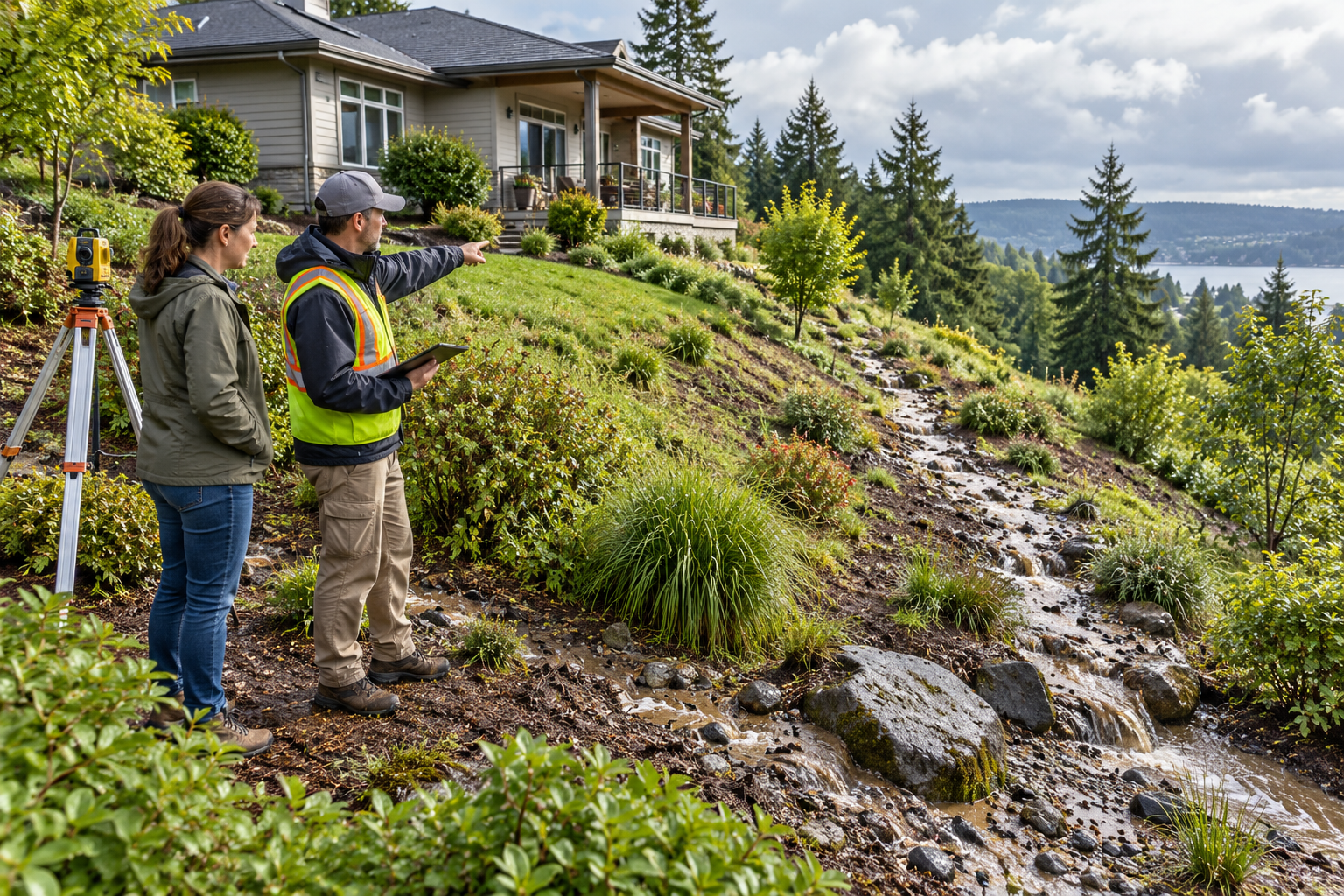
Cost tiers
- Initial inspection or consultation: useful for identifying whether visible erosion is maintenance, a drainage issue, or a reason for further study.
- Survey and technical assessment: adds measurements, records, soil or groundwater review, and a written risk or concept report.
- Design and mitigation planning: may include engineering, alternatives, permits, environmental review, easements, and construction documents.
- Construction: drainage, grading, erosion protection, retaining, stabilization, shoreline work, or foundation repair can cost far more than the initial assessment and require separate system-category or structural scopes.
Access, slope angle, vegetation, equipment, neighbor property, road or shoreline control, remote location, and urgency drive the price. Do not present a universal cost or a standard stabilization method.
Safety and responsibility boundaries
Do not provide a prescriptive slope-stabilization instruction from a general article. Concentrated runoff, excavation, retaining, vegetation removal, or adding fill can worsen movement or affect neighboring property. A shoreline or public drainage connection may require environmental, municipal, or conservation approval. Legal responsibility, easements, and shared drainage need local advice.
Seek prompt professional help for rapidly widening cracks, sudden settlement, tilted trees or poles, blocked or diverted drainage, new springs, retaining movement, or a structure moving toward a slope. If there is immediate danger, follow local emergency guidance and keep people away from the area.
Compare options economically
The final decision may be monitoring, drainage correction, grading, erosion protection, nature-based work, retaining or stabilization, foundation repair, relocation, or avoidance. Price each alternative with design, permits, access, construction, maintenance, and residual risk. A low-cost drainage change may be useful for surface erosion but inappropriate for a deep landslide. A large wall may not solve groundwater or subsurface movement.
FEMA coastal guidance adds soil, foundation, wave, and scour questions for coastal sites. U.S. and Canadian shoreline and slope rules differ, and a federal source does not establish a local permit or responsibility rule. Use local professional and authority review, price in the local market, and keep the assessment boundary clear before approving construction.
Questions to ask before paying for construction
Ask the consultant to define the hazard, the area evaluated, the data used, the limits of the maps, and the conditions that would require more investigation. Confirm whether the scope includes survey, soil or groundwater work, drainage tracing, monitoring, coastal or shoreline review, and structural evaluation. A visual walk-through may identify risk but may not support a construction design.
For each mitigation concept, request the expected mechanism, access, permits, easements, maintenance, and residual risk. Drainage work may reduce surface water but not deep movement. A retaining wall may require its own soil and foundation design. Vegetation may help erosion in one setting and conceal or worsen a problem in another. The assessment should explain these boundaries.
Budget for uncertainty and neighbors
Slope work can affect neighboring property, public rights-of-way, shorelines, shared drains, and environmental resources. Include survey, legal or easement review, authority coordination, traffic or access control, and monitoring where relevant. Keep a contingency for subsurface conditions and weather. A narrow construction allowance is not a substitute for understanding the ground.
If movement is active or threatens a structure, do not wait for a low-cost quote. Follow current local emergency and professional direction, and keep people away from dangerous areas.
Separate assessment from stabilization
An assessment may conclude that monitoring and drainage maintenance are appropriate, or it may lead to survey, geotechnical design, retaining, grading, erosion protection, foundation work, or relocation. Request separate prices for investigation, design, permits, and construction. This makes it possible to stop if the evidence changes without treating an early estimate as a construction commitment.
Ask how water, soil, groundwater, slope geometry, neighboring property, public infrastructure, and access affect each alternative. A retaining wall may need a foundation and drainage design; a channel may shift water toward another property; vegetation work may change erosion or conceal movement. These interactions belong in the professional scope.
After any work, budget for monitoring and maintenance. Storms, grading changes, shoreline movement, and new construction can alter the risk, so keep the records and know who will review a new sign of movement.