
Coastal resilience costs more to assess because several hazards can act at once. A home may face storm surge, waves and debris, wind-driven rain, erosion, scour around foundations, salt corrosion, and sometimes seismic or access constraints. A flood measure designed for a quiet inland water rise is not automatically adequate for waves or moving water.
The assessment comes first
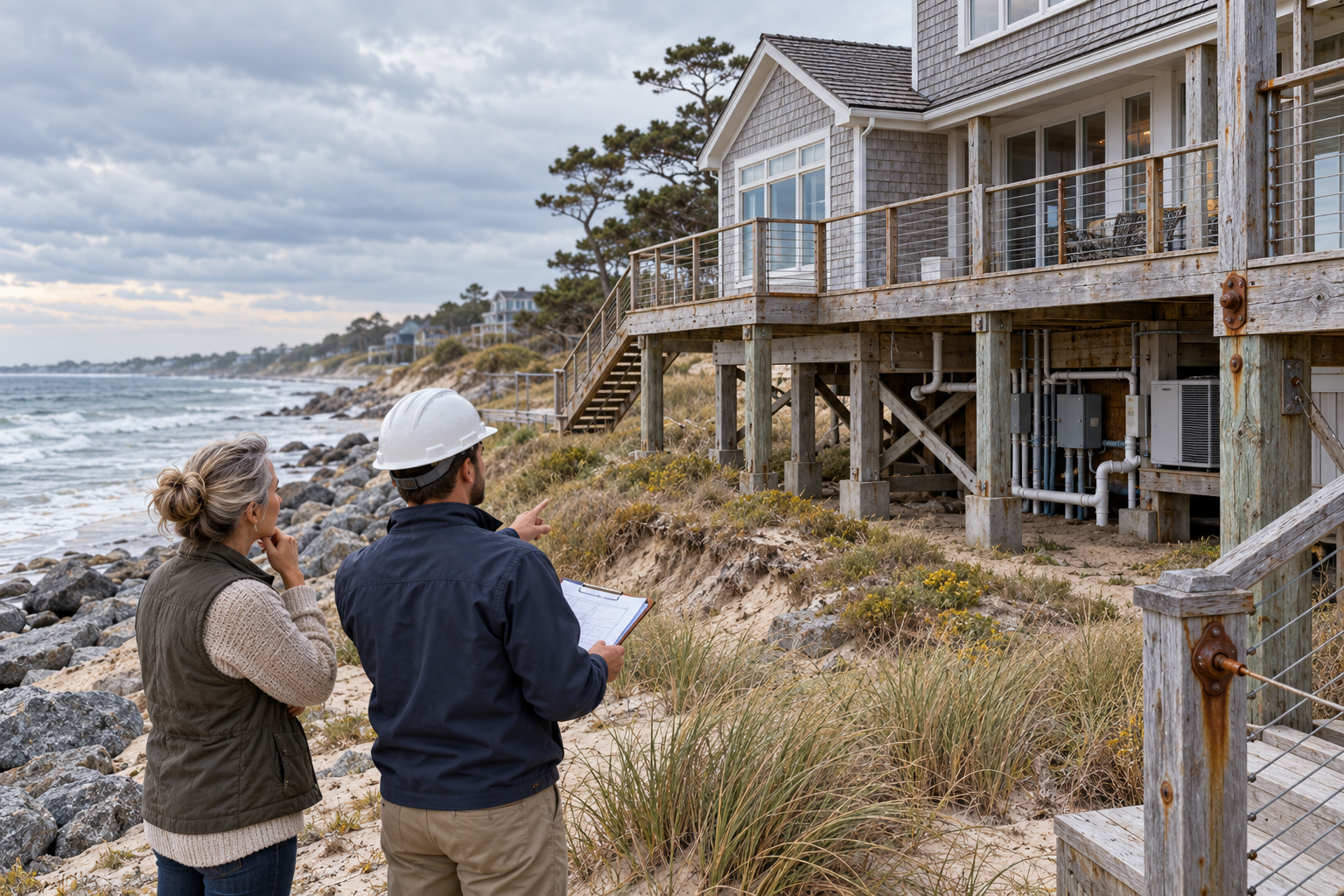
Before pricing a product, establish the site exposure, foundation type, elevation, expected flood characteristics, shoreline or slope condition, utilities, access, and the building’s structural path. Coastal guidance treats siting, surge, waves, wind, erosion, scour, soil, foundation, codes, and financial implications as connected questions. A geotechnical, coastal, structural, or civil professional may be required; a generic home inspection cannot answer every design issue.
The assessment may reveal that the priority is elevation, foundation work, utility relocation, opening protection, roof and connection upgrades, corrosion-resistant replacement, erosion monitoring, or a decision to retreat or relocate. It may also show that a proposed barrier or enclosure is unsuitable for the expected forces.
Budget by work package
Coastal retrofit budgets are usually easier to understand when separated into:
- site and hazard investigation;
- survey, engineering, design, and authority coordination;
- elevation, foundation, anchorage, or scour-related work;
- roof, opening, garage, and wind-driven-rain protection;
- utility elevation and service relocation;
- corrosion-resistant connectors, fasteners, equipment, and exterior materials;
- access, marine or remote logistics, temporary protection, and finish restoration;
- monitoring and recurring maintenance.
Even a modest visible upgrade can require expensive access or professional work. Salt exposure shortens the useful life of components and raises the importance of material compatibility and inspection. Repeated storm damage can justify a larger project, but there is no universal avoided-loss calculation or guaranteed insurance saving.
Bundled versus staged work
Bundling may reduce duplication when the roof is already being replaced, utilities are being relocated, or an addition exposes connections and foundations. Staging may be necessary when the property needs investigation before structural work, when funding is limited, or when a seasonal access window controls the schedule. The plan should state what hazard each phase addresses and what risk remains until the next phase.
Compare elevation or relocation when the home is repeatedly exposed to deep water, wave action, erosion, or foundation instability. Compare ordinary opening or roof upgrades when the primary risk is wind or debris. Avoid treating the coastal label as a reason to replace every component at once; spend on the failure pathway that the assessment supports.
U.S. and Canadian context
FEMA coastal publications are U.S. professional guidance. Canadian coastal properties may be governed by provincial, municipal, shoreline, conservation, environmental, building, or insurance requirements that need separate verification. Neither a U.S. flood-zone rule nor a historical grant should be presented as a Canadian requirement or current entitlement. Price projects in the local market; do not convert currencies mechanically.
The right coastal quote includes the hazard assumptions, design level, foundation and soil questions, corrosion environment, access plan, professional responsibility, permits, maintenance, and residual exposure. Without those items, a low bid may be pricing only a component while leaving the dominant coastal risk untouched.
Questions that reveal an incomplete scope
Ask whether the proposal is based on current flood and wind information, a site survey, the foundation type, soil and groundwater, expected waves or debris, erosion and scour, and the condition of connections. Ask how salt exposure changes fasteners, connectors, equipment, coatings, and inspection. Confirm whether shoreline, public drainage, easements, or neighboring property are involved.
Request separate amounts for assessment, engineering, permits, access, structural work, utility relocation, opening and roof work, corrosion-resistant materials, erosion or drainage work, finish restoration, and maintenance. If the contractor cannot define the design conditions, treat the price as an early budget only.
Include the property decision
For some sites, the economic comparison is not another component upgrade. It may include elevation, relocation, reconstruction, retreat, or accepting a known residual risk. That decision depends on ownership, shoreline rules, insurance, financing, future access, erosion, and household plans. A resilience article cannot determine the right property decision, but a good assessment can make the comparison visible.
If the privately controlled bank itself is eroding in sheltered water, the alternatives may include a living shoreline, a hybrid treatment, or a hardened bulkhead. Living Shoreline vs. Seawall Cost focuses on that shoreline-method and lifecycle comparison; it does not replace this page’s multi-hazard assessment of the house, foundation, and utilities.
Coastal work is often seasonal and access-dependent. Plan for weather delays, temporary protection, material lead times, and the possibility that opening the structure reveals corrosion or movement. The contingency should reflect those uncertainties rather than promise a narrow final price.
Coordinate a coastal maintenance plan
Salt, moisture, wind, and flooding can accelerate corrosion and damage. Ask who will inspect connectors, fasteners, anchors, roof edges, openings, equipment supports, drainage, and foundation exposure. Include cleaning, coating or replacement, access, and monitoring. A coastal material choice is valuable only when its installation and inspection assumptions are understood.
Track changes to the shoreline, grade, drainage, erosion, and neighboring property. A project that was appropriate at one exposure may need review after a storm, construction nearby, or a change in public shoreline management. Keep survey, engineering, permit, product, and maintenance records together.
Make the alternatives explicit
Ask for the cost and residual risk of staged component work, an engineered package, elevation, relocation, or no immediate capital work with monitoring. A homeowner can then see whether a lower-cost phase buys meaningful time or merely delays an unavoidable decision. The report should not promise that any one package defeats every coastal event.